When it comes to building warships, China is sailing far ahead of India

India has just one aircraft carrier against China's two; just 10 destroyers against China's 42 larger vessels; just 13 frigates against the PLA(N)'s 44; and barely 28 corvettes against China's 71

Rajnath Singh
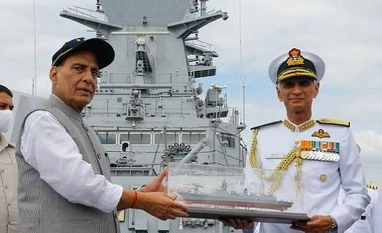
Defence minister Rajnath Singh (left) and Admiral Karambir Singh at the commissioning of INS Visakhapatnam.
Ajai Shukla New Delhi
4 min read Last Updated : Nov 25 2021 | 9:32 AM IST
On Thursday, the naval chief, Admiral Karambir Singh, will commission INS Vela, the fourth Scorpene-class conventional submarine built by Mazagon Dock Ltd, Mumbai (MDL) under Project 75I.

This comes just four days after Defence Minister Rajnath Singh commissioned INS Visakhapatnam, the first destroyer that MDL has completed under the so-called Project 15B.

In March, MDL had delivered INS Karanj – the third Scorpene submarine of its class. That took the number of indigenously-built capital warships commissioned this year to three – a figure not surpassed over the preceding decade.

Even so, navy admirals are bemused over the euphoria at this year’s warship-building numbers. They point to China’s People’s Liberation Army (Navy), or PLA(N), which routinely builds and commissions over a dozen warships each year, with the number rising to 23 warships last year and 17 this year.

That accounts for why India has just one aircraft carrier against China’s two; just 10 destroyers against China’s 42 larger vessels; just 13 frigates against the PLA(N)’s 44; and barely 28 corvettes against China’s 71.

Cruisers/destroyers

The PLA(N) has long regarded frigates as an instrument for exercising sovereignty over its claimed maritime area, given that these medium-sized vessels can flexibly combine multi-role capability with large numbers for persistence. 

Over the last decade, however, with the growing prospect of having to take on the US Navy’s sophisticated and heavily armed warships, the thrust of the PLA(N)’s warship building has switched from light frigates to heavy destroyers.


The PLA(N)’s destroyers are now switching from the 7500-tonne vessels of the Luyang, Luzhou, Luhai and Luhu class to the beefier 13,000-tonne, Type 055, Renhai-class destroyers, which are actually the size of cruisers. 

These massive warships are capable of not just handling a range of multi-dimensional threats from underwater, surface and air, but can also function as the flagships of naval task groups.

With the PLA(N) already fielding 42 destroyers, there is an expectation that ramped up production of Renhai-class destroyers is likely to increase these numbers further.


Frigates/corvettes

A large component of the PLA(N)’s rapid expansion since the turn of the century has come from building frigates and corvettes in large numbers. These smaller, more agile vessels were regarded as well suited for patrolling the waters of the South China Sea in larger numbers and backing up the Coast Guard in exercising Chinese maritime claims around the nine-dash line. 

Towards that end, the PLA(N) commissioned seven frigates in the 2015-2016 period and last year, it commissioned 18 corvettes. India, meanwhile, has commissioned just four frigates in the last decade.

Submarines

In conventional submarines, the PLA(N) fields 18 Yuan-class vessels, along with 13 Song-class boats. In addition to these, it deploys a dozen, Russian-origin, Kilo-class submarines, while 14 obsolescent, Ming-class submarines remain in reserve.

This conventional force is reinforced by the PLA(N)’s six nuclear-powered, attack SSNs (nuclear propelled, conventionally armed submarines) and 17 conventionally-powered attack submarines in reserve.

This comfortably outnumbers India’s conventional submarine force of 19 boats: which includes four German HDW submarines, nine Russian Kilo-class and four (eventually six) Scorpene boats.

Even after constructing another six boats with air-independent propulsion (AIP) that are in the acquisition pipeline under Project 75I, the Indian Navy will only have 25 conventional submarines.

In addition, the navy’s only nuclear-powered attack submarine, taken on a ten-year lease from Russia in 2012, was aimed at facilitating the building of an indigenous line of six SSNs.

These, it was planned, would carry out “sea denial”, to prevent Chinese warships from using the four straits between the South China Sea and the Indian Ocean. This project is making far slower progress than the PLA(N)’s Shang-class and Sui-class SSN projects.

In addition, the PLA(N)’s underwater nuclear deterrent is based on six obsolescent, 11,000-tonne, Jin-class SSBNs (nuclear propelled, nuclear armed submarines). These are likely to be replaced by the more modern Tang-class. The first of these was expected to be completed in 2021, but this has not yet happened.

India, meanwhile, has managed to complete just one SSBN, the INS Arihant. Delivery of the planned four SSBNs is far behind schedule.
 

One subscription. Two world-class reads.

Already subscribed? Log in

Subscribe to read the full story →
*Subscribe to Business Standard digital and get complimentary access to The New York Times

Smart Quarterly

₹900

3 Months

₹300/Month

SAVE 25%

Smart Essential

₹2,700

1 Year

₹225/Month

SAVE 46%
*Complimentary New York Times access for the 2nd year will be given after 12 months

Super Saver

₹3,900

2 Years

₹162/Month

Subscribe

Renews automatically, cancel anytime

Here’s what’s included in our digital subscription plans

Exclusive premium stories online

  • Over 30 premium stories daily, handpicked by our editors

Complimentary Access to The New York Times

  • News, Games, Cooking, Audio, Wirecutter & The Athletic

Business Standard Epaper

  • Digital replica of our daily newspaper — with options to read, save, and share

Curated Newsletters

  • Insights on markets, finance, politics, tech, and more delivered to your inbox

Market Analysis & Investment Insights

  • In-depth market analysis & insights with access to The Smart Investor

Archives

  • Repository of articles and publications dating back to 1997

Ad-free Reading

  • Uninterrupted reading experience with no advertisements

Seamless Access Across All Devices

  • Access Business Standard across devices — mobile, tablet, or PC, via web or app

Topics :Indian NavymilitaryChinaChinese navyNaval WarshipAircraft carrier

Next Story




