40% of rural youth can't tell time, 57% awful at basic math: ASER Survey

120 million youth are in 14-18 age group; survey covered more than 28,000 youngsters from 26 rural districts across 24 states
Education in India, education, school education, schools in rural India, rural India, rural youth, ATM, banks, ,internet banking,Arvind Subramanian
Sad state of youth in India
Abhishek Waghmare
Last Updated : Jan 17 2018 | 1:21 AM IST
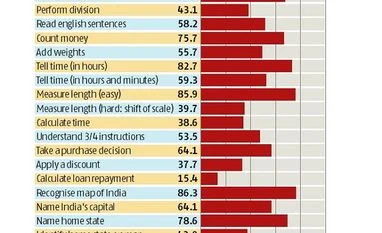
About 60 per cent of the rural youth have never used a computer or accessed internet; 57 per cent cannot solve a division problem; 40 per cent struggle to tell time in hours and minutes, while around 14 per cent of them cannot measure length using a reference scale properly, the 2017 annual status of education report (ASER) on assessment of youth in the age group 14 to 18 years, facilitated by Pratham education foundation has found.

In less simple tests of ability, only 54 per cent could understand three out of four instructions written on a food packet, and further down the complexity line, only 38 per cent could find a particular count after applying a discount, and only 15 per cent could calculate a loan repayment amount exercise.

However, there is a huge difference between youth who have completed more than eight years of education and those who haven’t, suggesting that the right to education (RTE) Act has made a difference. While 46 per cent of the former can perform arithmetic division, only 29 per cent of the latter can do the same. Similarly, while 63 per cent of the former can correctly read a small sentence, only 36 per cent of the latter can do it.

Close to 120 million youth are in the 14-18 age group today, according to the report. The pilot survey covered more than 28,000 youngsters from 26 rural districts across 24 states.

Sad state of youth in India
This is the 13th (thirteenth) year of ASER surveys that capture the ground realities of the state of education in the country through extensive surveys, but the first time an age group of 14-18, representing the upcoming youth, and not children, has been the focus.

Chief Economic Advisor Arvind Subramanian, and K P Krishnan, secretary at the ministry of skill development and entrepreneurship, discussed the report and other youth issues with Madhav Chavan, co-founder and president of Pratham moderating the discussion.

“The right to education (RTE) Act was enacted in 2009, and in 2017 i.e eight years later, we have a first-of-its-kind situation when all children in India have passed class VIII, and we thought it was imperative to take a note of their abilities and aspirations,” Rukmini Banerji, chief executive officer of Pratham said.

The number of children passing class VIII doubled from 11 million in 2004 to 22 million in 2014, writers of the report said citing data from district information system for education (DISE).

The report classified the parameters to be assessed under four broad heads — activity, ability, awareness and aspirations — representing, but not limited to, enrolment, arithmetic and reading ability, use of computers and ambition, respectively.

Though there are regional variations in the findings, national averages do point to lacunae in the state of aspirational young Indians. While 74 per cent of them have a bank account, about 51 per cent have used an account for deposit or withdrawal, and only 15 per cent have used an ATM, while less than 5 per cent have used internet banking.

Districts in central Indian states, which have low levels of literacy than their western and southern counterparts showed a lesser percentage of youth being able to count money or add weights. Most indicators for northeastern states fall behind these indicators that represent basic scholastic ability.

In the panel discussion, while K P Krishnan held that a rethink of the pedagogic nature of education is necessary, CEA Subramanian said that basic math and comprehension are “absolutely vital” for every child or youth.

Skill development secretary Krishnan admitted that the quality of employability in skilled personnel is not up to the mark yet, and pressed for the need for quality enforcement in school education, in order to improve employability in the long run.

One subscription. Two world-class reads.

Already subscribed? Log in

Subscribe to read the full story →
*Subscribe to Business Standard digital and get complimentary access to The New York Times

Smart Quarterly

₹900

3 Months

₹300/Month

SAVE 25%

Smart Essential

₹2,700

1 Year

₹225/Month

SAVE 46%
*Complimentary New York Times access for the 2nd year will be given after 12 months

Super Saver

₹3,900

2 Years

₹162/Month

Subscribe

Renews automatically, cancel anytime

Here’s what’s included in our digital subscription plans

Exclusive premium stories online

  • Over 30 premium stories daily, handpicked by our editors

Complimentary Access to The New York Times

  • News, Games, Cooking, Audio, Wirecutter & The Athletic

Business Standard Epaper

  • Digital replica of our daily newspaper — with options to read, save, and share

Curated Newsletters

  • Insights on markets, finance, politics, tech, and more delivered to your inbox

Market Analysis & Investment Insights

  • In-depth market analysis & insights with access to The Smart Investor

Archives

  • Repository of articles and publications dating back to 1997

Ad-free Reading

  • Uninterrupted reading experience with no advertisements

Seamless Access Across All Devices

  • Access Business Standard across devices — mobile, tablet, or PC, via web or app

Next Story


