EAC-PM takes on former CEA Arvind Subramanian's paper on India's GDP

In a research paper, Subramanian has said that India's real GDP growth was more likely to have been 3.5-5.5 per cent in 2011-2016
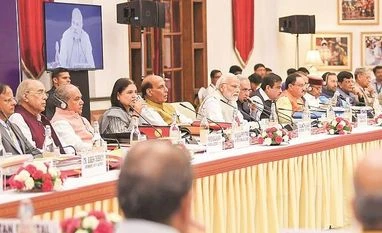
The EAC-PM said the base year of income calculations shifted to 2011-12 on the basis of recommendations of several committees with experts in national income accounting | File photo
Arup Roychoudhury New Delhi
3 min read Last Updated : Jun 12 2019 | 11:07 PM IST
A day after former chief economic advisor Arvind Subramanian said real gross domestic product (GDP) growth had averaged 4.5 per cent in 2011-2016 and not 6.9 per cent as estimated by the National Statistical Office (NSO), the Economic Advi­sory Council to the Prime Minister (EAC-PM) said it would examine Subram­anian’s paper and issue a point-by-point rebuttal.

“It is felt that any attempt to sensationalise what should be a proper academic debate is not desirable from the point of view of preserving the independence and quality of India’s statistical systems, all of which the former CEA is familiar with,” said a statement from the EAC-PM. 

“These are certainly issues that Dr Subramanian must certainly have raised while he was working as CEA, though by his own admission, he has taken time to understand India’s growth numbers and is still unsure,” it said.

In a research paper that analyses data on 17 different economic indicators in the non-financial sector, Subramanian has said that India’s real GDP growth “was more likely to have been 3.5-5.5 per cent” in the 2011-2016 period. He said that the new GDP series overestimated real GDP growth by 2.5 percentage points.

This has reignited the debate on the accuracy of GDP numbers.

Subramanian analysed out­put volume-based data, such as the index of industrial production, exports and im­ports, footfall of tourists, auto sales, airline passenger traffic, and electricity and petroleum consumption am­ong others, to make his claim. He concluded his paper by saying, “the entire methodology and implementation for GDP estimation must be revisited by an independent task force”.

The EAC-PM, however, said that the base year of income calculations shifted to 2011-12 on the basis of recommendations of several committees with experts in national income accounting. “Therefore, it is wrong to suggest that the views of experts have not been taken into account while changing the base year,” it said.

“Dr Subramanian has used cross-country regressions to estimate what GDP should be. This is the most unusual exercise, as is the suggestion that any country’s GDP that is off the regression line must be questioned. The proxy indicators that he used can also be questioned. Nor does this exercise allow for GDP increases on the basis of productivity gains,” the statement said.

On Tuesday, the Ministry of Statistics and Programme Implementation also released a statement rebutting Subramanian’s paper. It said the estimation adheres to global norms and is an output of a complex exercise. 

“It is important to note that a comparison of the old and new series is not amenable to simplistic macro-econometric modelling,” it said.

One subscription. Two world-class reads.

Already subscribed? Log in

Subscribe to read the full story →
*Subscribe to Business Standard digital and get complimentary access to The New York Times

Smart Quarterly

₹900

3 Months

₹300/Month

SAVE 25%

Smart Essential

₹2,700

1 Year

₹225/Month

SAVE 46%
*Complimentary New York Times access for the 2nd year will be given after 12 months

Super Saver

₹3,900

2 Years

₹162/Month

Subscribe

Renews automatically, cancel anytime

Here’s what’s included in our digital subscription plans

Exclusive premium stories online

  • Over 30 premium stories daily, handpicked by our editors

Complimentary Access to The New York Times

  • News, Games, Cooking, Audio, Wirecutter & The Athletic

Business Standard Epaper

  • Digital replica of our daily newspaper — with options to read, save, and share

Curated Newsletters

  • Insights on markets, finance, politics, tech, and more delivered to your inbox

Market Analysis & Investment Insights

  • In-depth market analysis & insights with access to The Smart Investor

Archives

  • Repository of articles and publications dating back to 1997

Ad-free Reading

  • Uninterrupted reading experience with no advertisements

Seamless Access Across All Devices

  • Access Business Standard across devices — mobile, tablet, or PC, via web or app

Next Story


