Exemption list to be pruned for GST
Excise relief for around 200 items may go, zero rate being debated
Dilasha Seth New Delhi Tea, coffee, biscuits and some medicines, currently exempted from excise duty, may come under the proposed goods and services tax (GST) as the finance ministry and empowered committee of state finance ministers draw up a common list of exempted items.
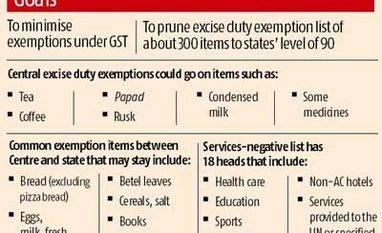
The Centre's excise duty exemption list of around 300 items will be reduced to the states' value-added tax (VAT) list of close to 90.
"We are finalising the exemption list. Excise exemptions will be pruned to around 90 items," said a government official. "The idea is to keep exemptions to a minimum."
States exempt unprocessed goods and those consumed by the poor like fruit, vegetables, salt, grain and coarse fabric. The Centre provides excise exemption to processed food and pharmaceuticals and a concessional rate to fruit-based items. Common items between Centre and states include bread, eggs, milk, vegetables, cereals, books and salt, which will continue to be exempted.
Items of importance in certain states could also be exempted. "Coconut oil in Kerala and sattu in Bihar are of local importance and state-level exemption could be provided," the official said.
The negative list of services, exempted from the levy, will be reduced to include only essential services like health and education. "We will have a very small number of essential services out of the GST net," the official added. The negative list of services has 18 heads, which include health care, education, goods transport agency and non-air conditioned restaurants, among others.
Chief Economic Advisor Arvind Subramanian, in his recommendation on a revenue-neutral rate for the GST, has argued eliminating the exemptions on health and education will make tax policy more consistent with social objectives. He has also recommended bringing electricity and petroleum within the scope of the GST.
"The government has been pruning the excise exemption list for quite some time. From 542 items in 2011, it has come down 300 items," said Rajeev Dimri, leader of indirect tax at BMR & Associates LLP.
"It will be difficult to have local items in certain states on the exemption list. The technology system has been designed in a way that there cannot be different lists for different states," pointed out Satya Poddar, senior tax advisor, EY.
"Some flexibility is sought to be introduced for goods of local importance, like in West Bengal," said Saloni Roy, senior director of Deloitte in India. "There are concerns over how area-based exemptions will be treated in a GST environment," Roy added.
The government is also yet to decide on a zero rate. "We are yet to take a view on whether there needs to be a zero rate," the official said. Poddar of EY argued the zero rate would continue to be limited to exports if it was part of the GST.

 "Exemption list to be pruned for GST")


 Connect with us on WhatsApp