
Govt's attempt to privatise Air India was ill-timed: Suresh Prabhu
Stating that there are 'legacy' issues around the carrier which government is trying to resolve, he said Air India is burdened with debt, which is clearly unsustainable
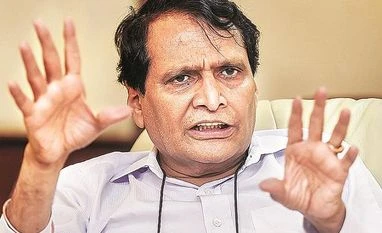 "Govt's attempt to privatise Air India was ill-timed: Suresh Prabhu")
Explore Business Standard
Stating that there are 'legacy' issues around the carrier which government is trying to resolve, he said Air India is burdened with debt, which is clearly unsustainable
Admitting that the attempt to privatise the loss-making Air India was ill-timed, aviation minister Suresh Prabhu on Friday said the airline cannot make profit unless the issues around its high financial cost are dealt with.
Notably, the government failed to get a suitor for the flag carrier early this year after working on the plan for nearly a year.
"Basically the timing (of Air India privatisation) was wrong. That is the time when the global airline industry was also not doing well," Prabhu said at an award function organized by news portal Moneycontrol here late this evening.
He also said the airline cannot make profit unless "we deal with this financial cost problem."
The minister, however, said for the first time government "sincerely and genuinely" tried to offer Air India ownership to private players.
"First time we made serious efforts to sell it in a transparent manner. There was a lot of discussion with a lot of stakeholders but the stake sale did not go through. We can sell only if we have a buyer," he said.
Stating that there are 'legacy' issues around the carrier which government is trying to resolve, he said Air India is burdened with debt, which is clearly unsustainable.
Air India has been making losses since its merger with Indian Airlines in 2007. According to its audited accounts, its accumulative losses stood at Rs 471.45 billion as of fiscal 2017, owing to high interest burden, and increasing competition among others.
Besides, it has Rs 55,000 debt in the books and the carrier shells out around Rs 40 billion annually to service this debt.
"There is a complete mismatch between the amount of debt and the ability of the assets on the balance sheet to service the debt. That is the root cause of this problem," Prabhu said.
This problem can only be addressed by taking away the debt burden from the airline and keep sustainable debt level, he said adding any airline with such a massive debt will not be able to fly.
He said that Air India has a good footprint globally which is probably the largest and better than any other domestic airline.
"You can make money on operative level. So you need to take the financial cost away. And this has not happened in the last four years. This has happened previously," he added.
On the new draft e-commerce policy, Prabhu, who is also the commerce minister said Mumbai, the country wants to protect the interests of domestic e-commerce companies in face of competition from "monopolistic" play by some global giants.
He also said a draft of the e-commerce policy is almost ready and now with the department of industrial policy and promotion.
"Our idea is that there are some companies who have created huge monopolistic tendencies in e-commerce. We don't want that we should lose out because we want our companies to grow and become global," Prabhu said.
Media reports had said in August that the commerce ministry was reviewing the draft policy after being criticised for protectionism. Infosys co-founder and Aadhaar architect Nandan Nilekani had also raised concerns on the draft e- commerce policy.
First Published: Nov 16 2018 | 10:45 PM IST

