Gujarat Summit numbers do not add up

Despite questions over its effectiveness, MoUs with investments worth Rs 25 lakh cr are lined up
chart
chart
Sohini DasVinay Umarji Ahmedabad
Last Updated : Jan 07 2017 | 9:53 PM IST
Come January 10, and Prime Minister Narendra Modi will inaugurate the eighth edition of the biennial Vibrant Gujarat Global Summit at Mahatma Mandir in Gandhinagar, an event that has grown in stature as far as investment intentions are concerned.

While the numbers keep growing year after year, the government machinery also works hard to claim better implementation ratios with each passing edition.

Merely days before the eighth summit, the state government claimed that the previous seven editions had together seen a success ratio of 66 per cent. In other words, 66 per cent of the total 51,738 memorandums of understanding (MoUs) signed in previous summits have either been completed or are under implementation.

Backing the government in its claims were leading industrial houses like Reliance, Essar, Adani, Torrent, Zydus and Welspun, which recently stated that around 72 per cent of the 21,304 MoUs signed during the previous summit in 2015 had either been implemented or were being executed.

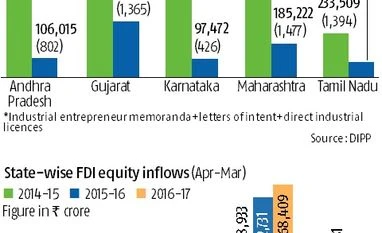
The seven editions together have attracted investment intentions of Rs 76 lakh crore. Going by the estimates put out by the Gujarat government, the implementation so far in the form of industrial entrepreneur memorandums (IEMs), letters of intent (LoI) or direct industrial letters (DIL) should be Rs 50.16 lakh crore.

And this is here where the narrative changes. According to the department of industrial policy and promotion (DIPP) in the commerce ministry as well as statements of regional offices of the Reserve Bank of India (RBI), domestic and foreign direct investment (FDI) inflows in Gujarat are much less.

Between 2011 and 2016, three Vibrant Gujarat summits drew investment intentions worth Rs 57.83 lakh crore. The period saw actual IEMs implemented worth Rs 1.16 lakh crore.  Without any investment summit of its own, neighbouring Maharashtra saw IEMs worth Rs 1.01 lakh crore being implemented during the same period.

Ironically, investment intentions in Gujarat, in terms of IEMs, LoIs and DILs, fell by 53.4 per cent during the Twelfth Five Year Plan period (April 2012 to December 2015) from the Eleventh Plan period (April 2007 to March 2012). 

In terms of FDI equity inflows, too, from April 2000 till September 2016, Gujarat, which attracted Rs 70,927 crore, ranks fourth after Maharashtra (Rs 4,84,163 crore), Tamil Nadu (Rs 1,22,683 crore) and Karnataka (Rs 1,16,128 crore), according to the DIPP, which quoted from statements of regional RBI offices.

Along with investments, the state government has also claimed a high employment success ratio in Gujarat due to the summits. Recently, Chief Secretary JN Singh claimed that Gujarat ranked number one in providing employment, with over 1.34 million people getting jobs in the last three years. According to data released by the state government, Gujarat's share in total employment generation across the country was 86 per cent in 2014, more than any other state.

Experts, however, said Gujarat had not seen any spectacular rise in job creation in the last five years. Rituparna Chakraborty, executive vice-president and co-founder of TeamLease Services, a recruitment consulting firm, said, "In fact, Maharashtra is attracting more jobs than Gujarat. Local talent availability here is also an issue. Bringing talent from outside the state at times becomes a cumbersome process.”

"According to the 5th Annual Employment/Unemployment Survey by the Centre, Gujarat has the lowest unemployment ratio at 0.9 per cent," Singh said.Contrasting this, Ashim Roy, vice- president, National Trade Union Initiative, said the number would look high because many people were engaged in some form of work, even petty work.

"That cannot be a marker of the overall employment scenario in the state. One has to see the status of formal employment," he said. According to Roy, though new manufacturing units had created jobs in the state, the government had not ensured that labour interests were protected. "Industrial development in Gujarat has given rise to un-secured jobs, and also the minimum wages are low compared to other states with similar size economies," he added.

Finally, the state government is also pegging huge participation by micro, small and medium enterprises (MSMEs), with sources claiming over 16,000 MoUs being lined up for the eighth edition of the summit. This, when in 2016 alone, over 42,500 MSME units reported “sick” in the state, making it the third highest in the country. In March 2016, there were around 42,579 sick MSME units in the state, after Uttar Pradesh (95,989) and Maharashtra (52,576), according to RBI figures shared in the Lok Sabha during the recently concluded winter session of Parliament. Despite the Gujarat government taking steps to help MSME units, the number reporting sick has risen from 20,452 in 2013 to 48,000 in 2014 and 49,003 in 2015.

While critics continue to question the effectiveness of the summits, and the government itself trying to market them as a “knowledge sharing platform”, it is the investment figure that grabs eyeballs. Already, 21,910 MoUs with investment intentions of over Rs 25 lakh crore have been lined up, according to government sources, with the numbers likely to go up to Rs 30 lakh crore. The state machinery has been working overtime to ensure that the investment amount does not slip in a crucial election year in Gujarat. The question remains, at this rate, how long can the summit keep beating its own record?


One subscription. Two world-class reads.

Already subscribed? Log in

Subscribe to read the full story →
*Subscribe to Business Standard digital and get complimentary access to The New York Times

Smart Quarterly

₹900

3 Months

₹300/Month

SAVE 25%

Smart Essential

₹2,700

1 Year

₹225/Month

SAVE 46%
*Complimentary New York Times access for the 2nd year will be given after 12 months

Super Saver

₹3,900

2 Years

₹162/Month

Subscribe

Renews automatically, cancel anytime

Here’s what’s included in our digital subscription plans

Exclusive premium stories online

  • Over 30 premium stories daily, handpicked by our editors

Complimentary Access to The New York Times

  • News, Games, Cooking, Audio, Wirecutter & The Athletic

Business Standard Epaper

  • Digital replica of our daily newspaper — with options to read, save, and share

Curated Newsletters

  • Insights on markets, finance, politics, tech, and more delivered to your inbox

Market Analysis & Investment Insights

  • In-depth market analysis & insights with access to The Smart Investor

Archives

  • Repository of articles and publications dating back to 1997

Ad-free Reading

  • Uninterrupted reading experience with no advertisements

Seamless Access Across All Devices

  • Access Business Standard across devices — mobile, tablet, or PC, via web or app

Next Story



