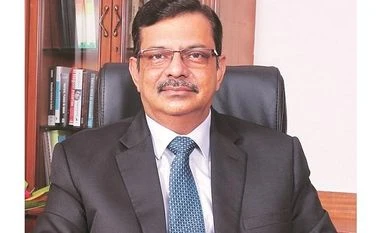
The Life Insurance Corporation of India (LIC) does not intend to sell its entire stake in IDBI Bank, considering that the lender is its strategic partner for the bancassurance channel. Also, at a time when the state-run insurer is looking to expand its bancassurance business, the relationship with IDBI Bank is of much significance, LIC Chairman M R Kumar said on Monday.
Kumar said LIC was keen to list in March itself despite global geo-political tensions weighing on market sentiment -- a stance that has been echoed by finance ministry officials time and again.
He also said LIC’s potential investors should not worry about government control after its initial public offering (IPO) because decisions in the insurance company were taken by its board and not the government. LIC, he said, was well capitalised and didn’t require capital as of now.
Addressing a press conference ahead of the IPO, Kumar said, “We would like to have some stake in IDBI Bank. The whole idea of us picking up a stake in the bank was for a strategic reason and that has not gone away. In fact, IDBI Bank has been the strongest contributor for us in the bancassurance channel.”
“In a post-listing scenario, when we would want to expand on the bancassurance business, this is something that will really help us. I, as chairperson, LIC, would like to see this relationship continuing in the future,” he added.
LIC had picked up a 51 per cent stake in IDBI Bank in 2019. Subsequently, in 2020, it reduced its shareholding to 49.24 per cent. Currently, the government of India and LIC hold 94.71 per cent in the bank. The government is looking to sell its stake in the lender and LIC will also offload its stake, although the quantum of stake sale has not been made public so far.
“It is up to the government and DIPAM (Department of Investment and Public Asset Management ) to kick off the privatisation exercise. But since it was a strategic partnership to begin with, we might stick on to some stake so that we continue the relationship we have in bancassurance and other areas, which is a win-win for both LIC and IDBI Bank,” Kumar said.
Since LIC is the parent company of both IDBI Bank and LIC Housing Finance, and since both are engaged in the mortgage business, the Reserve Bank of India (RBI) had given LIC time till November 2023 to wind down either of its associates’ housing finance business.
Kumar said, “The RBI has given time to us till November 2023 on the LIC Housing and IDBI Bank issue. Before that we have to take a call whether we want LIC Housing Finance to source the business from IDBI Bank. The other scenario is in case disinvestment happens before the timeline, then the problem would not arise.”
LIC had a single “life fund” before Section 24 of the LIC Act was amended by the government to bring its surplus distribution mechanism at par with private life insurers. Now, the life fund has been segregated to two funds – participating policyholders fund and non-participating policyholders’ fund. Consequently, the surplus distribution in the participating policyholders’ fund has been modified to 90:10 in a phased manner, wherein 90 per cent will go to policyholders and 10 per cent to shareholders. Further, 100 per cent of the surplus generated out of the non-participating business will be available for distribution to all shareholders.
This change, Kumar said, will help LIC to increase its profitability, a metric that will be closely tracked once it gets listed. “Going forward, with the change in surplus distribution, profitability will increase. Beyond that, it’s a question of how the product mix changes, penetration, more coverage to people, getting into sectors where we have been missing out. So, that should take care of the profits,” Kumar said.
Kumar also outlined the corporation’s policy post listing wherein it would focus on non-par products, which generate a lot of margins for insurers. They would also look to capitalise on the bancassurance channel of distribution and may also make customised products for this channel.
“On the bancassurance side, we have been making progress over a period of time. We have tie-ups with almost 58,000 bank branches and this is higher than any other private insurance companies. In terms of product mix, we are working on several products, both par and non-par. Going forward, we might have differentiated products for bancassurance as some others have,” Kumar said.
LIC filed its draft red herring prospectus (DRHP) with the Securities and Exchange Board of India (Sebi) on February 13, thus setting the ball in motion for the country’s largest-ever public listing. The government will sell 5 per cent of its stake, or 316.25 million shares of its over 6,325 million shares. The government owns 100 percent of LIC.