
India money in Swiss banks fell 80% since 2014, says Piyush Goyal
According to Swiss authorities, more reliable data source for deposits held in Switzerland is the Locational Banking Statistics (LBS) of Bank of International Settlements, says Goyal
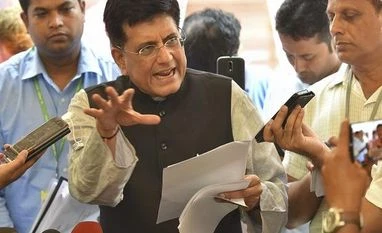 "India money in Swiss banks fell 80% since 2014, says Piyush Goyal")
Explore Business Standard
According to Swiss authorities, more reliable data source for deposits held in Switzerland is the Locational Banking Statistics (LBS) of Bank of International Settlements, says Goyal
Indian deposits in Swiss banks fell by 34.5 per cent in 2017 and by 80 per cent since the Narendra Modi government came to power in 2014, Finance Minister Piyush Goyal said on Tuesday, citing data from the global body of central banks, the Bank for International Settlements (BIS).
He said this in Parliament rebutting reports last month, which quoted the Swiss National Bank, the country's central bank, as saying in its annual report that Indian deposits had risen by 50 per cent in 2017.
He told Rajya Sabha during question hour that he discussed the issue with Swiss authorities, who told him in a written reply that media reports "have not taken account of the way the (SNB) figures have to be interpreted."
Last month, PTI had reported SNB data that the money parked by Indians in Swiss banks rose to CHF 1.01 billion (Rs 70 billion) in 2017 after falling for three consecutive years.
"The Swiss Authorities say that the figures published by the Swiss National Bank are regularly mentioned by the Indian media as a reliable indicator of the amount of assets held with Swiss financial institutions in respect of Indian citizens. They clarify how this is wrong. They say more often than not, the media reports have not taken into account the way the figures have to be interpreted which has resulted in misleading headlines and analysis. This is (the Swiss) government response," he said.
Goyal said according to Swiss authorities, the more reliable data source for deposits held in Switzerland is the Locational Banking Statistics (LBS) of Bank of International Settlements.
LBS measures international banking activity from a residence perspective, focusing on the location of banking office and captures around 95 per cent of all cross-border banking activity.
He said SNB data includes non-deposit liabilities, business of Swiss branches located in India, inter-bank transactions and fiduciary liability. BIS data show non-bank loans and deposits -- which constitute the individual and corporate deposits and exclude inter bank transactions — have fallen by 34.5 per cent in 2017 to $524 million compared to $800 million in 2016, he said and vowed to continue the crackdown against black money.
"Further, there has been significant reduction in Swiss non-bank loans and deposits of Indians by 80.2 per cent between 2013 and 2017," he said adding the figure in 2013 was $2.6 billion which came down to $2.3 billion in 2014 and $1.4 billion 2015.
"Moreover, it is frequently assumed that any assets held by Indians are undeclared," he said. "So if you want to know the deposits of Indian residents in Switzerland, the correct data source is called locational banking statistics."
The minister said the Automatic Exchange of Information based on Common Reporting Standard has commenced from 2017 with many countries enabling India to receive financial account information of Indian residents.
"This will also be useful in bringing the unaccounted income and assets to tax," he said.
First Published: Jul 24 2018 | 3:36 PM IST

