Sowing of kharif crops continued to lag behind last year’s level and was, in fact, almost 7.5 per cent lower. However, the gap has narrowed over the past week as the southwest monsoon regained strength over several areas of Gujarat, Jharkhand, Odisha and Bihar.
The improvement in monsoon over several parts of Gujarat and continuing good rains in Western and Central India have pushed up water levels in major reservoirs across the country, which should augur well for coming rabi crop too.
Latest data from the Central Water Commission showed that the combined volume of water in 91 reservoirs was 63.33 billion cubic meters. This is more than last year's volume and better than the 10-year average as well.
“Reservoir levels are a much better indicator of food prices than rain. Not only do they reflect rains in the current season, but they also carry over moisture from the previous season. While rains have been erratic (currently three per cent below normal), reservoir levels have been good (16 per cent above normal),” HSBC said in a report.
Meanwhile, according to the latest data from the department of agriculture, kharif crops have been sown on around 73.79 million hectares till Friday, down 7.5 per cent from 79.76 million hectares a year ago. Normally, kharif crops are sown on about 106 million hectares of land in a year.
Sowing of almost all major crops, except moong, soybean and sugarcane, has been lower than last year due to insufficient and delayed monsoon rainfall in some parts and shift towards more profitable crops such as soybean in Madhya Pradesh.
“The acreage pattern is below average for some crops, which can be a concern in case sowing does not pick up in the next 2-3 weeks. Pulses seem to be down as is the case with rice and cotton. It is hoped that by August 15 things would stabilise," CARE Ratings said in a statement on Friday
Rice acreage, the biggest foodgrain in the kharif season, was around 2.8 million hectares lower than last year. Almost 93 per cent of the acreage was in Bihar, Odisha and eastern Uttar Pradesh.
In all the three states, the southwest monsoon till July 27 was more than 35 per cent below than normal.
Though the deficiency in rains has narrowed the past few days, it is still a cause for concern. The Bihar government is likely to review the monsoon situation in the state in the next few days, to ascertain whether or not some parts could be declared drought-hit.
In pulses, the overall acreage was down by 8.73 per cent mainly due to a drop in urad area in Madhya Pradesh and Maharashtra, where farmers seem to have shifted to soybean in the hope of better returns.

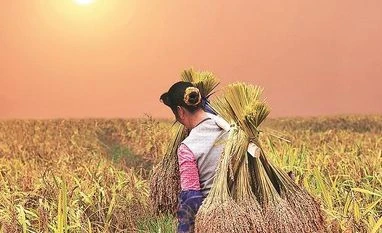 "Kharif sowing improves further as rains revive, reservoir levels rise")












