The Centre does not want to regulate the sugar sector and has fixed the minimum selling price for the sweetener, as also stock limits on mills, only in the interest of farmers, consumers as well as small units, a senior food ministry official said today.
The official also ruled out any increase in the minimum selling price of sugar and wondered why consumers will pay more in a glut market.
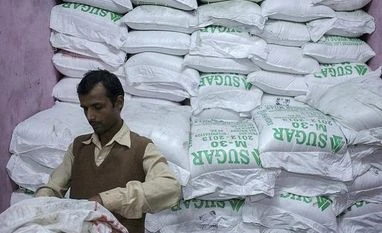
To bailout the cash-starved sugar industry, the government had last week decided to create a buffer stock of three million tonnes and fixed minimum selling price of sugar besides imposing monthly stock limit on mills.
Sugar industry bodies like ISMA and NFCSF have demanded higher minimum selling price of sugar saying that Rs 29/kg is inadequate to cover the production cost which is at around Rs 34-36/kg.
"The floor price cannot be the maximum price. Mills were selling at Rs 25/kg, now the minimum selling price has been fixed at Rs 29/kg. They are gaining Rs 4/kg. This is a decent price in the current scenario," the official said.
The minimum ex-mill price cannot been raised further. "Tomorrow, the government can be accused for helping mills at the cost of consumers," the official noted.
If the floor price is fixed at Rs 35/kg, mills will gain Rs 7-8 per kg but then the retail price will rise to Rs 44 per kg. "Why in a glut season, consumer have to pay high. Let consumers also get some benefit."
On imposing stock limit, the official said that purpose was not to regulate, but to ensure fair play.
"Otherwise, big mills will sell everything. Other poor mills, whose cost of production is higher, are not able to sell anything. The idea is to give equity and all mills are able to sell," the official said.
"The government is ready to withdraw and let them go back to Rs 25 per kg and no stock limits. Let them choose."
The official further said that the government was trying to help mills in all ways possible to clear the mounting cane arrears of over Rs 220 billion.
"Ultimately, it is the responsibility of the sugar mills to clear dues. The government has taken certain measures and that has pushed up sugar price. This is a major support for mills to pay arrears. What else they want? They want government to pay sugarcane arrears? They have bought cane, not the government," the official noted.
Sugar mills are incurring losses as prices have fallen below production cost on account of record output of 31.5 million tonnes in the 2017-18 season ending September as against the annual domestic demand of 25 million tonnes.
Read this article for free
Register to continue reading premium journalism and analysis from Business Standard.

 "Not controlling sugar mills, just helping them clear cane arrears: Govt")












 Connect with us on WhatsApp