Public spending to drive infrastructure growth over medium term: Experts
The experts' panel included Arup Roy Choudhury, Santosh B Nayar and Ravi Uppal
BS Reporter New Delhi Investment from the government and state-owned companies will drive infrastructure funding and projects over the next one-to-two years, industry experts said at the Business Standard Infrastructure Summit in New Delhi on Thursday.
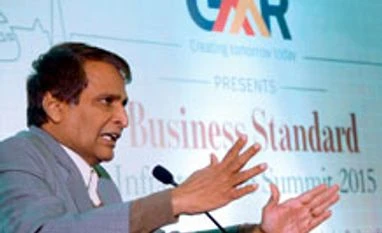
Railway Minister Suresh Prabhu, who spoke at the summit, said banks were overstretched in financing projects and that new institutions and financial instruments needed to be created to fund infrastructure.
The experts’ panel included Arup Roy Choudhury, chairman and managing director of NTPC; Santosh B Nayar, chairman and managing director of India Infrastructure Finance Corporation (IIFCL); and Ravi Uppal, managing director and CEO, Jindal Steel & Power. Aniruddha Ganguly, GMR Energy’s head of strategy and development; Alstom India president Rathin Basu; and Feedback Infrastructure president Vinayak Chatterjee were also part of the discussion.
“Bulk of infrastructure financing for the medium-term has to come from the public sector,” said Chatterjee. “We have to look at how to increase the corpus of public spending. And by that, I don’t just mean the government. PSUs (public sector units) are sitting on Rs 2 lakh-crore cash pile, and states have their own fiscal capacity for infrastructure projects.”
The panelists agreed with Prabhu’s assessment that banks lent only on a shorter term basis, and new institutions and instruments were required for projects with long gestation periods.
IIFCL's flexible refinancing scheme, popularly known as 5:25 scheme, to existing infrastructure projects would also require to be reframed, said Nayar. The 5:25 structure allows banks to loan to a developer for 25 years, with an option of rewriting terms or transferring loan to another bank or financial institution after five years.
“Infrastructure in our country has been substantially funded by banks. For them, an elephant in the room that no one is talking about is Basel-III norms. Once these norms kick in, banks will have less flexibility to lend to projects,” said Nayar.
These norms treat restructured loans on par with non-performing assets as far as provisioning is concerned. “Nothing prevents us from creating non-banking financial companies for infrastructure outside of Basel-III,” Nayar added. He said the industry is still to get over the financing hump. According to him, there is a lull in new projects; but when they start coming in, there would be a problem.
The government, through chief economic advisor Arvind Subramanian’s mid-year economic analysis last month, had made a case for increased public investment to drive economic growth. Since 1999-2000, public spending has risen steadily, while private spending has shown wild fluctuations. It was double of public investment in the boom years. However, after the global financial markets crash, it fell drastically; in 2012-13, was actually outstripped by the former.
It is likely that the government will initiate steps to increase public spending in the upcoming Budget. There is a likelihood of Finance Minister Arun Jaitley increasing the road cess on petrol and diesel to fund the government’s ambitious road construction plan.

 "Public spending to drive infrastructure growth over medium term: Experts")


 Connect with us on WhatsApp