Public transport ahead on electric path

At least six cities and states are either already operating or are in an advance stage of procuring e-buses
Graph
Jyoti Mukul New Delhi
Last Updated : Sep 18 2017 | 2:40 PM IST
This article has been modified to rectify an error in an earlier version

Automobile manufacturers are now under government pressure for shifting to electric vehicles (by 2030). But, public transport has moved much ahead in absorbing this way of travelling.

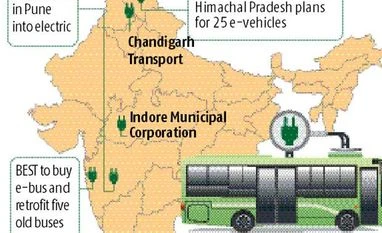
At least six cities and states are either already operating or are in an advance stage of procuring e-buses.

Experts say the move to have e-vehicles (EVs) should start with public transport, as it is easier to create an ecosystem for them. “Adoption of electric buses in city application might be faster, as they have fixed routes and it could be easier to set up charging infrastructure for them. Besides, public transport has the potential to cater to 85 per cent of transport needs of people in any given city. And, it will help in generating volumes and allow OEMs (original equipment makers) to manufacture the electric bus components in India, reducing the overall cost and making e-buses commercially viable for private operators,” Vinit Bansal, founder and managing director of EV Motors India, told Business Standard.

Anil Chaudhry, France-based Schneider Electric’s India country president and managing director, however, says public transport and private vehicles would have to move to EVs side by side.

The Karnataka government recently issued a policy on EVs. It was also the first state where EVs plied for public transport. Bangalore Metropolitan Transport Corporation in 2014 operated a Chinese BYD electric bus on the city’s streets for a three-month trial period. In December 2015, technology provider KPIT, with the Central Institute of Road Technology (CIRT), launched an electric bus based on indigenous technology.

Many cities started with retrofitting before moving on to new e-buses. CIRT and KPIT, for instance, floated a tender to retrofit 12 old diesel buses into electric ones for Pune in 2016. The city’s civic body is now looking at procuring 100 electric buses and has invited an Expression of Interest (EoI) for these.


In July 2016, Himachal Pradesh’s state road transport corporation floated a tender for design, manufacturing, supply and commissioning of 25 battery-operated passenger transport vehicles. The same year in April, Mumbai public transport operator BEST floated a tender to retrofit five old buses into electric one. In January this year, BEST floated another tender for the supply of six electric buses.

According to industry estimates, with 1.5 million in the private sector and 150,000 in the public sector, India has about 1.65 million buses. “It is expected that over the next 10 years, these will be transitioned to full electric buses,” said Bansal. In 2012-13, at least 250 million people used government-owned buses daily. The country’s population is expected to reach 1.35 billion in 2021, with 550 million expected in urban areas. The projected requirement for buses is about 645,000, said Bansal.

There are 71 state transport undertakings (STUs). The top 26 operate about 127,000 buses and the others another 11,650. “STUs constitute only nine per cent of the ownership pattern. Another 38 per cent is with private owners and 53 per cent is with school and employee transport operators,” adds Bansal.
 
Incorporated in India in 2016 by its US-based parent, EV Motors is a technology provider for electric buses and offers services for e-mobility within Indian cities through battery technology, developing of charging infrastructure and establishing captive supplies of clean energy.

According to Bansal, the total cost of ownership of a nine to 12-metre electric bus is Rs 2.5-3.5 crore over 10 years — including acquisition, operating and maintenance cost. “The purchase price is comparatively higher than a conventional bus but  operating costs are significantly less and would outweigh its initial purchase price in a few years,” he says.

To promote private participation in public transport, the rate for EVs should allow commercial viability, he says. For faster adoption of electric buses, the policy framework should allow multiple technologies to compete. There should also be a policy framework for charging infrastructure.

Chaudhry says Schneider has the technology to set up charging stations. “We do it globally and we can adapt it in India for meeting local standards.”
 
The central government is considering whether to allow state-owned power utilities to set up fast-charging stations. And, a scheme for e-buses to swap drained batteries with fully-charged ones at depots in some metros. These would be part of the National Electric Mobility Mission Plan that aims to get six-seven million EVs on the roads by 2020.

One subscription. Two world-class reads.

Already subscribed? Log in

Subscribe to read the full story →
*Subscribe to Business Standard digital and get complimentary access to The New York Times

Smart Quarterly

₹900

3 Months

₹300/Month

SAVE 25%

Smart Essential

₹2,700

1 Year

₹225/Month

SAVE 46%
*Complimentary New York Times access for the 2nd year will be given after 12 months

Super Saver

₹3,900

2 Years

₹162/Month

Subscribe

Renews automatically, cancel anytime

Here’s what’s included in our digital subscription plans

Exclusive premium stories online

  • Over 30 premium stories daily, handpicked by our editors

Complimentary Access to The New York Times

  • News, Games, Cooking, Audio, Wirecutter & The Athletic

Business Standard Epaper

  • Digital replica of our daily newspaper — with options to read, save, and share

Curated Newsletters

  • Insights on markets, finance, politics, tech, and more delivered to your inbox

Market Analysis & Investment Insights

  • In-depth market analysis & insights with access to The Smart Investor

Archives

  • Repository of articles and publications dating back to 1997

Ad-free Reading

  • Uninterrupted reading experience with no advertisements

Seamless Access Across All Devices

  • Access Business Standard across devices — mobile, tablet, or PC, via web or app

Next Story



