More than two years after India's ministry of defence (MoD) chose to buy 126 Dassault Rafale fighters for the Indian Air Force (IAF), the world's biggest fighter contract swings in the wind. With no deal in sight after 28 months of haggling with Dassault, two of the losing vendors -Eurofighter and Saab - believe they could yet come out tops.
Eurofighter GmbH, whose Typhoon fighter narrowly lost out to the Rafale, still retains a senior executive in New Delhi. This is to allow Eurofighter - the official runner-up - to quickly step in should negotiations with Dassault collapse.
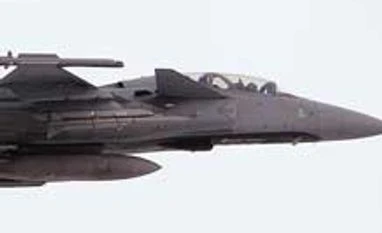
Swedish company, Saab, whose Gripen-D light fighter was evaluated but not selected, similarly believes the contract remains open. Saab places hope in a proposal that it formulated with the Defence Research and Developments Organisation (DRDO) to co-develop and co-manufacture the improved Tejas Mark II Light Combat Aircraft (LCA). This affordable, indigenous, single-engine fighter could be built in numbers, providing the IAF a more economical and effective option than limited numbers of enormously expensive, twin-engine Rafales.
Saab believes that a successful Tejas Mark II would erode the need for the Rafale. The Swedish company has offered co-development and co-manufacture of the Tejas Mark II, even whilst fielding the cheapest and most economical fighter of the six in the fray.
As IAF officers confirm, India had intended to buy a cheap, light fighter to replace the IAF's MiG-21s as they were phased out of service. In late 2004, IAF sent out a "request for information", to four manufacturers of small, cheap fighters - the Russian MiG-29; the American F-16; the French Mirage-2000-5, and the Saab Gripen.
Only in August 2007, when IAF issued a formal tender - termed "request for proposal", or RfP - were expensive, twin-engine fighters like the Eurofighter, Rafale and F/A-18 regarded as options. Today, with the economy stuttering, the daunting prospect of paying Rs 1,00,000 crore for 126 fighters could mean that low cost becomes decisive.
Saab sees further advantage in backing the indigenous horse, the Tejas Mark II. The Swedish company claims it is best suited for upgrading the Tejas Mark I, since it is currently upgrading the Gripen-D by fitting a new engine, the General Electric F-414 power pack. Upgrading the Tejas Mark I to Mark II specifications involves exactly the same upgrade.
Last DRDO chief, Dr V K Saraswat, was convinced that Saab's assistance would be ideal for the Tejas programme. In 2012, DRDO sent Saab a "Request for Information" asking a rough estimate of costs, which Saab duly submitted.
In Jan 2013, DRDO followed up with a RfP, asking for technical and financial bids for Saab to jointly audit the Tejas design with DRDO. Saab had proposed an eight-10 month long audit, after which a fresh design would be finalised and a manufacturing line established.
MoD sources tell Business Standard that Saab proposed in 2011 to co-develop the Tejas Mark II and roll it out from a new manufacturing line within five years. Saab wanted at least 51 per cent ownership of the joint venture company that built the new Tejas, to be free of government controls and procedures.
By May 2013, a joint design contract seemed imminent, says Saab. But on June 1, a new DRDO chief, Dr Avinash Chander, took charge and Saab was unofficially told that DRDO could not co-develop the Tejas with a foreign company without an international tender to select the partner.
Contacted for comments, a DRDO spokesperson told Business Standard that design work on the Tejas Mark II is proceeding satisfactorily without a foreign partner.
In fact, MoD sources admit the Tejas Mark II programme faces significant design challenges beyond merely fitting a new engine. The Tejas Mark I was not designed with operational availability in mind, with important systems placed in inaccessible places that take time for technicians to reach. The Gripen-D, in contrast, requires just five man-hours of maintenance for an hour of flying. (The figure for the Tejas is not available, but the Rafale is estimated to require 15 man-hours).
Furthermore, the new F-414 engine would require the Tejas' length to be increased by half a metre. In addition, experts say the air intakes will have to be redesigned, since they do not allow in sufficient air for even the F-404 engine, far less the more powerful F-414 that will be fitted.
Aerospace analysts acknowledge Saab's expertise in building economical and effective fighters. The Gripen-D costs half as much as a Rafale. International expert, Jane's, puts the operating cost of a Gripen at $4,700 per flight hour, while flying a Rafale for an hour costs $15,000.

 "Rafale contract elusive, Eurofighter and Saab remain hopeful")


