RCEP trade negotiations will not be over by 2018, says Suresh Prabhu

Recently concluded talks in Singapore have identified 'early deliverables', but don't address all issues
RCEP
RCEP
Subhayan Chakraborty New Delhi
Last Updated : Sep 05 2018 | 2:15 AM IST
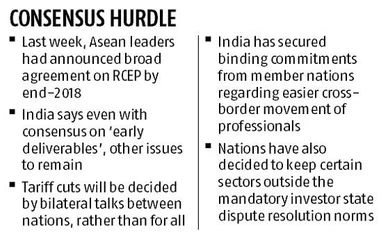
Negotiations on the proposed Regional Comprehensive Economic Partnership (RCEP) will not be over by the end of this year as had earlier been announced. 

This is because discussions on tariff reduction remain unfinished and member nations differ on trade in services, investment and other issues. 

However, RCEP nations have decided to set tariff reduction goals through “bilateral pairing”, meaning extensive one-on-one consultations.

Nations will also submit updated offers on the services trade by October 5, before the next round of discussions take place in October in Auckland.

"RCEP negotiations will not end this year. This has been agreed upon at the level of leaders. They will continue in 2019 and we will have opportunities to work on all issues," Commerce and Industry Minster Suresh Prabhu told reporters on Tuesday. 

Prabhu's announcement comes days after the Singapore government announced that the broad contours of the deal would be ready by December.

Trade ministers of the member nations met in Singapore last week and, led by the 10-member Association of Southeast Asian Nations (Asean), had adopted a joint proposal to finish negotiations by December. 

The adoption of a “package of year-end deliverables”, specific issues discussed by the trade negotiating committee of the RCEP, suggested this.

All major discussion areas including, goods, services, investment, competition and intellectual property rights are part of the package, according to sources.

"All members understand that even having convergence on certain areas still leaves open a lot of issues that need to be sorted out next year," a senior commerce ministry official said. He added members were hoping to achieve a comprehensive deal, based on consensus, by the end of next year, but even that was open to negotiation.

The RCEP is a proposed pact between the 10 countries comprising Asean and six others with which the grouping currently has free-trade agreements (FTAs). The six are New Zealand, Australia, China, India, Japan and South Korea.

So far, 23 rounds of talks have concluded, apart from six minister-level meets. 

Tariff tangle

India has resisted demands of most nations that it should slash tariffs on up to 90 per cent of all goods, as well as calls of developed countries such as Japan and Australia to open up the Indian markets to products such as dairy items and engineering goods.

Last year New Delhi offered to reduce duties on 80 per cent of all tariff lines with a variation of 6 per cent, depending on the extent of trade with a country.

Talks had been held up on this because other nations had continued to pressure for higher tariff cuts and reducing the variation to 2 per cent.

Nations such as New Zealand and Australia have offered to reduce tariffs on more than 92 per cent of all traded goods. Vastly different levels of economic development as well as liberalisation has complicated the process. 

"Rich Singapore has no tariffs on almost 99 per cent of all goods but Indonesia has not opened up even 50 per cent of all goods to India despite the India-Asean FTA," the official added.

Domestic industry is divided on India joining another trade pact with nations that are competing with the country. Some have advocated the deal, arguing that it will give the country access to the huge Chinese market. Most argue the existing trade agreements with Malaysia, Japan, Singapore and South Korea are unfavourable to India and have led to a widening trade deficits with them.

Prabhu on Tuesday said India needed to have separate discussions with Australia, New Zealand and China, the three nations India does not have a free trade agreement with.

One subscription. Two world-class reads.

Already subscribed? Log in

Subscribe to read the full story →
*Subscribe to Business Standard digital and get complimentary access to The New York Times

Smart Quarterly

₹900

3 Months

₹300/Month

SAVE 25%

Smart Essential

₹2,700

1 Year

₹225/Month

SAVE 46%
*Complimentary New York Times access for the 2nd year will be given after 12 months

Super Saver

₹3,900

2 Years

₹162/Month

Subscribe

Renews automatically, cancel anytime

Here’s what’s included in our digital subscription plans

Exclusive premium stories online

  • Over 30 premium stories daily, handpicked by our editors

Complimentary Access to The New York Times

  • News, Games, Cooking, Audio, Wirecutter & The Athletic

Business Standard Epaper

  • Digital replica of our daily newspaper — with options to read, save, and share

Curated Newsletters

  • Insights on markets, finance, politics, tech, and more delivered to your inbox

Market Analysis & Investment Insights

  • In-depth market analysis & insights with access to The Smart Investor

Archives

  • Repository of articles and publications dating back to 1997

Ad-free Reading

  • Uninterrupted reading experience with no advertisements

Seamless Access Across All Devices

  • Access Business Standard across devices — mobile, tablet, or PC, via web or app

Next Story


