Home / Economy / News / As Mauritius amends DTAC, India promises help for infra projects
As Mauritius amends DTAC, India promises help for infra projects
To help the Indian Ocean island nation tide over immediate loss to its economy, New Delhi committed to assist it in implementing key infrastructure projects
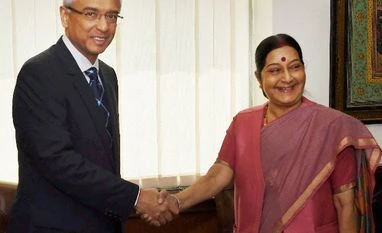
External Affairs Minister Sushma Swaraj with Mauritian Minister of Finance and Economic Development, Pravind Jugnauth in New Delhi
India on Tuesday congratulated Mauritius for revising the bilateral Double Taxation Avoidance Convention (DTAC), which had been a source of stress in their mutual ties. To help Mauritius tide over the immediate loss to its economy, New Delhi committed to assist it in implementing key infrastructure projects.
External Affairs Minister Sushma Swaraj held discussions with Mauritius Finance Minister Pravind Kumar Jugnauth here. She thanked Jugnauth for the “forward looking decision”, which has allowed the protocol on the amendment of the India-Mauritius DTAC. According to sources, Swaraj told the visiting minister that the decision has “added to Mauritius’ financial credentials”.
Swaraj said the long-standing request from Mauritius for restarting negotiations of Comprehensive Economic Cooperation Partnership Agreement (CECPA) and a Preferential Trade Agreement (PTA) has also been met, with discussions on Monday in Port Louis, the capital of Mauritius.
India promised Mauritius greater collaboration in defence and security. New Delhi also offered to provide assistance for hydrographic surveys. Swaraj said India was finalising the memorandum of understanding under which it would help Mauritius implement infrastructure projects, including the Metro Express and others that Jugnauth had announced in his budget.
She said India had always supported the development priorities of Mauritius. Swaraj also appreciated Jugnauth giving priority to visiting India on his first tour abroad, in keeping with the very special “blood relationship” between India and Mauritius.
The original DTAC, signed in 1982, which came into effect in December 1983, was aimed at strengthening investment flows between the two countries. However, after the economic reforms of 1991, it was misused to evade tax via round-tripping. Mauritius didn’t have capital gains tax. The ‘Mauritius route’, as it came to be known, also became a source of unaccounted money flowing into India. The loss to India, according to one estimate, was about Rs 22,000 crore.
However, Mauritius was reluctant to revise the agreement as it had helped its financial services sector grow, contributing about 10 per cent to its gross domestic product (GDP). Prime Minister Narendra Modi, who had fought the 2014 Lok Sabha elections on the issue of black money, convinced the leadership of Mauritius during his visit to that country in mid-2015 to agree to the amendments. The revised DTAC was signed in May.
According to the Mauritius government, in return India was to assist with specific projects as well as help strengthen its financial services sector. Apart from Mauritius, India has also reworked its treaty with Cyprus and is in negotiations with Singapore.

 "As Mauritius amends DTAC, India promises help for infra projects")


 Connect with us on WhatsApp