A year earlier, Rahul Gandhi squarely asked his Gujarat leaders what the problem with the Congress in the state was. He was, he told them, privy to feedback before the Gujarat elections of 2007 and 2012 that the party had “popular goodwill” and a “fairly strong chance” of unseating the Bharatiya Janata Party (BJP). It was routed both times.
The Gujarat brass’ conclusion was that their candidates fought the election on their own, without support of the Delhi “high command” or state leaders. As a result, the micro management the BJP had honed to an exemplary skill was missing. “We could not purvey our message and channelise people’s sentiments into votes,” conceded state party spokesperson Manish Doshi.
Insiders say the exercise of sorting out Gujarat began then. The party recognised that while the central command had to shepherd Gujarat, the state leaders had equal, if not higher, stakes in revival and must be co-partners. Ashok Gehlot, national general secretary and Bharatsinh Solanki, the state head, were designated as pivots to implement Rahul’s ‘blueprint’. Gehlot eased out Shankersinh Vaghela as the “first step towards uniting the party”. Vaghela, once Prime Minister Narendra Modi’s peer in the Gujarat BJP and who quit and joined the Congress, was the perennial outlier and a bugbear to the state satraps.
Gandhi and Gehlot recognised that the lack of booth management was a fundamental issue. The Congress couldn’t be a BJP copycat. A state functionary, seeking anonymity, said: “We are not cadre-based but have a workforce that kept us afloat in the years we were out of power. We used it.” The challenge was to reignite the workers and “make them stakeholders”.
Jitu Patel, state party vice-president, who is contesting from Sabarmati in Ahmedabad district, said a team of 15 workers for each booth was constituted. Overseen by the assigned central observers, their brief was to vet voter lists, sift “committed” Congress voters and the swing voters from the apathetic ones, a leaf gleaned from BJP president Amit Shah’s bible of election management, and work on them.
“At long last, Delhi and Gandhinagar worked in tandem and not at cross-purposes,” said Patel, who praised the “dedication” with which the Delhi hands in his constituency “slogged 24x7 on getting the 232 booths in shipshape”. Legislators and MPs from Maharashtra and Madhya Pradesh, including Hingoli MP and Rahul favourite Rajeev Satav, were put in charge of Saurashtra-Kutch and the south, north and central regions.
Arjun Modhwadia, a former Gujarat party president, contesting from Porbandar, said, “Our workers acquired the much-needed killer instinct because the threat of another spell out in the cold became unbearable.” Maulin Vaishnav, another vice-president, added the “instinct” was so “strong” that on their own, the booth workers informed the leaders that after polling, they would stand vigil by turn outside the booths, day and night, to ensure the electronic voting machines were not “tampered with”.
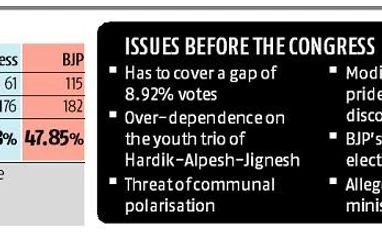
The Congress has got into shape its election machine but some significant issues could make the difference between winning and losing. A former MP and state party functionary said, “We still have to convert people’s emotions into votes.”
He explained, “The Patel and Thakore communities do not like the Congress but want to vent their anger against the BJP. Hardik Patel, Alpesh Thakore and Jignesh Mewani initially wanted to use their agitations as a chip to bargain with the BJP but the BJP was cold. They found a saviour in the Congress. How much of the groundswell in their favour is converted into votes depends on the Congress’ ability to transfer the votes to itself.” He sounded sceptical, saying, “The RSS and its affiliates fight the elections for the BJP’s candidates. By contrast, we have nothing.”
Their other big problem is PM Modi. A functionary said, “We are defensive on whether it’s on the Hindu-Muslim or Gujarati pride planks. Modi’s telling voters, I am one of you, I will take the responsibility for the GST and demonetisation fallout.” So far, the Congress has refused to bite the communal bait and fall in the “mauth ka saudagar” trap.
The Congress’ sense was that this sort of rhetoric worked persuasively on the urban voters. Gujarat has 48 urban and 14 semi-urban seats, of which the Congress won only seven in 2012. “It’s hard to pull the metro voters from their Modi obsession,” a source said. And, then, there’s the BJP’s access to “money, muscle and state power”.

 "Gujarat Assembly elections 2017: Congress tries hard to pick up the pieces")












 Connect with us on WhatsApp