Direct damages of Turkiye earthquakes equivalent to 4% of GDP: World Bank

At least 1.25 million people have lost their homes due to the earthquakes
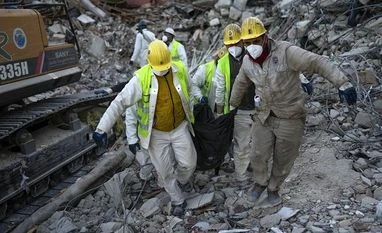
Turkey earthquake
Photo: AP/PTI
Raghav Aggarwal New Delhi
3 min read Last Updated : Feb 28 2023 | 11:44 AM IST
The direct damages of the earthquakes in Turkiye are expected to cost $34.2 billion, the World Bank said. This will equal 4 per cent of the country's gross domestic product (GDP). The recovery and reconstruction costs might additionally be "potentially twice as large".

As of February 19, over 41,020 people have died in the earthquakes, making it the most lethal since the 1939 Erzincan earthquake.

In its Global Rapid Post-Disaster Damage Estimation (GRADE) Report, released on Monday, World Bank said, "The direct damages are dominated by damages to residential buildings (53 per cent of the total), followed by damages to non-residential buildings (28 per cent), while effects on infrastructure account for the remaining 19 per cent".

The report accounted for damages primarily due to the two earthquakes of 7.8 and 7.5 magnitude on February 6.

"Recovery and reconstruction costs will be much larger, potentially twice as large, and that GDP losses associated with economic disruptions will also add to the cost of the earthquakes," it added.

Eighty-one per cent of the total direct damages are expected to be caused in five provinces: Hatay, Kahramanmaraş, Gaziantep, Malatya and Adiyaman. Hatay alone is expected to account for 36 per cent of all the total damages.

The report said that at least 1.25 million people have lost their homes due to the earthquakes.

"More than 200,000 people have been evacuated to other provinces and 5,800 students have been transferred to schools in other cities. In addition, 890,000 earthquake survivors are sheltering in public dormitories and 50,000 in hotels. Moreover, approximately 387,000 tents were sent to the region by local and international organizations, with 172,265 tents set up as of February 16, 2023," it said.

Further, almost 11 per cent of the capital in Turkiye was exposed to the damaging effects of these earthquakes. The total capital exposure is expected to be around $2.33 trillion.

It also highlighted three reasons why the consequences of earthquakes were exacerbated. The primary reason was many ageing buildings were constructed before the introduction of modern seismic design principles and the 1997 code.

Second, the earthquakes were shallow and were in quick succession of each other. Lastly, there were many cases where buildings may not have been built in compliance with the building codes.

The World Bank's numbers are the highest among such recent estimations. Verisk pegged the damages to cost over $20 billion, JPMorgan estimated it to be around $25 billion, and Karen Clark and Company estimated the damages at $20 billion.

However, the Turkish Enterprise and Business Confederation has published an estimate of $84 billion based on a comparison with the 1999 Izmit earthquake.

One subscription. Two world-class reads.

Already subscribed? Log in

Subscribe to read the full story →
*Subscribe to Business Standard digital and get complimentary access to The New York Times

Smart Quarterly

₹900

3 Months

₹300/Month

SAVE 25%

Smart Essential

₹2,700

1 Year

₹225/Month

SAVE 46%
*Complimentary New York Times access for the 2nd year will be given after 12 months

Super Saver

₹3,900

2 Years

₹162/Month

Subscribe

Renews automatically, cancel anytime

Here’s what’s included in our digital subscription plans

Exclusive premium stories online

  • Over 30 premium stories daily, handpicked by our editors

Complimentary Access to The New York Times

  • News, Games, Cooking, Audio, Wirecutter & The Athletic

Business Standard Epaper

  • Digital replica of our daily newspaper — with options to read, save, and share

Curated Newsletters

  • Insights on markets, finance, politics, tech, and more delivered to your inbox

Market Analysis & Investment Insights

  • In-depth market analysis & insights with access to The Smart Investor

Archives

  • Repository of articles and publications dating back to 1997

Ad-free Reading

  • Uninterrupted reading experience with no advertisements

Seamless Access Across All Devices

  • Access Business Standard across devices — mobile, tablet, or PC, via web or app

Topics :TurkeyEarthquakeWorld Bank Turkish economyBS Web Reports

Next Story


