Home / World News / Facebook scandal: CEO Zuckerberg apologises for data breach to EU leaders
Facebook scandal: CEO Zuckerberg apologises for data breach to EU leaders
Zuckerberg stressed that he's trying to plug loopholes across its services, including curbing fake news and political interference on its platform in the wake of upcoming elections
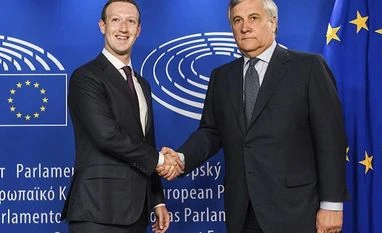
European Parliament President Antonio Tajani, right, welcomes Facebook CEO Mark Zuckerberg upon his arrival at the EU Parliament in Brussels on Tuesday | Photo: AP/PTI
Facebook CEO Mark Zuckerberg on Tuesday apologised again for the massive Cambridge Analytica data breach, this time in front of the European Parliament (EU) leaders.
Zuckerberg stressed that the social networking giant is trying to plug loopholes across its services, including curbing fake news and political interference on its platform in the wake of upcoming elections globally, including in India.
"Over the last couple of years, we haven't done enough to prevent the tools we've built from being used for harm as well.
"Whether it's fake news, foreign interference in elections or developers misusing people's information, we didn't take a broad enough view of our responsibilities. That was a mistake, and I'm sorry," Zuckerberg said while testifying during a round-table with the EU regulators in the Belgian capital.
Out of about 2.2 billion users, Facebook has 400 million users in Europe and the EU is ready to implement the more stringent General Data Protection Regulation (GDPR) to safeguard people's privacy from May 25.
"We're going even further to comply with strong new rules. In addition to GDPR, we're also working to give people important new controls," Zuckerberg said as he was grilled by the EU leaders.
Facebook would hire 20,000 people to work on safety and security by the end of the year, the Facebook CEO told them, adding that the company plans to employ 10,000 people across 12 European cities by the end of 2018.
"There are 18 million small businesses in Europe that use Facebook today, mostly for free," he said, adding that he is committed to Europe.
"Ireland is home to our European Headquarters. London is home to our biggest engineering team outside the US and Paris is home to our Artificial Intelligence (AI) research lab. We have data centres in Sweden, Ireland and Denmark," he told the EU leaders.
Zuckerberg said that in the wake of data scandal, Facebook has audited thousands of apps and has suspended more than 200 apps from its platform.
Appearing before the US Congress in April, Zuckerberg told the lawmakers that his own personal data was part of 87 million users' that was "improperly shared" with the British political consultancy firm.
The data was gathered via a quiz app, "thisisyourdigitallife," developed by Aleksandr Kogan, then a psychology researcher with University of Cambridge, and his company Global Science Research (GSR) which pulled out Facebook users' data in 2014-2015.
"In 2016, we were too slow to identify Russian interference in the US presidential election. We weren't prepared enough for the kind of coordinated misinformation operations that we're now aware of," he told the EU leaders.

 "Facebook scandal: CEO Zuckerberg apologises for data breach to EU leaders")


 Connect with us on WhatsApp