Home / World News / From immigration to Pakistan: Clinton and Trump's views on issues key to India's interests
From immigration to Pakistan: Clinton and Trump's views on issues key to India's interests
Donald Trump and Hillary Clinton's views on immigration are the biggest flashpoint for India, says an HDFC Bank report
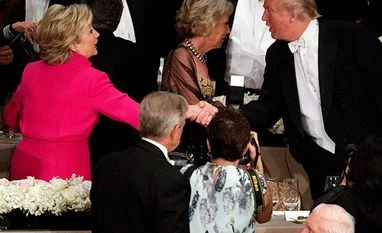
Republican presidential candidate Donald Trump, right, shakes hands with his Democratic counterpart Hillary Clinton during the Alfred E Smith Memorial Foundation dinner in New York. (Photo: AP/PTI)
With November 8 US Presidential election just around the corner, the world is now hooked to the big question: Who will be the next President of the US -- Republican candidate Donald Trump or his Democratic counterpart Hillary Clinton.
In India, people are still thinking which of the two candidates will be better for the US-India relationship.
For some time, the two sides have been working hard to improve their bilateral ties, more so since former US President George W Bush and former Indian Prime Minister Manmohan Singh signed a civil nuclear deal. Whether it will be taken forward or see a retreat backwards is the moot question.
A report titled, 'The US election cheat-sheet', released by HDFC Bank on Friday, looks at the respective thrusts of Clinton and Trump's policies on key issues. Here are a few takeaways from the issues that concern India the most:
On immigration The immigration issue has dominated a large part of Trump's campaign and has been particularly scathing in its attack of immigrants from Mexico and the Muslim community. Trump said he would bring back jobs from India and stop H-1B high-skilled visa programme, of which Indians are among the biggest beneficiaries. Clinton, on the other hand, has made it clear that immigrants are welcome and her proposals include automatic green card proposal to science, technology, engineering and mathematics (STEM) students completing masters degrees or PhDs from any US university. Indian students would cheer such a move, given that there are some 132,888 Indian students in the US at present, most of whom fall in the STEM category.
On Pakistan On the political front, Trump has said: “Pakistan is semi-unstable. We have a little bit of a good relationship. I think I’d try and keep it.” At the same time, he added: “If you look at India and some of the others, maybe they’ll be helping us out.” Although these statements have a slight tilt towards India, "it would perhaps be naive to read too much into an off-the-cuff statement made by a politician who is known for making somewhat loose statements", according to Abheek Barua, Chief Economist, HDFC Bank. Barua adds that the US’ historic cautious stance and the need to maintain what it perceives as ‘equilibrium’ is unlikely to change radically. Given that Clinton has worked closely with Indians in various capacities, one could expect the continuity of the same policy.
Trans-Pacific Partnership According to Barua, one area that India would be watching keenly is Clinton's stand on Trans-Pacific Partnership, a trade agreement among 12 of the Pacific Rim countries -- the US, Canada, Australia, New Zealand and Japan from the bigger economies; and Chile, Peru, Mexico, Vietnam, Singapore, Brunei and Malaysia from the smaller ones. The trade pact aims to create a single market like the European Union by slashing tariffs and strengthening the economic relationship among the member countries.
Although Clinton said it was a “gold standard in trade agreements", later during the election campaigning she opposed it, saying the final pact is not up to her standards. On the other hand, Trump is firmly against TPP. He said more jobs from the US would be outsourced to other countries. Ratification of the deal by the US and other TPP countries might put India in a disadvantageous position.
"Since India is not a signatory to the TPP, the agreement is expected to impact Indian businesses. For one, it will erode the existing preferences for Indian products and services in these countries, benefiting the partners to these agreements. Secondly, it is likely to develop a rules architecture, which will place greater burden of compliance on India's manufacturing and services standards for access to the markets of the participating countries," says Barua.

 "From immigration to Pakistan: Clinton and Trump's views on issues key to India's interests")

