NASA ups the ante with fresh 'brawniest and brainiest' Mars rover

The spacecraft Perseverance set for liftoff this week is NASA's biggest and brainiest Martian rover yet.
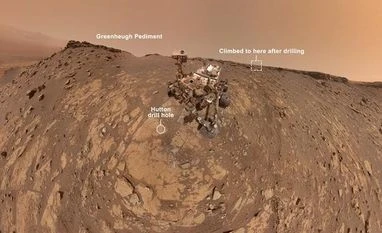
Curiosity rover, NASA
It sports the latest landing tech, plus the most cameras and microphones ever assembled to capture the sights and sounds of Mars. | Representative Image Source: NASA
AP | PTI
3 min read Last Updated : Jul 28 2020 | 12:47 AM IST
With eight successful Mars landings, NASA is upping the ante with its newest rover.

The spacecraft Perseverance set for liftoff this week is NASA's biggest and brainiest Martian rover yet.

It sports the latest landing tech, plus the most cameras and microphones ever assembled to capture the sights and sounds of Mars.

Its super-sanitized sample return tubes for rocks that could hold evidence of past Martian life are the cleanest items ever bound for space. A helicopter is even tagging along for an otherworldly test flight.

This summer's third and final mission to Mars after the United Arab Emirates' Hope orbiter and China's Quest for Heavenly Truth orbiter-rover combo begins with a launch scheduled for Thursday morning from Cape Canaveral.

Like the other spacecraft, Perseverance should reach the red planet next February following a journey spanning seven months and more than 300 million miles (480 million kilometers).

The six-wheeled, car-sized Perseverance is a copycat of NASA's Curiosity rover, prowling Mars since 2012, but with more upgrades and bulk.

Its 7-foot (2-meter) robotic arm has a stronger grip and bigger drill for collecting rock samples, and it's packed with 23 cameras, most of them in color, plus two more on Ingenuity, the hitchhiking helicopter.

The cameras will provide the first glimpse of a parachute billowing open at Mars, with two microphones letting Earthlings eavesdrop for the first time.

Once home to a river delta and lake, Jezero Crater is NASA's riskiest Martian landing site yet because of boulders and cliffs, hopefully avoided by the spacecraft's self-navigating systems.

Perseverance has more self-driving capability, too, so it can cover more ground than Curiosity. The enhancements make for a higher mission price tag: nearly $3 billion.

Perseverance will drill into rocks most likely to hold signs of ancient life and stash the collection on the ground to await a future rover.

Forty-three sample tubes are on board this rover, each one meticulously scrubbed and baked to remove Earthly microbes.

NASA wants to avoid introducing organic molecules from Earth to the returning Martian samples. Each tube can hold one-half ounce (15 grams) of core samples, and the goal is to gather about a pound (0.5 kilogram) altogether for return to Earth.

NASA hopes to launch the pickup mission in 2026 and get the samples back on Earth by 2031 at the soonest.

The 4-pound (1.8-kilogram) helicopter, Ingenuity, will travel to Mars clutching the rover's belly and, a few months after touchdown, attempt to fly solo. Once dropping onto the Martian surface, Ingenuity will start out like a baby bird, rising 10 feet (3 meters) into the planet's extremely thin atmosphere and flying forward up to 6 feet (2 meters).

With each attempt, it will try to go a little higher and farther. It really is like the Wright brothers' moment, said project manager MiMi Aung. She has one month to squeeze in as many helicopter hops as possible before the rover moves on to more pressing geologic work.

The future could see next-generation helicopters scouting out distant Martian territory for astronauts or even robots.

Besides the helicopter, Perseverance carries other experiments that could directly benefit astronauts at Mars.

An instrument the size of a car battery will covert atmospheric carbon dioxide into oxygen, an essential ingredient for rocket propellant and breathing systems.

Another instrument, zapping rocks with lasers to identify organic molecules and minerals, carries samples of spacesuit material.

NASA wants to see how the fabrics withstand the harsh Martian environment.

It will be the 2030s at best, according to NASA, before astronauts venture to Mars.

One subscription. Two world-class reads.

Already subscribed? Log in

Subscribe to read the full story →
*Subscribe to Business Standard digital and get complimentary access to The New York Times

Smart Quarterly

₹900

3 Months

₹300/Month

SAVE 25%

Smart Essential

₹2,700

1 Year

₹225/Month

SAVE 46%
*Complimentary New York Times access for the 2nd year will be given after 12 months

Super Saver

₹3,900

2 Years

₹162/Month

Subscribe

Renews automatically, cancel anytime

Here’s what’s included in our digital subscription plans

Exclusive premium stories online

  • Over 30 premium stories daily, handpicked by our editors

Complimentary Access to The New York Times

  • News, Games, Cooking, Audio, Wirecutter & The Athletic

Business Standard Epaper

  • Digital replica of our daily newspaper — with options to read, save, and share

Curated Newsletters

  • Insights on markets, finance, politics, tech, and more delivered to your inbox

Market Analysis & Investment Insights

  • In-depth market analysis & insights with access to The Smart Investor

Archives

  • Repository of articles and publications dating back to 1997

Ad-free Reading

  • Uninterrupted reading experience with no advertisements

Seamless Access Across All Devices

  • Access Business Standard across devices — mobile, tablet, or PC, via web or app

Topics :NASA Mars missionNASAMars Mission

Next Story



