In Chinese schools, students learn that the United States became a great nation partly by stealing technology from Britain. In the halls of government, officials speak of the need to inspire innovation by protecting inventions. In boardrooms, executives strategise about using infringement laws to fell foreign rivals.
China is often portrayed as a land of fake gadgets and pirated software, where intellectual property like patents, trademarks and copyrights are routinely ignored. The reality is more complex.
China takes conflicting positions on intellectual property, ignoring it in some cases while upholding it in others. Underlying those contradictions is a long-held view of intellectual property not as a rigid legal principle but as a tool to meet the country’s goals.
Those goals are getting more ambitious. China is now gathering know-how in industries of the future like microchips and electric cars, often by pushing foreign companies attracted by the country’s vast market into sharing their technology. It is also toughening enforcement of patents and trademarks for a day when it can become a leader in those technologies — and use intellectual property protections to defend its position against rival economies.
President Xi Jinping is in the midst of an effort to strengthen laws on patents, copyrights and trademarks, giving fledgling firms in China new sources of revenue and prestige. The country is also pursuing an ambitious plan, called Made in China 2025, to become a global leader in areas like robotics and medical technology and kick off the next phase of China’s development. The efforts reflect the view of Chinese officials that controlling global technologies and standards is on par with building military muscle.
Zhang Ping, a scholar of trade law at Peking University in Beijing, said the West had long used intellectual property laws as a “spear and shield” against Chinese companies, hurting their profits at home and blocking access to foreign markets. Now, she said, it is time for China to fight back.
“If you want to enter our market to cooperate, it’s fine,” Zhang said, “but you can’t grab us by the neck and not let us grow.” Trademarks and patents protect companies and inventors, compensating them for their time, ideas and investment. While poorer countries have throughout history worked to obtain inventions from wealthier nations, sometimes running afoul of intellectual property laws, China has rewritten the playbook for acquiring advanced technology.

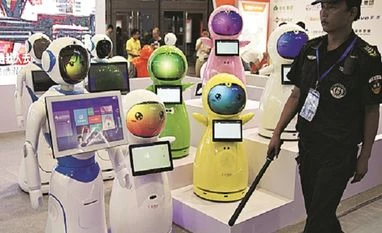 "Seeking greater global power, China looks to robots")












 Connect with us on WhatsApp