The Cartier family: A century's worth of wealth went through the empire

The Cartier family is the story of wealth creation in the 19th and 20th centuries as it moved in waves from country to country
Cartier, Jewllery, Ruby,
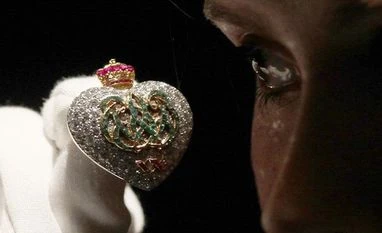
A trainee specialist holds a ruby, diamond and emerald brooch by Cartier at Sotheby’s in London in 2010 | photo: reuters
Bloomberg
3 min read Last Updated : Nov 27 2019 | 3:06 AM IST
By the time the final chunk of the Cartier jewellry empire was sold off in the 1970s, its founding family was almost entirely dispersed and disinterested.

Almost everyone was wealthy—the Cartier family had an uncanny knack for marrying into money, then making even more of it. And even though four generations of Cartier men had worked tirelessly to create a business that elevated jewellry salesmanship from “mere trade” to an art form, their descendants were more interested in bobsledding in St. Moritz than hawking the company’s famous Tank watches. This rise and then—instead of a “fall,” let’s call it a “plateau”—is artfully documented in a new book, The Cartiers, by a member of the family’s sixth generation, Francesca Cartier Brickell.

Several years ago, Brickell discovered a trunk full of family correspondence in her grandfather’s wine cellar and used it as a starting point to chronicle her illustrious family.

What saves the book from being yet another variation on the “from shirtsleeves to shirtsleeves in three generations” parable is that the family business hinged on the shifting fortunes of the world’s super rich. As a result, the story of the Cartier family is the story of wealth creation in the 19th and 20th centuries as it moved in waves from country to country. 

Massive wealth, at least from the Cartiers’ perspective, was often a zero-sum game: The Russians bought until the Bolsheviks came to power, at which point the Americans stepped in. After the Depression hit, the Americans bowed out, at least for a time, to be replaced by celebrities and petroleum-rich Middle Easterners. 

Cartier managed to benefit from both the rises and the falls. The company would sell jewels at retail prices to its rich clients, then buy them back wholesale (or sell them on commission) once those same clients fell on hard times.

“The same grand duchesses who had been snapping up diamond tiaras and sapphire stomachers before the war,” Brickell writes, “were now selling them back, often gemstone by gemstone, just to survive.”

Royal patronage

The Cartier dynasty was founded in the late 1840s by Louis-Francois Cartier. His little Parisian shop, where he sold mostly knickknacks, took off only when he began to enjoy the patronage of Princess Mathilde Bonaparte, the niece of Napoleon I.

Initially, she asked him to repair a necklace, but she soon became a bona fide customer, purchasing more than 200 items. And even though Cartier’s first client base was wiped away after Napoleon III abdicated following the Franco-Prussian war, the company continued to expand thanks to Louis-Francois’s son, Alfred, who married an heiress to a manufacturing fortune. 

Alfred first worked in London after the Franco-Prussian war “as a middleman between fellow French exiles forced to sell their gems to pay for their new lives, and the English aristocracy whose daily rituals demanded a change of jewels for every meal,” Brickell writes. After moving back to Paris, he expanded until the company counted multiple princes and princesses among its clientele. 

World domination

Even though Cartier was selling significant jewels to significant people (it made the wedding jewels for Princess Marie Bonaparte’s marriage to Prince George of Greece in 1907), it was still a distant second or third to such companies as Boucheron, Fabergé, and even Tiffany. It was only the next generation of Cartier children— Louis, who first married a French heiress, and then a Hungarian heiress; Pierre, who married an American heiress; and Jacques, who did the same—who elevated Cartier to a global powerhouse. 

One subscription. Two world-class reads.

Already subscribed? Log in

Subscribe to read the full story →
*Subscribe to Business Standard digital and get complimentary access to The New York Times

Smart Quarterly

₹900

3 Months

₹300/Month

SAVE 25%

Smart Essential

₹2,700

1 Year

₹225/Month

SAVE 46%
*Complimentary New York Times access for the 2nd year will be given after 12 months

Super Saver

₹3,900

2 Years

₹162/Month

Subscribe

Renews automatically, cancel anytime

Here’s what’s included in our digital subscription plans

Exclusive premium stories online

  • Over 30 premium stories daily, handpicked by our editors

Complimentary Access to The New York Times

  • News, Games, Cooking, Audio, Wirecutter & The Athletic

Business Standard Epaper

  • Digital replica of our daily newspaper — with options to read, save, and share

Curated Newsletters

  • Insights on markets, finance, politics, tech, and more delivered to your inbox

Market Analysis & Investment Insights

  • In-depth market analysis & insights with access to The Smart Investor

Archives

  • Repository of articles and publications dating back to 1997

Ad-free Reading

  • Uninterrupted reading experience with no advertisements

Seamless Access Across All Devices

  • Access Business Standard across devices — mobile, tablet, or PC, via web or app

Topics :rich families

Next Story


