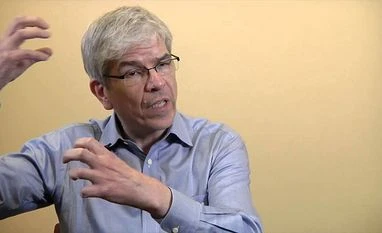
Paul Romer says he really hadn’t planned to trash macroeconomics as a math-obsessed pseudoscience. Or infuriate countless colleagues. It just sort of happened.
His intention actually had been to write a paper that would celebrate advances in the understanding of what drives economic growth. But when he sat down to write it in the months before taking over as the World Bank’s chief economist, Romer quickly found his heart wasn’t in it. The world economy wasn’t growing much anyway; and the math that many colleagues were using to model it seemed unrealistic. He watched a documentary about the Church of Scientology, and was struck by how groupthink can operate.
So, Romer said in an interview at the Bank’s Washington headquarters, “I just thought, OK, I’m going to say what I think. I don’t know if I’m the right person, but no one else is going to say it. So I said it.”
The upshot was The Trouble With Macroeconomics, a scathing critique that landed among Romer’s peers like a grenade. In a time of febrile politics, with anti-establishment revolts breaking out everywhere, faith in economists was already ebbing: They got blamed for failing to see the Great Recession coming and, later, to suggest effective remedies. Then, along came one of the leading practitioners of his generation, to say that the sceptics were on to something.
“For more than three decades, macroeconomics has gone backwards,” the paper began. Romer closed out his argument, some 20 pages later, by accusing a cohort of economists of drifting away from science, more interested in preserving reputations than testing their theories against reality, “more committed to friends than facts.” In between, he offers a wicked parody of a modern macro argument: “Assume A, assume B, ... blah blah blah ... and so we have proven that P is true.”
What’s at stake far exceeds hurt feelings in the ivory tower. Central banks and other policy makers use the models that Romer says are flawed. The idea that consumers and businesses always make rational choices pervades mainstream economics. Romer thinks that’s not only wrong, but may lead to the misleading conclusion that government action can’t fix big problems.
That debate goes back at least to John Maynard Keynes, who thought policy makers needed to take bolder action to address the deep shortfall in demand that was prolonging the Great Depression. By the 1970s, Keynes’s ideas were mainstream —but the policies they spawned had failed to prevent high unemployment and inflation.
Economists trying to understand what went wrong came up with the theories of rational expectations and the “real business cycle” — the ones Romer dismantles. They argued that Keynesian models didn’t account for the way consumers and businesses recalibrate their behaviour to take account of policy shifts.

 "The rebel economist who blew up macroeconomics")

