Trump's first year in one word

The few picks seem to follow a chilling but logical evolution
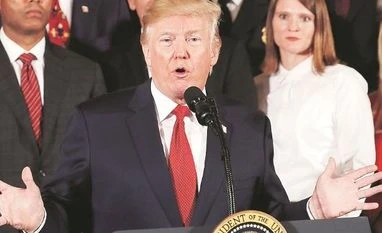
Donald Trump
This year is on track to be the second warmest since records began in the 19th century
Lindy West | NYT
Last Updated : Nov 30 2017 | 11:47 AM IST
It’s weird to think that one year ago today Barack Obama was still the president. Michelle Obama was decorating the White House with happy snowmen and gingerbread dogs instead of transforming the East Colonnade into a hell-bound gullet of witch fingers, apparently our new tradition, and the president of the United States somehow made it through the entire week without insulting a single 90-year-old Native American war hero.

Many of us were angry and terrified but still energized about things like vote audits and faithless electors. We hoped the system might have a fail-safe to protect us from our worst selves — a flash-frozen grown-up to defrost in case of emergencies. Now, a year wiser and few thousand older, in too many ways we are still waiting. It hasn’t clicked with the necessary urgency that we are the grown-ups. We are still frozen.

Every year, Dictionary.com chooses one word, “a symbol of the year’s most meaningful events and lookup trends,” to be the Word of the Year. The past few picks seem to follow a chilling but logical evolution. In 2015 the Word of the Year was broad and neutral — “identity” — issues of racial and gender injustice having finally come closer to becoming national priorities and weathered a ghastly but predictable (and still developing) backlash. Two thousand fifteen was a difficult year, but it was a year of progress.

By the end of 2016, as Trumpism seized the wheel, our national conversation on identity sharpened to a sinister specificity: that year’s word was “xenophobia.” Two thousand sixteen was a year of us versus them, of villains making their plans clear, of straight, white, Christian identity politics moving to supplant everyone else.

This year, the Word of the Year zooms out, implicating millions of us. The word is “complicit.” Two thousand seventeen is a year of reckoning.

Searches for the definition of “complicit” spiked in May, Dictionary.com tells us, when Ivanka Trump was asked to respond to accusations of complicity on “CBS This Morning.” This is one of my favorite Trump-family anecdotes, if one can be said to have a “favorite” venomous snake biting your child on the face: “If being complicit is wanting to be a force for good and to make a positive impact,” Ivanka said, “then I’m complicit.”

I mean, sure, if complicit means that you are 7-foot-1 and love Gold Bond Medicated Foot Powder, then Shaq is complicit. If complicit means an 18th-century wooden shoe, then I have some Dutch klompen Robert Mueller should talk to.

Unfortunately for the first daughter, despite what her father has taught her, even the very rich do not have the right (yet) to redefine basic English words so they can weasel out of accountability for abetting the rise of Nazism in America. The actual definition of complicit is having “involvement with wrongdoing,” and Ivanka Trump is certainly complicit by that measure. (Shaq, as far as I know, is in the clear.) Unfortunately for the rest of us, the rise of Trumpism is a systemic issue — the conditions that made it possible were fostered by our system, not in spite of it — which means that we’re culpable, too.

Complicity, obviously, is a spectrum. Ivanka Trump, for example, is more complicit than your neighbor who voted for Gary Johnson, who is more complicit than your cousin who supported Hillary Clinton but still laughs at sexist jokes. She’s presumably less complicit than her father, although one of the scariest things about Donald Trump is that he doesn’t even seem to be at the top of his own complicity food chain.

It is vital to catch the big fish here — those in power trying to dismantle net neutrality, affordable health care, abortion access, immigrants’ rights, religious freedom, anti-discrimination legislation, environmental regulation, any semblance of a reasonable tax code and our national sense of shared humanity — but it’s just as important to remember that Trumpism didn’t spring out of nowhere. Social media companies let it happen. Politicians let it happen. White Americans let it happen.

We didn’t take to the streets when Republicans were rolling back voting rights in plain sight. We let labor unions dwindle. We ignored our racist uncles at Thanksgiving. We pretended that “apolitical” wasn’t a political stance. We didn’t bother to call our representatives. We turned activists into clowns. We left sexism and racism on the table as viable debate topics. We made sure to hear “both sides.” Millions of us voted for Trump on purpose.

If we manage to get rid of Trump (or Harvey Weinstein or Leon Wieseltier or Louis C. K. or Matt Lauer) without profoundly addressing the culture and power structure that made his success possible, we’re just going to end up with a smarter, savvier, more effective Trump. And we’re barely surviving the incompetent version.

The opposite of complicity isn’t apology — it’s fixing what you broke.
©2017 The New York Times News Service

One subscription. Two world-class reads.

Already subscribed? Log in

Subscribe to read the full story →
*Subscribe to Business Standard digital and get complimentary access to The New York Times

Smart Quarterly

₹900

3 Months

₹300/Month

SAVE 25%

Smart Essential

₹2,700

1 Year

₹225/Month

SAVE 46%
*Complimentary New York Times access for the 2nd year will be given after 12 months

Super Saver

₹3,900

2 Years

₹162/Month

Subscribe

Renews automatically, cancel anytime

Here’s what’s included in our digital subscription plans

Exclusive premium stories online

  • Over 30 premium stories daily, handpicked by our editors

Complimentary Access to The New York Times

  • News, Games, Cooking, Audio, Wirecutter & The Athletic

Business Standard Epaper

  • Digital replica of our daily newspaper — with options to read, save, and share

Curated Newsletters

  • Insights on markets, finance, politics, tech, and more delivered to your inbox

Market Analysis & Investment Insights

  • In-depth market analysis & insights with access to The Smart Investor

Archives

  • Repository of articles and publications dating back to 1997

Ad-free Reading

  • Uninterrupted reading experience with no advertisements

Seamless Access Across All Devices

  • Access Business Standard across devices — mobile, tablet, or PC, via web or app

Next Story



