Home / World News / Trump's tariff troubles: Solar tariffs clouding the industry's future
Trump's tariff troubles: Solar tariffs clouding the industry's future
Over the last eight years, an influx of cheap imported panels has driven down the cost of solar projects by 85 per cent, according to Lazard
premium
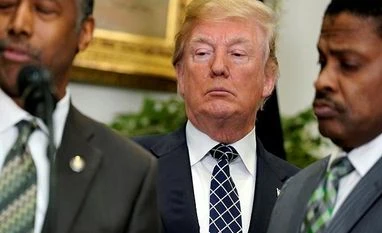
US President Donald Trump stands between US Secretary of Housing and Urban Development Ben Carson (left) and Issac Newton Farris before signing a proclamation to honour Martin Luther King Jr day on Friday
Across North Carolina, textile factories and tobacco farms have disappeared, giving way to fields of solar panels. However, for those venturing into solar farming, the future of this vibrant industry is now cloudy.
After US President Donald Trump’s announcement Monday about steep tariffs imposed on imported solar panels, which could raise the cost of solar power in the years ahead, slowing adoption of the technology and costing jobs.
The two solar companies that had sought the tariffs, Suniva and Solar World Americas, argue that low-cost imports have decimated American manufacturing of solar cells and modules in recent years. Today, 95 per cent of the solar panels used in the US are imported from countries like Malaysia and South Korea, and the companies contend that tariffs are needed to protect the nation’s remaining solar factories.
“Today the president is sending a message that American innovation and manufacturing will not be bullied out of existence without a fight,” Suniva said on Monday.
But while the tariffs may help domestic manufacturers, they are expected to ripple throughout the industry in ways that may ultimately hurt American companies and their workers. Energy experts say it is unlikely that the tariffs will create more than a small number of American solar manufacturing jobs, since low-wage countries will continue to have a competitive edge.
The tariffs the president announced start at 30 per cent next year and ultimately fall to 15 per cent by the fourth year. In each of the four years, the first 2.5 gigawatts of imported solar cells will be exempted from the tariff.
In North Carolina, state laws and tax incentives that favour solar projects selling power directly to the electrical grid have helped the industry expand to the point where it now powers more than 400,000 homes and employs around 7,000 people.
“Everything you see here, with the exception of the module, was built in America,” said Tom Kosto, the executive vice president of Horne Brothers Construction.
Over the last eight years, an influx of cheap imported panels has driven down the cost of solar projects by 85 per cent, according to Lazard, a financial advisory company. As a result, the number of solar installations has soared to 12 gigawatts last year, from less than one gigawatt in 2010.
While the tariffs are likely to slow the adoption of solar power in the US, they will not entirely halt the industry. An analysis by GTM Research found that solar installations will continue to rise from 2018 to 2022, though there will be 11 percent fewer panels installed as a result of the tariffs. In the meantime, the companies involved with the long rows of solar panels that have cropped up on the Vinson’s land — Cypress Creek, the project’s designer; RBI Solar, which made the mounting system; and Horne Brothers Construction — expect to be hurt by the measure.
“Every percentage point of tariff is going to mean projects which will no longer be built, because they are no longer economically viable,” said Matthew McGovern, the chief executive of Cypress Creek Renewables. “We’ll lose projects, no question.”
@2018 The New York Times News Service
Read this article for free
Register to continue reading premium journalism and analysis from Business Standard.

 "Trump's tariff troubles: Solar tariffs clouding the industry's future")












 Connect with us on WhatsApp