Xi Jinping lays out vision for China's new era

Opening a critical Communist Party congress, president pledges to build a 'modern socialist country'
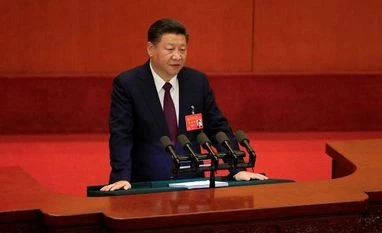
Chinese President Xi Jinping speaks during the opening of the 19th National Congress of the Communist Party of China at the Great Hall of the People in Beijing, China. (Photo: Reuters)
Chinese President Xi Jinping speaks during the opening of the 19th National Congress of the Communist Party of China at the Great Hall of the People in Beijing, China. Photo: Reuters.
Christian Shepherd & Stella Qiu | Bloomberg Beijing
Last Updated : Oct 19 2017 | 1:55 AM IST
Chinese President Xi Jinping on Wednesday laid out a confident vision for a more prosperous nation and its role in the world, stressing the importance of wiping out corruption and curbing industrial overcapacity, income inequality and pollution.

Opening a critical Communist Party congress, Xi pledged to build a "modern socialist country" for a "new era" that will be proudly Chinese and steadfastly ruled by the party but open to the world.

Although his wide-ranging address made clear there were no plans for political reform, Xi said China's development had entered a "new era", using the phrase 36 times in a speech that ran nearly 3-1/2 hours.

The twice-a-decade event, a weeklong, mostly closed-door conclave, will culminate in the selection of a new Politburo Standing Committee to rule China's 1.4 billion people for the next five years, with Xi expected to consolidate his control and potentially retain power beyond 2022, when the next congress takes place.

The 64-year-old Xi, widely regarded as the most powerful Chinese leader since Mao Zedong, spoke to more than 2,000 delegates in Beijing's cavernous, red-carpeted Great Hall of the People, including 91-year-old former president Jiang Zemin.

Security was tight on a rainy, smoggy day in the capital. As expected, the speech was heavy on aspiration and short on specific plans.

On the economy, Xi said China would relax market access for foreign investment, expand access to its services sector and deepen market-oriented reform of its exchange rate and financial system, while at the same time strengthening state firms.

During Xi's first term, China disappointed many investors who had expected it to usher in more market-oriented reforms, especially in the debt-laden state sector.

"If Xi gets the political mandate that he is expected to out of the congress, then my hope is that the state sector reforms actually get done," Damien Ma, fellow and associate director at US thinktank the Paulson Institute, told the Reuters Global Markets Forum.

"If not, then I would also revise my assessment of the state of reforms in China. There have been talks in Beijing that the state sector will be a focus after the 19th party congress, so we need to see."

The European Union Chamber of Commerce in China said it welcomed commitments to open wider the door and treat all companies equally, but said European companies operating in China continued to suffer from "promise fatigue".

"The only cure for this is promise implementation," it said in a statement. In what was probably an indirect reference to US President Donald Trump's "America First" policy, Xi promised that China would be fully engaged with the world, and reiterated pledges to tackle climate change. 

Trump this year opted to withdraw the United States from the Paris climate pact. "No country can alone address the many challenges facing mankind; no country can afford to retreat into self-isolation," Xi told the delegates, among them Buddhist monks, Olympic medalists, farmers and at least one astronaut.
Xi set bold long-term goals for China's development, envisioning it as a "basically" modernised socialist country by 2035, and a modern socialist "strong power" with leading influence on the world stage by 2050.

But he signalled there would be no significant political reforms, calling China's system the broadest, most genuine, and most effective way to safeguard the interests of the people.
Xi has overseen a sweeping crackdown on civil society, locking up rights lawyers and dissidents and tightening internet controls as he has sought to revitalise the Communist Party and its place in contemporary China.

One subscription. Two world-class reads.

Already subscribed? Log in

Subscribe to read the full story →
*Subscribe to Business Standard digital and get complimentary access to The New York Times

Smart Quarterly

₹900

3 Months

₹300/Month

SAVE 25%

Smart Essential

₹2,700

1 Year

₹225/Month

SAVE 46%
*Complimentary New York Times access for the 2nd year will be given after 12 months

Super Saver

₹3,900

2 Years

₹162/Month

Subscribe

Renews automatically, cancel anytime

Here’s what’s included in our digital subscription plans

Exclusive premium stories online

  • Over 30 premium stories daily, handpicked by our editors

Complimentary Access to The New York Times

  • News, Games, Cooking, Audio, Wirecutter & The Athletic

Business Standard Epaper

  • Digital replica of our daily newspaper — with options to read, save, and share

Curated Newsletters

  • Insights on markets, finance, politics, tech, and more delivered to your inbox

Market Analysis & Investment Insights

  • In-depth market analysis & insights with access to The Smart Investor

Archives

  • Repository of articles and publications dating back to 1997

Ad-free Reading

  • Uninterrupted reading experience with no advertisements

Seamless Access Across All Devices

  • Access Business Standard across devices — mobile, tablet, or PC, via web or app

Next Story



