In Bengal, a rice economy rots away on food habits, subsidy
Mill closures swell bank NPAs
Namrata Acharya Kolkata The closure of 500 of 1,200 rice mills in West Bengal over two years is weighing heavy on the non-performing loans of banks. Changing food habits, rising food subsidy and falling exports have brought the rice economy in Bengal, the highest rice producing state in the country, to the verge of a crisis.
ALSO READ: Basmati rice exporters in a fix over falling prices With the size of loans of rice mills between Rs 4 crore and Rs 15 crore, and around 200-250 accounts turning into NPAs in the past few months, the amount of NPA addition could be between Rs 800 crore and Rs 3,000 crore, according to DN Mondol, president of the Bengal Rice Mills Association.
“The market for rice in West Bengal is shrinking, and there is no upgradation in technology. The parboiled rice produced in Bengal was in high demand in eastern India, Bangladesh and Africa. However, Bangladesh has attained self-sufficiency in rice, leading to a shrinkage of exports. Due to lifestyle changes, the consumption of rice is also going down. The mills have also complained about delays in payment for levy rice,” said the manager of a public sector bank in Burdwan district.
West Bengal produces 15 million tonnes of rice every year, mostly rice that has been partially boiled in the husk. Of this, the state government procures 2.2 million tonnes through the levy mechanism.
ALSO READ: Basmati rice acreage to go up despite lower realisation last year Ever since the Trinamool Congress government came to power, the procurement has more than doubled from around one million tonnes. Much of this owes to the state government’s scheme for providing 35 kg of rice per month at Rs 2 a kg in the Naxal-affected blocks of the state.
Under the levy mechanism, mills last year procured paddy at around Rs 1,310 a quintal, while the government bought rice from the mills at Rs 2,060 a quintal. The effective cost for mills for buying a quintal of rice works out to Rs 2,046 because a quintal of paddy yields 64 kg of rice.
ALSO READ: Divide and conquer approach to tackle NPAs: Jayant Sinha However, the profit of Rs 14 per quintal turns into a loss of over Rs 50, when the cost of milling and transport is added. According to mill owners, against the Rs 80 per quintal cost of milling, the government provides only Rs 25 per quintal.
The market price of paddy, on the other hand, is lower than the government procurement price. At present the market price of rice is Rs 1,700-1,800 per quintal. Moreover, earlier, around three million tonnes of rice from West Bengal was exported annually to Bangladesh. This has come down to nearly 700,000 tonnes.
The demand for parboiled rice has also declined substantially as rising income has led the demand shift to better quality rice. In the rural market, the key market for parboiled rice, demand for non-PDS rice has shrunk because of government subsidy schemes.
Data from the NSSO survey on household consumption suggests between 2004-05 and 2011-12, the monthly per capita consumption of rice in urban areas declined from 6.77 kg to 6.24 kg. The monthly per capita consumption of PDS rice in rural areas increased from 0.61 kg in 2004-05 to 0.95 kg in 2011-12. But the monthly per capita demand for rice from non-PDS sources in rural areas decreased from 9.08 kg to 8.97 kg.
The trend is not restricted to West Bengal, as per capita monthly rice consumption in rural India declined to 5.98 kg in 2011-12 from 6.38 kg in 2004-05. In urban India, the fall in rice consumption was 0.2 kg per person per month. Per capita consumption of PDS rice has, however, doubled in rural India and risen by 66 per cent in urban India since 2004-05, implying the share of PDS purchases in rice consumption has risen substantially, according to the NSSO.

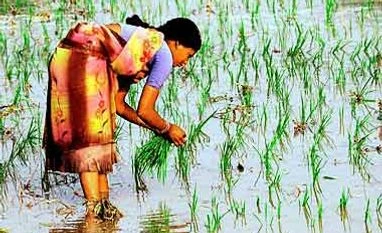 "In Bengal, a rice economy rots away on food habits, subsidy")

