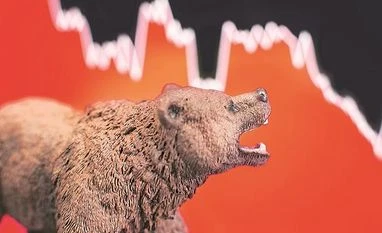
Equity markets have suffered deep losses relentlessly in the last three sessions amid downbeat global sentiment and heightened fears in anticipation of interest rate hikes by the US Federal Reserve. The BSE Sensex has shed 1,844 points from Monday's close ending at 59,464 level today, way below the 60K-mark. The NSE Nifty, on the other hand, has lost 552 points during this time as it closed at 17,757 level today.
A number of factors are at play as to why the markets have turned bleak recently, most of which are broadly related to global apprehensions around high oil prices, inflation and faster-than-expected interest rate hikes by central banks.
Bond yields: Another factor that is seen dealing a huge blow to investors’ confidence is the continuous rise in bond yields globally, which is driving the markets away from riskier assets. Amid increased speculation that the Federal Reserve could deliver more than a 25-basis-point rate hike in March, investors are positioning themselves that is being reflected in the bond yields. Federal Reserve Governor Christopher Waller has reportedly said there may be even as many as five hikes this year, depending on inflation levels.
On Wednesday, the 10-year Treasury yield in the US rose to 1.9 per cent, its highest level since December 2019. The US markets, consequently, have seen a huge sell-off in the last few sessions with the Nasdaq benchmark now down over 10 per cent from its 2021 November highs.
Back home, the 10-year government bond yield hit a two-year high on Monday, following peers globally. The benchmark 10-year bond yield rose to 6.64 per cent on Monday, its highest since January 22, 2020.
“In light of these headwinds, investors are advised to stick to the safety of high quality large-caps in performing sectors like IT, financials and construction. Many low-grade small-caps driven by speculation are heading for disaster,” said V K Vijayakumar, Chief Investment Strategist at Geojit Financial Services.
Profit booking ahead of Budget: With merely 10 days left for the Union Budget for FY23 to be announced, the market participants are trying to tread cautiously amid high levels of volatility. Further, given high valuations that the market has been commanding over the last weeks, such profit-booking remains on cards.

 "Sensex falls 1,800 points in 3 days. Here's what is spooking the markets?")












 Connect with us on WhatsApp