Survey gives a boost to commodity futures
Commodity futures trading is essential as it generates forecasts about future prices that shape sowing and storage decisions across the country: Survey
BS Reporter Mumbai Economic Survey 2013-14 has given a thumbs-up to commodity futures, saying, “Commodity futures trading is essential for a modern food sector, as it generates forecasts about future prices that shape sowing and storage decisions across the country.”
This comes as relief for market participants, as most feared harsh action related to essential commodities. A 2011 report by a committee headed by then Gujarat chief minister Narendra Modi had opposed futures trade in essential commodities.
The survey, recommended, “Procurement agencies can use this platform to their benefit by hedging their future requirements on a regular basis, according to the provisions of the NFSA (food security Act)”
The survey also said the Price Dissemination Scheme, under which prices at 1,700 mandis were disseminated to 267 Agricultural Produce Marketing Committees, should now be used for all markets.
Opposing sudden bans related to futures trade, as well as their withdrawals, the survey sought commodity futures market trends be used to understand price trends. “It thus facilitates the government to take pre-emptive action, whenever required. They help farmers take decisions about the cropping pattern and the investment intensity of cultivation, as well as improve their bargaining capacity. They also help manufacturers hedge their requirement of raw materials and their finished products.”
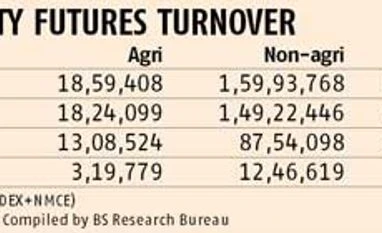
Currently, only 46 of the 113 commodities notified for futures trading are actively traded on six national exchanges and 11 commodity-specific exchanges. In 2013-14, futures trading in agricultural commodities accounted for 15.8 per cent of the total turnover, with food items (refined soya oil, soyabean, chana, rapeseed/mustard seed and coriander) contributing 55.56 per cent, and non-food items (castor seed and cotton) 17.46 per cent. Compared to 2012-13, the total volume of trade declined 39 per cent, while that of agri-trade fell 18 per cent.
In September 2013, the Forward Markets Commission (FMC), regulator of the commodity futures market, was brought under the administrative control of the finance ministry.

 "Survey gives a boost to commodity futures")


 Connect with us on WhatsApp