A long road ahead for Biden in Asia

Finally, Mr Biden made waves when he appeared to confirm American military involvement in the event of a Chinese attack on Taiwan
Joe Biden
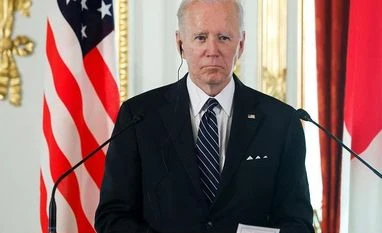
US President Joe Biden in Tokyo, Japan ahead of Quad summit. (Photo: Reuters)
Harsh V PantShashank Mattoo
4 min read Last Updated : May 26 2022 | 10:52 PM IST
More than 16 months after taking office, President Joe Biden stepped off Air Force One and onto Asian soil for the first time in his presidency. His four-day visit coincided with a slew of diplomatic initiatives: Bilateral summits with allies like South Korea and Japan, the Quad Leader’s Summit and the much-awaited launch of the Indo-Pacific Economic Framework (IPEF).

Mr Biden’s visit had three main goals. His first aim was to reaffirm and strengthen America’s alliances in Asia through bilateral meetings with Japanese Prime Minister Fumio Kishida and the newly elected President Yoon Suk-yeol of South Korea. In his interactions with both leaders, Mr Biden took pains to reaffirm some standard but foundational American policies in Asia. America’s allies committed themselves to dealing with North Korea’s nuclear challenge, securing freedom of navigation in the Indo-Pacific, redrawing the global supply chains and staring down the Chinese threat over Taiwan. Washington will be particularly heartened by the election of a conservative Administration in Seoul that shares much of its worldview. While earlier South Korean governments hid behind bureaucratese and refrained from explicitly endorsing the American vision of a “free and open Indo-Pacific” for fear of offending Beijing, Mr Yoon’s administration gave a ringing endorsement. Most significantly, Mr Yoon reiterated his country’s interest in working with the Quad and even indicated the possibility of repairing Seoul’s battered relationship with Tokyo.
 
So far, so good. Mr Biden’s second aim, countering Chinese influence, met with some modest success. Seoul moved to expand its defence partnership with Washington by growing joint development and manufacturing of defence goods, which will prove a shot in the arm to America’s military alliances in the region. Tokyo's commitment to increase defence expenditure will go some way to lightening Washington’s considerable military burden in the region. Further, Washington has found that it is pushing on an open door with another of its major priorities: Redrawing the global supply chains to reduce dependence on China. Regional capitals have long recognised that Beijing’s overweening ambitions in Asia stem directly from its dominance in manufacturing key industrial products. Japan’s new economic security law and the Quad’s efforts on supply chain resilience dovetail with Washington’s ambitions. Washington’s growing diplomatic investment in the Quad is also reassuring to many of its regional partners that the US is in the region for the long haul.

Finally, Mr Biden made waves when he appeared to confirm American military involvement in the event of a Chinese attack on Taiwan. While American diplomats fell over themselves in an attempt to qualify his comments, Taiwan and Japan saw it as an “excellent gaffe”. Taken together with a pledge to protect Japan’s Senkaku Islands from Chinese aggression, Mr Biden’s Asia trip will soothe any frayed nerves among the region’s military and political leadership as to the depth of American military commitment to Asia. 

Finally, Mr Biden’s Asian sojourn gave him the perfect opportunity to launch the IPEF. Touted as the American response to China’s economic dominance, the IPEF will serve as a forum for 13 regional economies to frame rules for the digital economy and hammer out joint responses to climate change and supply chain shocks, among other things. Washington’s hope was that the IPEF would provide a much-needed economic complement to America’s military-heavy strategy in Asia. On this, the Biden Administration has arguably failed to deliver. Over seven months after it was first announced, details regarding the IPEF remain puzzlingly scarce and what we know so far isn’t encouraging.

To begin with, Washington has made painfully clear that it does not expect to make trade concessions in the form of reduced tariffs or increased market access. Meanwhile, it expects regional developing economies, many of which are still suffering from the economic aftershocks of the pandemic, to make expensive and politically difficult commitments to reduce emissions, enforce anti-corruption measures and raise labour standards. With no real incentives on offer, the IPEF seems headed for irrelevance if the course is not corrected soon. It is a strategic imperative for the US to leverage its considerable influence in the region to make a dent in China’s growing economic sphere of influence. Without it, the geopolitical headwinds in the region won’t be effectively managed.

As the US president wrapped up his brief sojourn and headed home, North Korea launched a parting shot in the form of an Inter-Continental Ballistic Missile as a reminder of its deadly capabilities. It was a stark and sober reminder of the task the Biden Administration has ahead of it in Asia.
The writers are, respectively, vice president-studies at Observer Research Foundation (ORF), New Delhi and Professor at King’s College London, and research assistant at ORF

One subscription. Two world-class reads.

Already subscribed? Log in

Subscribe to read the full story →
*Subscribe to Business Standard digital and get complimentary access to The New York Times

Smart Quarterly

₹900

3 Months

₹300/Month

SAVE 25%

Smart Essential

₹2,700

1 Year

₹225/Month

SAVE 46%
*Complimentary New York Times access for the 2nd year will be given after 12 months

Super Saver

₹3,900

2 Years

₹162/Month

Subscribe

Renews automatically, cancel anytime

Here’s what’s included in our digital subscription plans

Exclusive premium stories online

  • Over 30 premium stories daily, handpicked by our editors

Complimentary Access to The New York Times

  • News, Games, Cooking, Audio, Wirecutter & The Athletic

Business Standard Epaper

  • Digital replica of our daily newspaper — with options to read, save, and share

Curated Newsletters

  • Insights on markets, finance, politics, tech, and more delivered to your inbox

Market Analysis & Investment Insights

  • In-depth market analysis & insights with access to The Smart Investor

Archives

  • Repository of articles and publications dating back to 1997

Ad-free Reading

  • Uninterrupted reading experience with no advertisements

Seamless Access Across All Devices

  • Access Business Standard across devices — mobile, tablet, or PC, via web or app

More From This Section

Disclaimer: These are personal views of the writer. They do not necessarily reflect the opinion of www.business-standard.com or the Business Standard newspaper

Topics :Joe BidenBS Opinion

Next Story



