Coronavirus is third shock to Indian economy in a little over 3 years

The impact of the shutdowns on the economy would show up later; but the shutdowns would help contain the spread of the virus
Coronavirus is third shock to Indian economy in a little over 3 years
Mahesh Vyas
5 min read Last Updated : Mar 17 2020 | 6:58 AM IST
The coronavirus pandemic is the third shock to the Indian economy in a little over three years. The economy will not escape unhurt. More importantly, households are likely to be hit through loss of jobs and/or earnings.

The impact of such economic sho­cks on the labour markets is usually on the young who delay their entry in­to the labour market in response to a fall in job opportunities. This shows up in a fall in the labour force participation rate. And, quite perversely, leads to a fall in the unemployment rate.

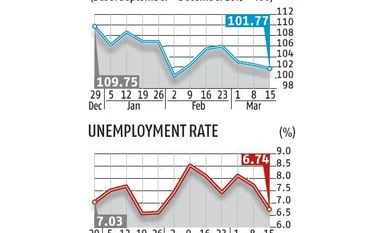
The labour participation rate did plummet in the last week of February to below 42 per cent. It was 41.96 per cent. It continued to remain close to 42 per cent in the following two weeks at 42.1 and 42.3 per cent. The lowest monthly labour force participation recorded so far was 42.3 per cent in November 2019. India may test such levels again this summer. The unemployment rate fell to 6.7 per cent in the week ended March 15.

The two shocks of the recent past have shown a lesser impact on employment. Employment did fall, but not as severely as the labour participation rate or the employment rate.

The coronavirus impact began working initially through the supply shock of China’s shutdown, then through the impact of travel bans across the globe and finally through the awareness or enforcement of social distancing. So far, India is spared the impact of widespread deterioration in health of workers.

We expect the impact of the coronavirus shock on the labour markets to show in the data for April and May. Labour statistics of March could provide the first glimpse.

In the meanwhile, the slowdown in economic activities is palpable in train stations, bus stands, malls and markets in general. The small uptick in industrial production and an equally welcome fall in inflation announced last week passed without much ado. They seemed to belong to a different world. The world we face today is full of new challenges and uncertainties.

India is lucky to remain relatively safe so far. But the Indian economy is too weak and Indian medical facilities are grossly inadequate to deal with a serious health challenge, if it were to strike.

The World Travel and Tourism Council has projected that travel could fall by 25 per cent in 2020 putting to risk 12-14 per cent of the jobs in the sector. This translates into 50 million jobs at risk, globally. Of this, 30 million jobs at risk would be in Asia. Tourism accounts for 10 per cent of global GDP and jobs according to the council.

According to estimates from CMIE’s Consumer Pyramids Household Survey, travel and tourism accounts for 5 per cent of the total employment in India.

Travel and tourism accounts for nearly 20 million jobs in India. Hotels and restaurants account for another four million jobs. Employment in the travel and tourism industry has been on a declining gradient since late 2017. The sector has already lost over two million jobs since then. The hotels and restaurant sector has lost fewer jobs. But even this is on a sloppy gradient.

With government restrictions on travel by foreigners into the country, these sectors may be expected to see a further hit in employment. The Indian Association of Tour Operators expects a loss of 1.2 million tourists on a base of 10 million, following government restrictions. Airlines have been asked to waive cancellation charges. This would lead to a welcome increase in cancellations as this would help contain the spread of the virus. But the collateral damage would be a further slowing down of the economy and a possible loss of jobs.

Newspaper reports suggest that malls and restaurants have registered a 30-35 per cent fall in footfalls. BEST buses in Mumbai reported a three per cent fall in riders over a week. Ola and Uber have also reported a fall in traffic. The shutdowns have just begun in large cities. The impact of the shutdowns on the economy would show up later. But this would help contain the spread of the virus.

From a health perspective, the most vulnerable are senior citizens. Most global fatalities are among senior citizens of over 80 years of age with prior respiratory conditions. But 80 years is not a magical cut-off. The gradient of risk starts rising after 60 years of age. Data from China show that fatality rate till age 59 is less than 1.3 per cent. It rises to 3.6 per cent for those in their 60s, then to 8 per cent for those in their 70s and then to 14.8 per cent for those in their 80s.

We estimate that in India, there are well over 100 million who are over 60 years of age. There are nearly 69 million who are over 65 years of age.

According to CMIE’s Consumer Py­ramids Household Survey only 3.5 million are employed in the health care industry. This includes doctors, nurses, dental practitioners, midwives etc. India is ill-equip­ped to deal with the scale of testing and treatment that a coronavirus pandemic requires. Containment is the best strategy.


One subscription. Two world-class reads.

Already subscribed? Log in

Subscribe to read the full story →
*Subscribe to Business Standard digital and get complimentary access to The New York Times

Smart Quarterly

₹900

3 Months

₹300/Month

SAVE 25%

Smart Essential

₹2,700

1 Year

₹225/Month

SAVE 46%
*Complimentary New York Times access for the 2nd year will be given after 12 months

Super Saver

₹3,900

2 Years

₹162/Month

Subscribe

Renews automatically, cancel anytime

Here’s what’s included in our digital subscription plans

Exclusive premium stories online

  • Over 30 premium stories daily, handpicked by our editors

Complimentary Access to The New York Times

  • News, Games, Cooking, Audio, Wirecutter & The Athletic

Business Standard Epaper

  • Digital replica of our daily newspaper — with options to read, save, and share

Curated Newsletters

  • Insights on markets, finance, politics, tech, and more delivered to your inbox

Market Analysis & Investment Insights

  • In-depth market analysis & insights with access to The Smart Investor

Archives

  • Repository of articles and publications dating back to 1997

Ad-free Reading

  • Uninterrupted reading experience with no advertisements

Seamless Access Across All Devices

  • Access Business Standard across devices — mobile, tablet, or PC, via web or app

More From This Section

Disclaimer: These are personal views of the writer. They do not necessarily reflect the opinion of www.business-standard.com or the Business Standard newspaper

Topics :CoronavirusConsumer Sentiment IndicatorCMIEUnemployment in IndiaEmployment in IndiaJobs India

Next Story



