It has been whispered for a while that
B N Goswamy, one of the country's leading art historians and the pre-eminent scholar of Indian miniature painting, has been labouring on a unique composition of his own. That rumour became reality this week with the publication of
The Spirit of Indian Painting: Close Encounters with 101 Great Works, 1100-1900 (Penguin; Rs 1,499). The book is not a conventional coffee table tome, though with 570 full colour pages, it has the heft of a bicep-building dictionary -three public-spirited foundations contributed Rs 5 lakh each to defray publication costs. Advance praise has been huge, from artists like Krishen Khanna and Gulam Mohammed Sheikh to museum directors such as Neil MacGregor of the British Museum and Glenn Lowry of the Museum of Modern Art. The British painter Sir Howard Hodgkin, who owns an important collection of miniatures, says, "In all the years I have been involved with Indian art, I have repeatedly been asked to recommend a book which covers the whole subject. This is it. This is it. This is it."
Goswamy is Professor Emeritus of Art History at Panjab University and makes his home in Chandigarh, where he has taught for most of his 81 years. Being as celebrated a public speaker and guest curator as he is a teacher, he is often on the move with a calendar packed with engagements. Home away from home is often the India International Centre in New Delhi, so the Lodi Garden restaurant, round the corner, is the perfect place to meet. I find him installed ahead of time at a first floor table, looking as if he's just breezed in from a round of golf. With his balding pate and clipped moustache, his navy jersey offset with a smart silk cravat, hearty laugh and quick lapse into salty Punjabi and Urdu verse at discovering a fellow speaker, he reminds me of a warm-hearted uncle who retired as a brigadier.
Actually, his life has been no less adventurous than a soldier's - long forays into remote parts of the countryside, cultivating sources with buried secrets and cross-examining evidence in obscure scripts. As Goswamy describes it, an art historian's life is not all swotting in libraries and sifting through dusty pictures - though it is that, too - but requires the physical resilience and strategic mind of a camp commander.
Goswamy is vegetarian and has functioned for many years with one kidney, having lost the other to an infection. He orders a vegetable lasagna and
nimbu paani; I ask for a vegetarian mezze platter and Coke. But soon, we are so absorbed in conversation that we barely notice the food's arrival.
Decoding the mysterious world of a miniature, he writes in his book's introduction, is "like a great floral carpet that lies rolled up but can be spread out endlessly, revealing new things with each mellow unfurling." Titled
A Layered World, the 40,000-word essay, written with authoritative ease, is his attempt to explain to viewers - newcomer and connoisseur alike - on how to "read" a painting. Like a pyrotechnic display, it is filled with illuminating insights and dazzling diversions. Why, for instance, can a figure recur several times in the same picture? It is a painterly device to "stretch time, to render it elastic and malleable." (Interestingly, the convention occurs in Hindu but not Islamic subjects.) Why do perspectives sometimes shift in a miniature - a garden may appear as observed from some distance but its central fountain is painted as seen from above? Because the painter wants to provide several points of view for his audience. Why does an unusual portrait of Jahangir, circa 1610, show him holding a portrait of his father Akbar and gazing reverentially at it? Strife had marked the father-son relationship in later years, with the rebellious prince setting up a parallel court as Akbar lay dying; the newly-crowned Jahangir now publicly wants to express reconciliation and atonement.
I notice that Goswamy's lasagna is lying virtually untouched. Instead, he seems mildly interested in my plate of pita bread, hummus, baba ganoush and falafel, picking at them absently.
We order cappuccinos and move to the terrace, shaded by a canopy of high trees and ringing with the cries of distant picnickers in Lodi Garden.
The Spirit of Indian Painting will stir, surprise and even shock the reader. His choice of 101 masterpieces (from a gigantic corpus of hundreds of thousands painted over 800 years) comes from about 40 museums and private collections in the world. But they are not always scenes of sensual delight and courtly splendour, epic storytelling and religious fervour. The suffering of old age and sickness, and the brutality and horror of human life is also present.
The Capture and Death of Khan Jahan Lodi from Shahjahan's reign is a bloodthirsty picture of a traitor's beheading: the Emperor's soldiers crowd round Lodi in a graphic political assassination.
When the Lamp of Life is Extinguished is a haunting Akbar period image of a suicide: a lonely young man is shown hanging from the roof in his chamber; the upturned stool bears witness to how he took his life. In both paintings, however, the violence is counterpointed with flashes of exquisite beauty: in the first a resplendent chinar tree and flower-filled meadow appear above the killing; in the second a gorgeous peacock struts on the roof of the house where the hanging occurred. It is the painters' way of suggesting, says Goswamy, that despite its unfolding terrors, life goes on.
Goswamy comes from a family of Bengali migrants long-settled in Punjab. He was born in Sargodha, now in Pakistan, where his father was a judge; at Partition, the family found itself in Amritsar where Manmohan Singh was a classmate in school. Professionally, however, he can claim descent from a line of distinguished civil servants-turned-art historians, among them W G Archer, M S Randhawa, N C Mehta and J C French of the Indian Civil Service. In 1954, he topped his Master's in History from Panjab University, sailed into the Indian Administrative Service, and was posted to Gaya in Bihar. But a couple of years later he resigned. His boss wrote to his father to ask his son to desist from taking the drastic decision. "My father wrote back saying if he's bright enough to get into the IAS, then he must be bright enough to make his choices." After a spell of teaching history in Hoshiarpur, the best he was offered was a monthly fellowship of Rs 276 in Chandigarh to research his PhD on "The Social Background of Kangra Valley Painting." Archer, at London's Victoria & Albert Museum, was appointed his examiner. His mentors, Randhawa and Archer, were remarkable minds but they had their drawbacks. "Dr Randhawa tended to lump all Pahari paintings broadly under the Kangra school whereas Mr Archer was unable to read local scripts such as Takri." (Goswamy himself is fluent in Sanskrit, Farsi, German and hill dialects. "And you can't fool me in French," he says.)
Years of travel in villages and studying genealogical records guarded by
pandas (priests) led him to identify more than a dozen distinct schools of Pahari painting - Nurpur, Guler, Basohli, Jasrota among them - that flourished in the 17th-18th centuries under hill rajas, and conclude that styles varying from "hot intensity…to cool elegance" evolved not from locations but from families, as in gharanas of Indian music. His Eureka! moment came when he discovered nine lines of precious family history inscribed in the hand of the master painter Nainsukh of Guler in one such priestly register.
Does he have a photographic memory? Goswamy reckons he must have scrutinised about 150,000 miniatures in his lifetime and can clearly recall more than a thousand. But he is fond of quoting the Bengali adage: "In a bamboo forest a bamboo cutter can go blind." Choosing 101 great miniatures was an arduous test. And with his generous laugh he adds, "Of course, the sub-title of the book should have been, 'No One Has To Agree'."

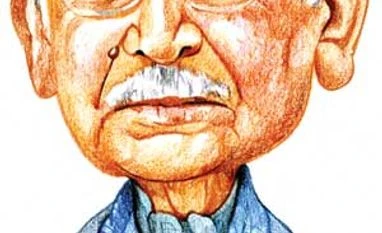 "<b>Lunch with BS:</b> B N Goswamy")


 Connect with us on WhatsApp