The Bharatiya Janata Party’s magnificent victory in Uttar Pradesh gives the central government enormous political space going forward. The 2019 general election is now its to lose; unless it errs on a truly monumental scale — and perhaps not even then — it will come back to power. This means that now, for the first time since the early months of the administration, it has the opportunity to implement meaningful change.
In some ways, the BJP has been playing defence since it was obliterated in the Delhi Assembly elections, less than a year after it came into office. It was forced further on the back foot by the Bihar assembly elections in 2015. But, with its comprehensive victory in UP behind it, there are few political hoops left through which it must jump in the years leading up to the general election. In addition, the BJP's massive superiority in narrative-building over the Opposition has been effectively demonstrated. Given that as politically problematic a move as demonetisation has redounded instead to its benefit, it can hardly feel now that it is constrained by regular political necessities.
How will the central government respond? At best, Prime Minister Narendra Modi could avoid the errors and timidities of his earliest months and re-commit to the kind of broader reform that gives him a chance of following up on the promises that he has made. A less sanguine possibility is that this opening will once again be squandered, with less excuse than in the first months of a new government’s term.
While the government has indeed introduced some important reforms — including the bankruptcy Bill and the goods and services tax — these have fallen well short of the slate of legislation and rule changes that seemed possible shortly after it was sworn in. The pressure on the government to reform has slackened since then, as more and more people realised that it was unable or unwilling to implement that slate of legislation and rule changes. But a government’s ability to legislate depends crucially on its perceived political heft, and thus the payoff to opposing it — and this government’s political heft at the moment is great indeed. Thus expectations of reform should now be reset to the pitch that they were at the beginning of the government’s term.
It should go without saying what constitutes the sort of broader reform that would be expected. But here is a short and partial list: Labour law reform at the Centre, towards which some very limited, halting progress has been made; privatisation of some white elephant public sector units; direct tax reform, including addressing the question of agricultural income; changes to the public distribution system and the Food Corporation of India; and proper arrangements for healthcare. Many of these have been suggested by the BJP’s 2014 manifesto, by Union ministers, or by the prime minister himself as being feasible or desirable in the past. Some would say only the desire to avoid spending valuable political capital was preventing the government from moving on them and related reforms. If so, that can no longer be a constraint, after UP.
It is important to note that, if BJP statements are to be taken at face value, the party believes it won a mandate in Uttar Pradesh for governance and job creation — an extension, if not a replication, of the mandate it received in 2014. It should be clear by now even to the most hardened supporter of the government that business-as-usual is not creating the jobs that were hoped for, or that these voters have been led to expect. Indian competitiveness simply has to increase if jobs are to be created at home. And that requires a more radical programme of structural change. In other words, the UP mandate not only provides the means for reform to take place, it should also remind the BJP of the importance of carrying out such reform as soon as possible.
It could be argued that the UP verdict, while a shot in the arm for the BJP, does not change anything fundamental in terms of numbers at the Centre. In other words, the Rajya Sabha is not immediately going to turn in the government’s favour. The Opposition still has a loud voice there, and will for a while longer. But that misses the point. First of all, governments with minorities but with big election victories behind them find it less difficult to manage parliamentary business than even those with majorities but which appear unstable and weak.
However, even more important is the fact that, with the addition of UP and Uttarakhand to the BJP’s stable of states, a vast contiguous swathe of India has the BJP in power at both central and state levels. The BJP and Mr Modi have so far ignored the opportunities for co-ordination that this has provided. Yet in UP the PM campaigned explicitly on the plank that a national party would provide a perspective to the state’s development that regional parties have not. Similarly, control of state governments and legislation give power to a national government to implement its agenda — the sort of power that can easily make up for being a few votes short in the Rajya Sabha.
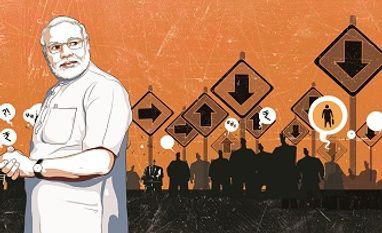
Illustration by Ajay Mohanty
I have argued earlier that the saffron belt in India’s north and west, which controls such a large proportion of India’s gross domestic product, can be revitalised whenever Narendra Modi wills. Minimal political capital is involved. And as the UP victory demonstrates, it is he who is personally popular enough to win state elections now even though he is not on the ballot, and even if there is a popular state leader standing against the BJP, and even if there is no BJP “face” for the chief minister’s post. The BJP’s CMs know it would be foolish to resist policy suggestions from the PM’s office at this point. The Centre has been quite forbearing with BJP states in terms of determining their policy choices so far, but that must now come to an end. “Competitive federalism” is all very well, but the PM has made a specific promise to the electorates in these states: That having the BJP in power at state and Centre would be good for governance. The party must act like it intends to live up to that promise. Greater regulatory co-ordination, a common commitment to particular kinds of fiscal restraint and governmental responsibility, shared physical and social infrastructure — these can all be brought into existence fairly swiftly in the BJP states. At one end of this saffron corridor, from the mountains to the sea, lie the unemployed masses of UP; at the other end lies the capital and promises of the coast. The BJP’s job is to connect them, and it now has the power to do so.
Disclaimer: These are personal views of the writer. They do not necessarily reflect the opinion of www.business-standard.com or the Business Standard newspaper