NASA’s DART (Double Asteroid Redirection System) Mission is a rare blue sky science project, which directly addresses a long-standing nightmare of mass extinction. It tests proof of concept for a planetary defence system, which could prevent a large asteroid from smashing into the Earth, or making a close fly-by with disastrous consequences. It is known that approximately 66 million years ago, a very large meteorite crashed into the Yucatan region of Mexico and caused the extinction of a large number of animal and plant species. It caused tsunamis and led to a nuclear winter that lasted a long time. It is estimated that the object was around 10 km in diameter and it caused a crater that’s 180 km wide and 2 km deep. Something similar almost happened in 1908, when a large meteorite smashed into an uninhabited part of Siberia with a force equivalent to a large nuclear bomb. Even a large meteorite burning up in the lower atmosphere could damage the ozone layer, or release enough energy to cause damage similar to a nuclear explosion.
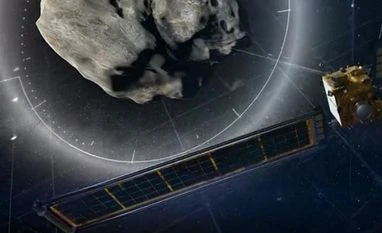
On average about 17 meteorites of substantial size hit the Earth every day (smaller ones burn up due to friction in the atmosphere). NASA’s Center for Near Earth Studies and multiple other astronomical institutions track meteors and classify large ones as potentially hazardous objects. But until DART there was absolutely nothing that people could do to safeguard the planet from a large flying rock that could trigger another extinction event. DART involved flying a small 550-kg vehicle about 11 million km to crash into a 10-billion kg rock that’s about the size of a football field. That rock, Dimorphos, orbits another much larger rock, Didymos. Dimorphos is so small in celestial terms that it was visible only when DART was around 4 hours’ flight time away. The onboard AI had to make late course corrections to ensure that it hit the rock. It did so, successfully. The kinetic energy imparted by the collision should be enough to slightly alter the orbit of this dual-asteroid system. The outcome will be watched by more or less every eye in the sky, including a small cube satellite Licia, which was dropped off by DART to observe the collision from close range. A later mission is planned to study the impact consequences and the geology of these two
Since DART appears to have worked, scientists can now conceive a similar mission possibly involving a large nuclear warhead if there’s a future emergency. However, it must be noted that DART was planned for several years, and the vehicle was launched in November 2021 in order to intersect Dimorphos ten months later. Observational capabilities will need to be good enough to afford this sort of lead-time if there is indeed a hazardous object heading on a collision course. Given the eccentric movements of relatively small objects like these the interceptions must happen at a distance of several million km. As with most technology demonstrations, there is a dark side to this. The equipment and technologies tested by DART could save the Earth from meteors. It could also be used for military purposes. Given mankind’s propensity for weaponising everything, it probably will be, at some stage in the not too distant future.

 "Saving the world")












 Connect with us on WhatsApp