Canada’s young prime minister and global liberal star, Justin Trudeau, first made the term “hyphenated liberal” popular, even if he was using it in a limited way to rally together his party men, divided among many factions, each linked to a leader whose ideas it followed, notably Jean Chretien and Paul Martin. I am, therefore, claiming authorship, at least in our domestic context, to the idea of dehyphenated liberalism. If liberalism means viewing ideas, issues, people with an open mind, can it survive being qualified with a hyphenated allegiance?
Left and Right will only be the two broadest choices, with “centre” thrown in for the lazy and indecisive. In India, it could also be a liberalism drawn from the gentler socialism of Nehru, deeper pink of Indira, a kind of saffron pink (yes, such a thing exists today) of Deen Dayal Upadhyaya.
Or you can pick one of a hundred choices. Start on the left: From widely respected social scientist Partha Chatterjee, who found Gen. Rawat “echoing” Gen. Dyer, and then put our liberal commitment to a higher test by insisting that the tribal states of the northeast and Kashmir were India’s colonial possessions — the northeast, a bequest from the British; and Kashmir, a conquest of our own — never mind how the Constitution defines the republic (republic as in the nation, not the TV channel that claims to speak for it).
Or swing all the way to the right, and join Tarun Vijay of the RSS, who fights for Dalit equality in temples, and wants the Delhi Golf Club de-licensed and converted into a cultural centre for the northeast because of its racist insult of a Meghalaya tribal. Never mind again that his own ideology is engaged in a brutal campaign to deny the same ethnicities their normal food (beef for northeast tribals) and the same Dalits their living, leather, and shoe-making. More contemporarily, you could also be judged depending on whether or not you went to the Jantar Mantar protest, or used the hashtag #NotInMyName. Both of which tests this writer fails.
Labels are chips on our shoulders. The heavier the label, the greater the burden, and it makes it that much tougher to keep open minds, or, if you do, answer searching questions. “Why do you keep switching sides? Can’t you decide which side you are on? Why are you being a weathercock, or, more apt and contemptuous in Hindi, a thaali ka baingan” (shifting sides like a baseless brinjal on a plate)? You can hear it from the Left when you praise Prime Minister Narendra Modi’s reformist move in selling off Air India, after attacking him and his ideology over beef-lynching. Then, from the Right, when you condemn an Army major’s use of a human shield after a track record of muscularly backing India’s case on Kashmir with few ifs-and-buts. How can you be with India and not the Indian Army? Or questioned by even the Centre, when you call that Rawat/Dyer comparison a flaky clickbait. How dare you, when you know the scholar’s reputation?
There are simple answers to all three sets of questions. First, just as two wrongs don’t make a right, a dozen wrongs do not so erase a right so you can’t refuse to accept it exists. Second, supporting your country and its Army doesn’t mean you unthinkingly back the constitutionally illegal and militarily immoral action of one of its officers out of tens of thousands who would never do such a thing. And third, what has reputation got to do with facts? And if an intellectual’s reputation was to justify shutting the rest (ok, the lesser ones) out of the debate, it isn’t liberal. You might still insist that it is, but find a hyphen to fit your definition.
Much has been written and debated on these issues globally. The rise of Trump, Brexit and the fear of Le Pen, also the further radicalisation of the counter, as in Bernie Sanders’ Democrats and Jeremy Corbyn’s Labour also find a parallel in the Modi-Shah BJP shifting to harder saffron nationalism and its rivals to sharper, hyper-liberalism. One side, therefore, will lock up JNU students allegedly shouting “Bharat tere tukde” slogans with sedition charge, while the other would land up on their campus in their defence. The result: The former wins. The loser is the liberal Indian, who believes in individual freedoms, to shout slogans as much as to disagree with them. Also, that these freedoms are best protected if my republic and its Constitution remain intact. Further, that use of force to protect both is legitimate and also a moral responsibility of a duly established constitutional state. Annihilating a Maoist hideout (as in Odisha last year) would therefore be applauded, as the killing of Burhan Wani, but use of a non-combatant Kashmiri as human shield would be contested, as use of sedition law against slogans.
Significant works have emerged lately bemoaning the end of the liberal era. Fareed Zakaria foresaw the shift (“The Rise of Illiberal Democracy”, Foreign Affairs) and another name we are familiar with, The Financial Times’ former India correspondent Edward Luce (The Retreat of Western Liberalism) analysed what fuelled it, beginning with the failure of nearly two dozen democracies since the end of the Cold War, led by Russia. Turkey is headed there. American media theorist Douglas Rushkoff (Present Shock: When Everything Happens Now) told us it was all attributable to the impatience of our times when attention spans are shorter, conventional narratives with beginning, middle and end are collapsing and we are all living in the present, though not in the way our meditation gurus would want us to. We are trapped in a continuous churn, having lost our ability to question or make choices. In such a frantic fix, it is tempting to pick the box that makes you most comfortable, and keep trading fire with those in the opposite box. The result, as with all trench-warfare, is wide open space in the middle.
The landslide of Emmanuel Macron demonstrates how useful this open space can be, if you have the audacity to move out. At a time when The Guardian, that final defender of left-liberalism, is breathlessly celebrating the small gains of Jeremy Corbyn as having ended the Blairite notion that you had to move to the centre to win an election, Macron’s rise, Trump’s falling ratings, Angela Merkel’s consolidation and regret over Brexit all prove that too much middle-ground has been abandoned, too lazily.
The Macron phenomenon has, therefore, added to our vocabulary: Radical Centre, muscular middle, and so on. Since Indian intellectuals traditionally borrow from the West, especially Europe, it will be tempting to limit the new debate to these new boxes, made of the same ideological ticky tacky, and the choices will still all look just the same.
Wisdom is sometimes found in unusual places. Like the mind of the copywriter who wrote e-Commerce brand Snapdeal’s tagline: Unbox Zindagi. We Indian liberals need to unbox. To build an idea that’s liberal on society, liberal on economy, uncompromising on constitutional sanctity and national security, accepting no “root-causes” excuse for terrorism or Maoist violence. Then you won’t need to go to Jantar Mantar or promote hashtags to prove anything, to either side. May I suggest a mission statement for this dehyphenated liberal: The Left thinks I am Right, the Right thinks I am Left, so I get trolled by both.
Twitter: @ShekharGupta

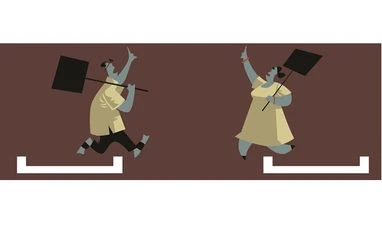 "<b>Shekhar Gupta: </b>A case for dehyphenated liberalism")












 Connect with us on WhatsApp