Shekhar Gupta: Buried, cremated, reborn

Nehruvian secularism gave minorities many privileges. Modi's BJP has redefined it using Triple Talaq
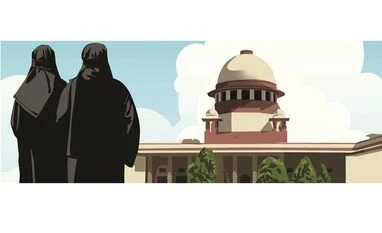
Triple Talaq, Triple Talaq SC
Illustration by Binay Sinha
Shekhar Gupta
Last Updated : May 19 2017 | 11:15 PM IST
Today’s intellectual and philosophical polarisation (I have carefully excluded “political”) over the ongoing campaign to abolish triple talaq for the Muslim women is a more complex story than the Supreme Court hearings or the usual TV “debates” would suggest. The starkest example of how complex it is is the fact that all mainstream political parties have stayed aloof from this polarisation.

They are all on one side. Some, like the BJP, with gung-ho enthusiasm over a cause for social reform, end of seven decades of “appeasement”, others with understated hypocrisy over the inevitability of change to bring equal rights to Muslim women. Nobody in the mainstream dares to disagree. Nobody can afford to.

It is an exaggeration, or oversimplification, or a bit of both. But the triple talaq issue has now become like Pakistan, Kashmir or corruption. You can’t buck the consensus. You can call it manufactured, manipulated or inescapable. But it’s the reality of today’s politics. Watch Congress leaders wince each time Kapil Sibal represents Muslim conservative organisations.

The liberal (including Left) mainstream has retreated. Any opposition or questioning has been left to only a small, reckless group of extreme “liberals” who cannot oppose change. They would also not dare defend the continuation of the practice. They can only taunt the BJP for getting its priorities wrong, with deliberate mala fide.

The BJP/RSS don’t care, and they don’t need to. They are celebrating their biggest ideological and philosophical victory in some time. The opposition has been frightened into coalescing with a politically correct, virtuous social reform, for the sake of a minority nearly 170-million-strong and which always voted to defeat them.

Whatever the Supreme Court rules, the triple talaq issue is a win for the Hindu Right. For this alone, grandees of the RSS would accord Narendra Modi and Amit Shah the highest place in their pantheon. Their view of Atal Bihari Vajpayee as prime minister ranged from suspicion to contempt because he defined his commitment to inclusiveness in Nehruvian terms. Take everybody along, don’t disrupt any social groups, let change come slowly, from within. In other words, keep ideology and vote-politics out of governance. That's why his was never seen by the RSS and Hindu Right as a genuine BJP government, and they were right. A true BJP government is what Modi and Shah have given them.

The Hindu Right’s obsession with reforming Muslim personal laws, particularly of marriage and divorce, lies in events that took place six decades ago. Nehru, then at the peak of his popularity, railroaded Hindu Code Bills, by far the most far-reaching, welcome and politicised social reform in independent India. The legislation ended the worst ills of Hindu society, giving women constitutional equality within family laws. In the course of time, this greatly benefited the majority community, leading to better laws for divorce, succession, adoption, widow-remarriage, monogamy. It was by and large accepted by Hindus. By the mid-Sixties it ceased to be a political issue.

Illustration by Binay Sinha
If you read the debates of those years, this was opposed by conservatives within the Congress. It counted for little in those years of hard, Nehruvian secularism. Those defeated were left bitter and scarred. In the course of time conservative demands to restore old “traditional” practices faded away. One argument, however, remained: If the Hindu Code Bill is amrit (elixir) why deprive our Muslim brethren of it? If it’s vish (poison), why force-feed it only to us Hindus? This is an exact translation of the line I heard at the first election-time (Jan Sangh) political rally I saw, bunking school as a small-town six-year-old.

Over time this festered and fed into larger fears. Muslims are allowed more wives, they breed freely as “we Hindus” take to contraception, the hum paanch, hamaare pachees (Muslim husband, four wives and 25 children between them) as Narendra Modi famously said in September 2002 as Gujarat chief minister. It only started finding a larger resonance among the majority with the rise of global jihadist terror and suspicion of conservative Muslims across the world. Deteriorating relations with Pakistan didn’t help. The Modi-Shah BJP, unlike its Vajpayee-Advani predecessor, was happy to fan these to political benefit. The shamshan and qabrastan was the most striking metaphor of this strategy. It speaks of their political wizardry, now that they’ve used Islamophobia to force an incredible consensus on what is, at least to the naked eye, an issue of liberal social reform, Muslim women’s rights.

This is the season of Nehru-bashing. So let’s ask if Nehru himself planted the seed for today’s successful redefinition of secularism by using his political capital to reform the social and family laws of just the majority, and leave all the minorities to their own clergy or internal reform movements. Most of these have been brutally put down by their own respective clergies, from Christianity to Sikhism and Islam to smaller sects like Dawoodi Bohras over female genital mutilation (FGM). If a secular parliament could pass a law banning polygamy among Hindus, why can’t it also declare FGM to be a serious crime chargeable under relevant sections of the IPC (causing grievous injury, Section 320, for example), or even attempt to murder?

There’s been much analysis on why Nehru didn’t do this. His critics would say he laid the foundations of vote-bank politics, dividing the Hindus and “appeasing” the minorities. His fans would ascribe it to his post-Partition idealism and guilt: If he had forced change in personal laws of Muslims, more would have continued going to Pakistan, these freedoms were a part of his reassurance to them.

His legatees, who didn’t quite have his intellect, moral authority or commitment to secularism that only an agnostic could have, further strengthened this notion of minority appeasement. Indira Gandhi courted babas, sadhus and tantrik yogis. Rajiv Gandhi reversed the law to strike down a liberal Supreme Court verdict on the Shah Bano case and, to over-correct in panic, allowed shilanyas at Ayodhya, even promised Ram Rajya while opening his 1989 campaign.

The UPA took it to another level, abolishing POTA (Prevention of Terrorism Act) as it was seen as anti-Muslim, raising doubts over its own anti-terror successes like the Batla House encounter and failing to control its leaders who supported the idiotic theory of 26/11 being an RSS conspiracy. Nehru’s hard secularism had a moral sheen, from his agnosticism and abhorrence of all religious practice and politics. His successors lacked it.

His party, especially since 1985, repackaged secularism into pure politics. In an earlier National Interest (Pulping the Modi script on Muslims, Business Standard, November 14, 2015) we had noted how post-Jinnah Indian Muslims never trusted a Muslim as their leader. They put their faith in “secular” Hindu leaders who started taking them, their votes and the quality of their lives for granted. Hard analysis would tell you, Modi and Shah have killed that political proposition, buried or cremated, you choose.
Twitter: @ShekharGupta

One subscription. Two world-class reads.

Already subscribed? Log in

Subscribe to read the full story →
*Subscribe to Business Standard digital and get complimentary access to The New York Times

Smart Quarterly

₹900

3 Months

₹300/Month

SAVE 25%

Smart Essential

₹2,700

1 Year

₹225/Month

SAVE 46%
*Complimentary New York Times access for the 2nd year will be given after 12 months

Super Saver

₹3,900

2 Years

₹162/Month

Subscribe

Renews automatically, cancel anytime

Here’s what’s included in our digital subscription plans

Exclusive premium stories online

  • Over 30 premium stories daily, handpicked by our editors

Complimentary Access to The New York Times

  • News, Games, Cooking, Audio, Wirecutter & The Athletic

Business Standard Epaper

  • Digital replica of our daily newspaper — with options to read, save, and share

Curated Newsletters

  • Insights on markets, finance, politics, tech, and more delivered to your inbox

Market Analysis & Investment Insights

  • In-depth market analysis & insights with access to The Smart Investor

Archives

  • Repository of articles and publications dating back to 1997

Ad-free Reading

  • Uninterrupted reading experience with no advertisements

Seamless Access Across All Devices

  • Access Business Standard across devices — mobile, tablet, or PC, via web or app

More From This Section

Disclaimer: These are personal views of the writer. They do not necessarily reflect the opinion of www.business-standard.com or the Business Standard newspaper
Next Story



