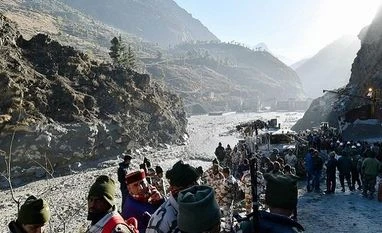
Uttarakhand’s location at the point where the Indian tectonic plate slides under the Eurasian tectonic plate makes it one of India’s most ecologically fragile regions, a perilous position that global warming and climate change have enhanced. This much was clear in Sunday’s tragedy when a chunk of the Nanda Devi glacier near Joshimath broke off, falling into the river below and triggering an avalanche of mud and water that destroyed two power stations downstream, washed away several villages and left over 100 people, mostly labourers working on NTPC’s hydro-power sites, missing. Early investigations suggest that a glacial lake had formed under the glacier, causing a chunk of it to break off, a geological development associated with global warming. The lesser Himalayas are one of the epicentres of the climate change crisis with glaciers retreating at a rapid pace. This is not the first time this area has been devastated by landslides and floods. In this century alone, there have been similar incidents in 2004, 2005, and, most devastatingly, in 2013, when a cloudburst caused flash floods around the pilgrimage site of Kedarnath, killing over 5,700 people during the annual Char Dham yatra.
Enhancing the heavy human toll caused by these natural disasters is the Centre’s and successive state governments’ indiscriminate and poorly thought-through development agenda. For instance, this unstable terrain sustains 14 dams, including the Tehri hydro-electric complex, the world’s highest dam across the Bhagirathi river, straddling the Central Himalayan Seismic Gap, a major geological fault zone. A major earthquake could submerge hundreds of towns and villages in its wake. It was built despite an almost two-decade-long campaign by environmental activist Sunderlal Bahuguna. Political developments have taken their toll on the state’s precarious ecology as well. Uttarakhand was carved out of Uttar Pradesh and became a separate state in 2000. Since then, the picturesque state, with its abundance of natural beauty, chose to rely heavily on tourism income. As the locus of multiple sites central to Hindu worship, religious tourism gained centre stage. The annual Char Dham yatra at four temples at 9,800 feet — Yamunotri, Gangotri, Kedarnath, and Badrinath — has been a money-spinner for the state, unleashing a construction explosion that indiscriminately felled trees and scoured the mountainside to build roads right up to the temples. Hotels and guest houses mushroomed on the banks of the river into which they disgorged their waste.
The dangers of this indiscriminate construction were evident in 2013, when whole buildings were submerged by the flash flood. Astonishingly, the government appeared not to have absorbed the ecological message from that disaster. Instead, the prime minister launched the Char Dham Mahamarg in 2016, as a tribute to those who died in the 2013 disaster. This mega-project plans to upgrade 900 km of the damaged highways with two lanes, 12 bypass roads, 15 big flyovers, 101 small bridges, 3,596 culverts, and two tunnels. The impact of this is already being felt in frequent landslides, since the terrain is unstable and the walls built to hold back construction debris are inadequate. Meanwhile, the 500-metres limit for construction from the river-line is being observed mostly in the breach. Taken together with the encroachments into the Rajaji wildlife sanctuary to create infrastructure for the upcoming Maha Kumbh mela in Haridwar, Uttarakhand is ripe for many more natural disasters that would render the government's developmental agenda a zero sum game.

 "Unstable development")












 Connect with us on WhatsApp