Home / Opinion / Specials / Why OBC status is not the solution for Jat unemployment
Why OBC status is not the solution for Jat unemployment
It is time for community leaders to focus on equipping members with skills so that they can have bigger share of 82 per cent jobs. Reservation covers only 18 per cent of total jobs in the country
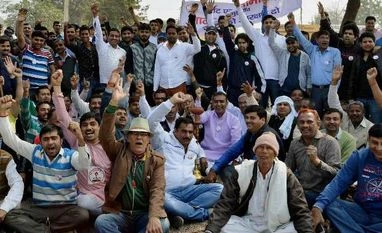
People of Jat community jam the Sukhrali road in Gurgaon on Sunday to support the reservation in OBC quota agitation.
Haryana will take a while, probably few years and couple of thousand crore rupees, to get over the impact of nearly two weeks of agitation by the Jats to press for their demand for quota in government jobs. Physical reconstruction is possible. But what about the ugly caste clashes that killed many lives? Will dilon ka milan be possible henceforth?
What was this for? For few government jobs?
Reports after reports suggested that many of the youths who participated in the agitation had stories to tell. While some missed civil services examination by just one mark, some others could not qualify for staff selection commission and therefore had to settle for “less lucrative private sector jobs”. If others have quota, why not Jats was the common refrain.
But will the inclusion in the OBC category fulfil all their aspirations? Unlikely, if you consider the pace of growth of government jobs in the country. A study based on National Sample Survey Organisation (NSSO) data by three scholars-Sukhadeo Thorat, Nitin Tagade and Ajaya K Naik — in the recent issue of the Economic and Political Weekly show that the provisions of quota apply to mere 18 per cent of the total jobs in the country. That comes to just 15.4 million jobs. It includes all jobs—of Centre and state governments- at all levels. And we know that for some jobs, especially of state governments, preference is given to local candidates.
The authors say that “In 2012, of the 856 lakh total non-farm regular salaried employees (which exclude farmers and non-farm producer/business and casual labourers), about 70% (or 6oo lakh) were employed in the private sector, whereas only the remaining 30% (256 lakh) were employed in the government sector. And even among these 256 lakh government employees, about 40% were temporary and hence not covered by reservation policies. Thus, only about 154 lakh or 60% of the government employees—those permanently employed—were covered under reservation.”
What is more, while the number of permanent government jobs has remained static in the last ten years, the growth has happened only in the private sector and temporary government jobs. That is to say that all the talk of quota by various social groups is to have a share in just 18 per cent of all jobs.
What community leaders therefore should focus instead is on equipping members with skills so that they can have bigger share of 82 per cent jobs. It needs patience, perseverance and constant nurturing. Do so-called community leaders have time for all this?
Vandalism is the easiest thing to do. Vandalism of the kind we witnessed in Haryana recently divides society and scares investors. It has the potential to put brakes on job creation in the pool that provides 82 per cent jobs in the country.
Haryana needs more auto hubs like Manesar, more education cities like Sonipat and more Gurgaons so that the pool of 82 per cent jobs keeps expanding.
If Jats or any other community feel that they have legitimate demand to be included in the other backward classes (OBC) category, press for it by all means. But please do it peacefully. They must realise that other than their share, if they get it, in reserved jobs, they will also need many jobs in the unreserved category if majority of them have aspirations to be meaningfully employed. That is only possible with the help of Gurgaons and Manesars.

 "Why OBC status is not the solution for Jat unemployment")


 Connect with us on WhatsApp