World leaders and their writings

Narendra Modi is the most popular PM since Jawaharlal Nehru and yet we know so little about him
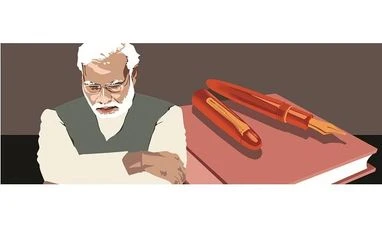
Illustration by Binay Sinha
Aakar Patel
Last Updated : May 11 2018 | 6:00 AM IST
On January 3, 2014, as it became clear that Narendra Modi would do well in the general election, the then prime minister Manmohan Singh said the following in his last press conference: “I do believe, that having Mr Modi, whatever his merit, as the prime minister, will be a disaster for India”.

What did Mr Singh mean? He did not elaborate and wasn’t asked to. The two men would have worked together, as chief minister and prime minister, reasonably closely over the 10 years between 2004 and 2014.

Certainly Mr Singh would have had occasion to observe Mr Modi, his manner of functioning and his performance. And so Mr Singh was presumably predicting this on the basis of both what he thought a PM’s job required and his knowledge of Mr Modi. But unfortunately all we have is this one line. Earlier this week, on the campaign trail in Karnataka, Mr Singh repeated that Mr Modi had introduced “disastrous policies”, listing demonetisation and the implementation of the Goods and Services Tax as his evidence. But this is nothing new, and it doesn’t tell us why Mr Singh predicted what he did in 2014.

So has Mr Modi’s term been a disaster, a word meaning total failure? It would be difficult for a neutral observer to say that it has. It is true that the ruling party is pushing a particularly nasty majoritarianism in which its leader is complicit, but one can be repelled by it and still be attracted to the man (as I am, having known him for long personally).

It would have been fascinating to know what Mr Singh thought were the requisite qualities to lead a nation and where he felt Mr Modi fell short in the decade that he had known him. The larger point I am trying to make is about opacity, which is unhealthy in a democracy and particularly one of India’s size. There is only one way in which transparency of the sort being referred to happens, and it is when leaders reveal their perspective at length. 

This is not possible in interviews on television or even in print, but through memoir and autobiography. This is where we have fallen short. The leaders of liberal democracies, particularly the United Kingdom and the United States, usually leave a record of their term in office. Even those actually thought to be a disaster, including by their own party, have done this. George W Bush wrote Decision points (quite unreadable) as his apologia. Barack Obama already has two books out from before his term and is readying a third.

Across the pond, British prime ministers, especially since Churchill who was the most prolific writer of any leader in history, have been particular about doing this. Even Blair, another disaster according to his own party, wrote his autobiography.

In our parts of the world, the tradition has actually been one of decline. Students of Pakistan will know that the finest period in terms of such material was the 1970s, when Z A Bhutto’s lieutenants like Rafi Raza, Mubashir Hasan and Iqbal Akhund recorded their reflections. Bhutto himself wrote quite a bit, including his final book from jail, If I am assassinated (which he was, of course).

The two decades since have produced poorer material. Benazir wrote some self-serving stuff but Nawaz Sharif had no interest in writing. 

Illustration by Binay Sinha
Manmohan Singh’s daughter has written a book on her parents, Strictly personal: Manmohan and Gursharan, but it ends tantalisingly at 2004 and so that period we are referring to is absent again. Before Mr Singh, Mr Vajpayee wrote mostly Hindi poetry (quite banal verse, to be honest) and his keeping poor health now for several years means that we will be denied his perspective on his term also, unless something has been kept in storage for publishing later. Mr Vajpayee also had to encounter Mr Modi in the critical 2001-2004 period and it would be very unfortunate if we are to be denied this view.

Vinay Sitapati wrote an excellent biography of P V Narasimha Rao, although Rao himself wrote quite a bit, both on the period of the demolition of the Babri mosque and a fictionalised account of a politician. He is the exception to this sorry list.

Before Rao, I K Gujral wrote a book, Matters of discretion (a modest work) describing itself as “the first autobiography written by a prime minister”, which itself is a remarkable fact to consider. Rajiv Gandhi was not a particularly literary individual (so far as one knows), having failed to secure a degree at Cambridge, just as his mother failed to secure one at Oxford (brother Sanjay was a high school dropout) and did not write much. Indira has been written about quite a bit, most recently by Sagarika Ghose and also Jairam Ramesh (who reveals that Indira had read one of the great works of natural history, Maurice Maeterlinck’s The life of the bee). But she did not write much herself, again unfortunate given that she straddled the pre-Independence era, knew its great figures, and herself presided over the partition of Pakistan, far-reaching economic policies and great communal disharmony.

I have the three volumes of Morarji Desai’s autobiography (hard to get and very detailed but otherwise unremarkable) but these again stop before the period in which he was prime minister. Nehru’s three great works, including his autobiography, came much before 1947, but we are lucky to have his “selected works”, which are still being released slowly, which reveal his correspondence and therefore much of the man and his observations as a leader.

In Mr Modi we have a prime minister who in my opinion is the most popular we have had since Nehru, and entirely on merit. He has written quite a bit in Gujarati, which I have translated. This is hagiographies of the RSS leaders who mentored him and some poetry, which I found ordinary. 

His decade as chief minister was transformative for Gujarat in many ways, including socially. And his years as prime minister also promises and/or threaten to be that.

It would be a favour to all of us if he were to reveal himself not through oratory and rhetoric as he does now, but in text.

One subscription. Two world-class reads.

Already subscribed? Log in

Subscribe to read the full story →
*Subscribe to Business Standard digital and get complimentary access to The New York Times

Smart Quarterly

₹900

3 Months

₹300/Month

SAVE 25%

Smart Essential

₹2,700

1 Year

₹225/Month

SAVE 46%
*Complimentary New York Times access for the 2nd year will be given after 12 months

Super Saver

₹3,900

2 Years

₹162/Month

Subscribe

Renews automatically, cancel anytime

Here’s what’s included in our digital subscription plans

Exclusive premium stories online

  • Over 30 premium stories daily, handpicked by our editors

Complimentary Access to The New York Times

  • News, Games, Cooking, Audio, Wirecutter & The Athletic

Business Standard Epaper

  • Digital replica of our daily newspaper — with options to read, save, and share

Curated Newsletters

  • Insights on markets, finance, politics, tech, and more delivered to your inbox

Market Analysis & Investment Insights

  • In-depth market analysis & insights with access to The Smart Investor

Archives

  • Repository of articles and publications dating back to 1997

Ad-free Reading

  • Uninterrupted reading experience with no advertisements

Seamless Access Across All Devices

  • Access Business Standard across devices — mobile, tablet, or PC, via web or app

More From This Section

Disclaimer: These are personal views of the writer. They do not necessarily reflect the opinion of www.business-standard.com or the Business Standard newspaper
Next Story



