Home / India News / SC seeks UP govt response on Facebook post in support of Durga
SC seeks UP govt response on Facebook post in support of Durga
Justice H L Gokhale, issued notice to the state government asking them to file their response for arresting writer Kanwal Bharti, in violation of its order.
The Supreme Court today sought an explanation from Uttar Pradesh government for arresting a Dalit scholar for allegedly writing a post on Facebook in support of suspended IAS officer Durga Sakthi Nagpal.
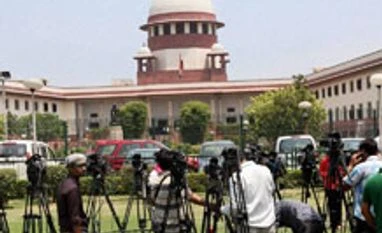
A bench headed by Justice H L Gokhale, issued notice to the state government asking them to file their response for arresting writer Kanwal Bharti, in violation of its order.
Bharti, author of various books dealing with problems faced by Dalits, in his post had said that the Gautam Budh Nagar SDM was suspended for alleged demolition of wall of a mosque. However, Bharti was granted bail in the matter.
The apex court had earlier on May 16 said that the person allegedly posting objectionable comments on social networking sites cannot be arrested by the police without getting prior permission from senior officers.
The court had directed the state government to strictly comply with the Centre's advisory which had said that a person should not be arrested without taking permission from police officials of the rank of IGP or DCP or SP level.
In view of public outrage over people being arrested for making comments or liking posts on Facebook, Centre had on January 9 issued advisory to all states and UTs asking them not to arrest a person in such cases without prior approval of a senior police officer.
The apex court had restrained police while hearing an application seeking its direction to the authorities not to take action for posting allegedly objectionable comments during the pendency of a case before it pertaining to constitutional validity of section 66A of the Information Technology (IT) Act.
The section states that any person who sends, by means of a computer resource or communication device, any information that was grossly offensive or has a menacing character could be punished with imprisonment for a maximum term of three years, besides imposition of appropriate fine.

 "SC seeks UP govt response on Facebook post in support of Durga")


 Connect with us on WhatsApp