
China, US reached consensus on key currency exchange rate issues: Official
US President Donald Trump imposed heavy tariffs on imported steel and aluminium items from China in March last year
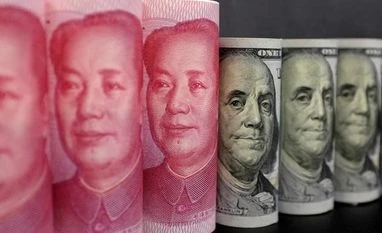 "China, US reached consensus on key currency exchange rate issues: Official")
WebinarsNew
Deep DiveNew
Explore Business Standard
US President Donald Trump imposed heavy tariffs on imported steel and aluminium items from China in March last year
Chinese and US officials discussed exchange rates and reached a consensus on many "important" issues during the latest round of negotiations to end the trade war, Governor of the China's central bank Yi Gang said on Sunday.
Top trade officials from America and China are holding talks to negotiate a comprehensive trade deal during the last few months to end a trade war in which the world's two largest economies are locked in since last year.
US President Donald Trump imposed heavy tariffs on imported steel and aluminium items from China in March last year.
Trump is demanding China to reduce the $375-billion trade deficit, provide legal protection for intellectual property rights (IPR), technology transfer and more access for American goods to Chinese markets.
He has imposed tariff hikes on $250 billion of Chinese goods and threatened to extend tariffs on $200 billion Chinese imports to 25 per cent.
In response, China, the world's second largest economy after the US, imposed tit-for-tat tariffs on $110 billion of American goods.
Successive US Presidents, including Trump, have accused China of manipulating its currency RMB or Yuan to make its exports more competitive. But Washington, so far, avoided declaring Beijing a currency manipulator.
"The two parties discussed about how to respect the autonomy of each other's monetary authorities in determining the monetary policy," Yi told a media briefing here.
Yi was part of the Chinese delegation, led by Chinese Vice Premier Liu He, which took part in the latest round of talks in Washington, to discuss important trade issues with US Trade Representative Robert Lighthizer and Treasury Secretary Stephen Mnuchin.
"The discussion also involved mutual adherence to the market-decided exchange rate mechanism, honouring the commitments made at previous G20 summits such as choosing not to adopt competitive depreciation, not to use exchange rates for competition purpose, and maintaining close communication on foreign exchange markets," Yi said.
They also discussed the issue that both sides should commit to disclose data in accordance with the statistics transparency standard of the International Monetary Fund, he said.
He reiterated that China will never use exchange rates for competition purpose, nor apply them to boost exports or take them as tools of trade frictions.
China's exchange rates are becoming increasingly market-oriented, Yi said.
First Published: Mar 10 2019 | 6:40 PM IST


 Connect with us on WhatsApp