Scientists have discovered one of the oldest horned dinosaurs - a one-tonne behemoth that roamed the Earth about 79 million years ago and had a 'fantastically adorned' skull with forward-curling hook-like horns.
The striking new species of horned dinosaur (ceratopsian) was discovered based on fossils collected from a bone bed in southern Alberta, Canada.
The new dinosaur, named Wendiceratops pinhornensis, was approximately 6 meters long and weighed more than a tonne.
It lived about 79 million years ago, making it one of the oldest known members of the family of large-bodied horned dinosaurs that includes the famous Triceratops, the Ceratopsidae.
Wendiceratops is described from over 200 bones representing the remains of at least four individuals (three adults and one juvenile) collected from a bone-bed in the Oldman Formation of southern Alberta.
It was a herbivore, and would crop low-lying plants with a parrot-like beak, and slice them up with dozens of leaf-shaped teeth.
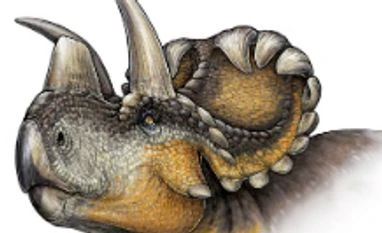
Wendiceratops had a fantastically adorned skull, particularly for an early member of the horned dinosaur family.
Its most distinctive feature is a series of forward-curling hook-like horns along the margin of the wide, shield-like frill that projects from the back of its skull.
The new find ranks among other recent discoveries in having some of the most spectacular skull ornamentation in the horned dinosaur group, researchers said.
"Wendiceratops helps us understand the early evolution of skull ornamentation in an iconic group of dinosaurs characterised by their horned faces," said Dr David Evans, Temerty Chair and Curator of Vertebrate Palaeontology at the Royal Ontario Museum in Toronto, and co-author of the study.
"The wide frill of Wendiceratops is ringed by numerous curled horns, the nose had a large, upright horn, and it's likely there were horns over the eyes too. The number of gnarly frill projections and horns makes it one of the most striking horned dinosaurs ever found," said Evans.
The horn on the nose is the most interesting feature of Wendiceratops. Although the nasal bone is represented by fragmentary specimens and its complete shape is unknown, it is clear that it supported a prominent, upright nasal horncore.
This represents the earliest documented occurrence of a tall nose horn in Ceratopsia, researchers said.
Not only does it tell scientists when the nose horn evolved, the research shows that an enlarged conical nasal horn evolved at least twice in the horned dinosaur family, once in the short-frilled Centrosaurinae group that includes Wendiceratops, and again in the long-frilled Chasmosaurinae group which includes Triceratops.
A nose horn has been generally thought to characterise Ceratopsidae, and be present in their common ancestor.
The research was published in the journal PLOS ONE.

 "New dinosaur with 'halo' of horns found in Canada")

