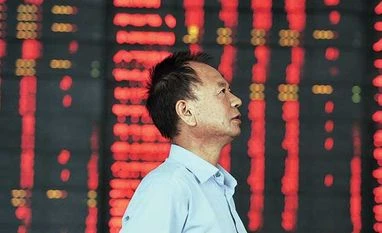
Chinese stocks plunged more than six per cent on Tuesday, their biggest fall in three weeks, on speculation the central bank may be in no rush to ease policy further and concerns a further weakening in the yuan would hit importers.
Though the market has stabilised after a slew of official measures to arrest a sharp drop in June and July, investor sentiment has remained fragile.
After data showing a modest recovery in July home prices, profit-taking pressures accelerated in afternoon trade, traders said.
"The securities regulator made it clear last week that the government will withdraw from regular market intervention to support share prices," said a senior trader at a major Chinese brokerage in Shanghai.
China's securities regulator said last Friday the government would allow market forces to play a bigger role in determining stock prices, the first official signal from Beijing it could be moderating its efforts to prop up equity markets via state-backed financial institutions.
"Because sentiment has been weak since the sharp fall that began in June, people believe the market itself cannot support the current share price levels without the state's support. Such belief has caused widespread jitters," the trader said.
The Shanghai Composite Index closed down 6.1 per cent at 3,749.12 points in its biggest daily decline since July 27, snapping a three-day winning streak.
The CSI300 index of the largest listed companies in Shanghai and Shenzhen fell 6.2 per cent at 3,825.41.
Volatility in both indexes spiked in the afternoon.
Traders said a large cash injection by People's Bank of China via its open market operation earlier in the day was taken as a sign that the central bank may not ease monetary policy further for now.
"The PBOC's fund injection into the money market on Tuesday sparked speculation that the central bank may delay its next easing step," another trader said.
The injection, the biggest in more than six months, added to worries that liquidity was tightening as investors moved more capital out of the country.
Minsheng Securities estimated 800 billion yuan ($125 billion) had flowed out in July and August alone.
An analyst at Guangfa Securities also blamed the fall on a research report published late on Monday — and widely shared on WeChat messaging — that said planned reforms in the state-owned enterprise sector may not benefit shares in that sector.
Investors have grown more concerned that Beijing may begin to withdraw its unprecedented support for share prices.
Stocks also had come under pressure in the morning as the yuan weakened against the dollar, reigniting fears that Beijing may be intent on a deeper devaluation of the currency despite the central bank's comments that it sees no reason for a further slide. By the end of the day, the yuan ended flat.
Shares of importers and firms with high US dollar-denominated debt have been under pressure, along with Chinese airlines, which face higher fuel bills following the devaluation.
Selling was broad based. The CSI 300 infrastructure index fell 8.4 per cent, the energy index dropped 6.1 per cent, and the real estate index tumbled 7.3 per cent despite the data showing Chinese home prices rose for the third month in a row in July.

 "China stocks fall 6% on policy outlook")

