
Guwahati, Srinagar have highest risk of earthquake
Guwahati and Srinagar fall in what is called "very severe intensity zone", or zone V, which are areas with the highest risk for an earthquake
 "Guwahati, Srinagar have highest risk of earthquake")
WebinarsNew
Deep DiveNew
Explore Business Standard
Guwahati and Srinagar fall in what is called "very severe intensity zone", or zone V, which are areas with the highest risk for an earthquake
Guwahati and Srinagar are the two Indian cities at highest risk of being devastated by an earthquake, with 36 other cities in areas prone to earthquakes, according to government data.
Guwahati and Srinagar fall in what is called “very severe intensity zone”, or zone V, the highest-risk earthquake zone.
Eight cities, including Delhi, fall in the “severe intensity zone” or zone IV, according to a seismic zoning map issued by the Bureau of Indian Standards and quoted in this National Disaster Management (NDM) report. The other 30 cities fall in the “moderate intensity zone”, or zone III.
This map shows India’s 38 earthquake-prone cities:
Source: National Disaster Management
“India has highly populous cities, including the national capital of New Delhi, located in zones of high seismic risk,” said the report. “Typically, the majority of the constructions in these cities are not earthquake resistant. Thus any earthquake striking in one of these cities would turn into a major disaster.”
A reminder of India’s vulnerability
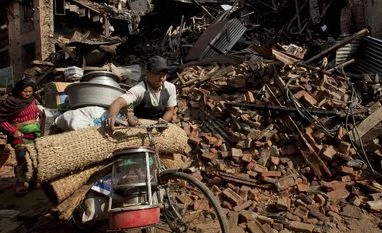
The Nepal earthquake, which has now claimed more than 3,000 lives, and the NDM data are a reminder of India’s vulnerability.
IndiaSpend recently reported that nearly 60% of the sub-continental landmass is vulnerable to earthquakes.
About 50 million years ago, India—then an island that had previously broken off from a supercontinent called Gondwana, a name still used for what is now Chhattisgarh—slammed into the Eurasian mainland, creating the Himalayas as it collided.
All land on earth rides on “plates”, which glide on the mantle, a rocky inner layer. The Indian plate continues to grind into the Eurasian plate, and as it does, the Himalayas and north India are on shaky ground.
India pushes northeast into Asia at roughly 5 cm every year, causing subterranean stresses that are released in the form of earthquakes every now and then.
Vulnerable zones are monitored, but prediction is impossible
An array of sensors in India and abroad monitor plate activity, but it is impossible to predict an earthquake, as many tweets and Whatsapp messages after the Nepal temblor appeared to indicate:
What is available is data on areas of specific vulnerability.
Gujarat and Uttar Pradesh appear to be the most vulnerable states, with six cities each in earthquake- prone zones. Both the states have one city each under zone IV and five cities marked under zone III. Maharashtra is next with four cities in zone III.
The Bureau of Indian Standards [IS-1893 – part – 1: 2002], based on scientific inputs from a number of agencies, including earthquake data supplied by Indian Meteorological Department (IMD), has grouped India into four seismic zones, II, III, IV and V.
The Modified Mercalli (MM) intensity scale, which measures the impact of earthquakes on the surface of the earth, is broadly associated with India’s earthquake zones, as follows:
| Intensity Of Earthquakes In Different Zones | ||
|---|---|---|
| Seismic Zone | Intensity on Modified Mercalli scale | % Of Total Area |
| Zone II (Low intensity zone) | VI (or less) | 43 |
| Zone III (Moderate intensity zone) | VII | 27 |
| Zone IV (Severe intensity zone) | VIII | 18 |
| Zone V (Very severe intensity zone) | IX (and above) | 12 |
India has 42 digital seismograph stations to measure earthquake magnitude and monitor earthquake activity, operated by the Ministry of Earth Sciences. As many as 78 new digital seismographs are likely to be installed during 2015-16.
Here is a look at some of the major earthquakes that have struck India since the 19th century:
Tip: Click in the top-right corner to scroll forward; Source: Indian Meteorological Department.
China, United States, Indonesia, Philippines and India were among the five countries world-wide most frequently hit by natural disasters over the last decade, according to this report from the Center for Research on Epidemiology of Disasters.
(IndiaSpend is a data-driven, public-interest journalism non-profit)
First Published: Apr 28 2015 | 10:22 AM IST


 Connect with us on WhatsApp