The Par 3 16th hole has a lateral green with an awkward slope towards a long body of water that stretches from tee to green. It’s a favourite viewing spot for patrons on practice days as they throng its boundaries to watch player after player try his luck at skipping shots over the surface of the water on to the green. There are roars every few minutes just on this hole. The patrons are entertained but nothing turns on it. Jon Rahm, the World No 2 hit just such a shot, which skipped a few times on the water, scampered over the edge on to the green, caught the slope in a long, almost Fibonacci arc, slowed a bit on top of the incline as though to stop, then gathered pace and curled right into the hole. A hole in one! No roars, only Rahm high-fiving with caddy and hoping somebody had caught it on camera. They had, and it’s gone viral. It’s fantastic but there were no patrons and, therefore, no roars. And of course, he would never try that shot in tournament.
Patron roars (and groans) are a very important feature at the Masters. These are seismic signals that are emitted by patrons to inform leaders and trailers as to whether someone behind or in front of them has birdied or eagled or just missed a short putt or put his ball into the water. If one is playing well, the roars can give a boost to one’s energy and body language but contrariwise roars for others can magnify one’s decline. Now, with no patrons, the players will simply not know what is happening in front of or behind them. It’s an eerie feeling to hear no roars even for TV viewers. In other sports, such as football and cricket (at least in the short form), they blare in canned spectator noise, even scantily clad cheer leaders to make it sound natural on the screen. No such thing in golf. Remarkably and expectedly, the loudest and longest roars are reserved for Tiger, the Big cat. When he’s on the prowl, playing in the last 2 or 3 groups, the atmosphere becomes thick with suspense and those roars reverberate within the bowl in which Augusta National resides.
Normally, with Tiger Woods as the defending champion, one would expect him to be high on the radar entering this tournament, but he isn’t. His recent indifferent form causes even the faithful (moi) to entertain serious doubts before casting them aside. But even more remarkably, players like Dustin Johnson, the World No 1, Rahm, Rory Mcllroy and other hungry players such as Brooks Koepka, Xander Schauffele and several Masters winners, come in well under the radar. Their pre-game interviews all seem to have the ‘idea’ of Bryson DeChambeau, like Banquo’s ghost, at the back of their minds. DeChambeau himself is understated, poised, purposeful, respectful of them, and clearly stating that distance off the tee is the most important factor in winning any tournament. In practice, he carried the Par 4 third hole with a three wood, hit 8 or 9 irons on wedges into the Par 5s for his second and didn’t have to trouble his long or mid irons at all. Gary Player, that remarkable 85-year-old three-time Masters champion and British Open winner, says that when the next championship is played at St Andrews, in a couple of years, DeChambeau could drive 9 greens. That, he says, will make a mockery of this game (at the professional level) and therefore rules to limit the improvement in golf equipment (balls and clubs) have to be established.
The day began cold and wet and dark, with Jack Nicklaus and Player serving as honorary starters. On another occasion, K P Singh of India had the honour of being on Players bag on the tee with Arnold Palmer, Nicklaus and Player (13 Green Jackets between them). At the next tournament (2021), Lee Elder, the first person of colour to have played at the Masters (in 1975), has been invited to join as Honorary starter as well. In America, the past of African Americans having been enslaved weighs heavily on society and surfaces during elections (just concluded) and any time a person of colour is treated with undue disrespect. The installation of two scholarships in his name at Paine College goes a long way to address the ravages of discrimination and has been widely appreciated.
With just a dozen having teed off, play was called off for about three hours owing to heavy rain and electrical storms. The excessive rain rendered the course soft. Drives had virtually no roll and putts on the Augusta National’s famously fast greens were just not moving. Players had to rely on a sharp short game and discover new angles to approach the pins. However, the course laid itself open for the taking with lots of red figures.
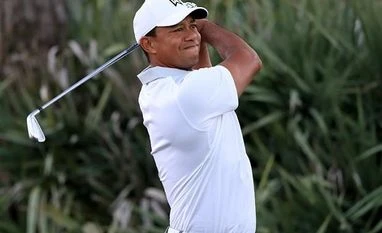
When play resumed, there were some surprises in store. DeChambeau hit a mammoth tee shot on the Par five 13th to find his ball nestled in light pine straw from where it is difficult to play with confidence. He pulled his second into heavy foliage, which in April would be covered with the riotous colours of azaleas, and his provisional from the same pine straw landed in the creek fronting the green. He was lucky to find his ball and take a double bogey with a quadruple staring him in the face should he not have found it. That’s a three-shot swing right there. He pulled one back on the Par 5 15th with a perfect drive and short iron to the green and another on the Par 3 16th. He might learn that when one tries to hit it so hard and long, the fairways magically tend to become narrower. Despite this set back, he ended at -2. Woods was playing regulation golf, going one under on the Par 5 13th while putting for an eagle, then birdying the 15th, almost holding out for an ace on the Par3 16th to end the day at -4. Don’t count him out, chaps!
Very regrettably there was no huge crowd cheering to see Jazz (Jazz Janewattananond), the golfing prince of Thailand, patiently holding onto his one under all the way through the 9th to finish at 3 under. Just be patient on your first time at the Augusta, Jazz, and you will be fine.
Schauffele was fast off the block with birdies on the first three holes only to give them back soon thereafter. This sort of snakes and ladders where one rises and falls goes on until the last shot is played. One need not get too excited; don’t allow the adrenalin to flow too prematurely; just be patient, cool and calm, like Paul Casey who was at 4 under after just 7 holes (finishing as the club house leader at -7). Lee Westwood is grasping at possibly his last chance to win a major by going out in 5 under starting on the first half. These two Englishmen could bring the Green Jacket back to the UK as a morale booster for a nation that needs it these days.
Several notables, such as Johnson and Justin Thomas could not finish because of darkness but they are very well placed. The game will start early on Friday morning to finish the first round with the second to follow. The greens and fairways will have dried out a bit so the game will be much different from the first day.
Tomorrow: Day 2, No roars, Analysis