Anyone familiar with the first-generation devices of Canadian smartphone maker Blackberry would agree that those machines were built to deliver exceptional enterprise-level security, without compromising on technical superiority and features available at the time.
However, times changed and Blackberry seemed to meet a fate similar to those of Nokia and Motorola, with other, cheaper alternatives emerging for on-par services and technology. But Blackberry took little time to realign its strategy and launch its second-generation devices with the edge of superior enterprise-level security, along with the more user-friendly Android operating system.
BlackBerry DTEK50: Google Android 6.0.1
The latest of company’s second-generation offerings, the BlackBerry DTEK50, coming after the Blackberry Priv, makes a shift from the usual look and feel of Blackberry devices. Objectively speaking, it is not a bad move, but a departure from QWERTY keyboards in the transition might be missed by some loyal users.
Business Standard reviewed the BlackBerry DTEK50 extensively to assess what works in its favour, and what doesn’t. Here are some of our observations:
Hardware The Blackberry DTEK50 is a mid-range device equipped with a balanced hardware. The device is powered by Snapdragon 617 chipset, and has a 3GB RAM. It has 16 GB of internal storage and an option to expand via microSD card slot. On the front, the device flaunts a 5.2-inch full-HD IPS (1920 x 1080 pixels) display, complemented by a pair of stereo speakers – one at the top and the other at the bottom. The 8-megapixel (MP) front camera and notification LED is found at the top bezel area, which is relatively thick.
The back side of the device sports a 13MP main camera that supports phase detection auto-focus and a dual-tone LED flash.
On the right, there is a volume rocker on the upper side and an ejectable SIM-cum-microSD slot at the lower side. In between volume rocker and SIM-cum-microSD card slot sits the convenient key, which hardly adds convenience; it, in fact, causes some trouble. The power switch is placed on the left and it feels that BlackBerry has jinxed the placement of both keys – convenience key and power switch.
Had they swapped the placement of convenience key and power switch, things might have been a lot better.
Another important factor missing in the device is a fingerprint sensor. For a device coming from the stable of BlackBerry, known for its security features, giving a basic hardware like fingerprint sensor a miss is difficult to understand. More so when the feature has become so mainstream that even the budget phones use it nowadays.
Display The BlackBerry DTEK50 features a 5.2-inch fullHD (1920 x 1080 pixels) IPS display covered with a scratch-resistant glass and oleophobic coating. The screen is bright and works flawlessly under direct sunlight. There is no dearth of colour and the screen throws natural colours, unlike the over saturated ones seen in the BlackBerry Priv.
The 5.2-inch display is enough for day-to-day tasks like browsing the internet, playing games and watching YouTube videos. But the screen feels small while reading an extensive article or a long-form text. A 5.5-inch screen with fullHD resolution would have made the device score some extra points, but it is just a matter of perception.
Software Now this is one area where we noticed that BlackBerry has done some major work. The BlackBerry DTEK50 runs on Android 6.0.1. It is out of the box and customised by the company to offer some neat features readily available at the swipe on the screen, and security features embedded deep in the OS.
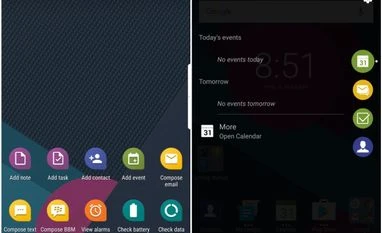
BlackBerry DTEK50: Software interface
One noticeable feature that came in handy is the swipe-up feature; a swipe up from the bottom of the screen opens a hub that shows all the messages at one place – e-mails, BBMs, instant messages, text messages, etc.
Another feature worth mentioning is the productivity tab placed on the right side of the screen. It becomes active on the swipe and shows unread messages, day’s tasks, calendar entries and favourite contacts. It takes some time to get used to use the productivity tab and, in most cases, it would be the least used feature. But once you get a hang of it, there is a lot that you could do just by using it, especially if you are a mail person and keep a lot of calendar entries.
Now that the Blackberry iconic physical QWERTY keyboard is gone – it is replaced by software-based touch keyboard. We admit we missed the QWERTY while using the device. The new software-based keyboard doesn’t offer the same feel as the former physical keyboard, though the new one holds some surprises. The keyboard feels faster, accurate and supports swipe-based writing and doesn’t consume much of screen estate; in a compact form, it offers word suggestions.
Coming to the security aspect of the device, the BlackBerry DTEK50 comes fully encrypted by default; it also has security certificates, etc, which keep working in the background.
BlackBerry DTEK50: DTEK Security
There is a DTEK app that monitors activity, controls app permission, tracks access to root files and notifies if there is anything that requires attention. On the surface, the app does offer basic tips to secure the device and, in most cases, expresses that the device is secure. At an advanced level, the device offers some insight that could come in handy while understanding which apps have access to which parts of the phone, and when an app has tried to take access.
The security that the device offers with DTEK is basic and it could have been better, like Samsung Knox solution. We would appreciate having all these security features in a mid-range device.
Camera, performance and battery life
The BlackBerry DTEK50 sports 13MP rear and 8MP front cameras. Both cameras perform well during well-lit conditions. The rear camera captures right colours and fixes the focus in almost no time. The photos look crisp and offer a lot of detail. In low-light conditions, both cameras were soon to struggle in capturing the shot. While the rear camera had to take the help of dual-tone LED flash, which makes little difference, the front camera failed to capture details and shot bad to average photos. Though the cameras’ performance cannot be compared to what the flagship devices offer, considering the price range of the device, the camera department could have been improved. However, to its credit, BlackBerry was never for sophisticated cameras.
The Blackberry DTEK50 runs smoothly across without any hiccup. The apps open without any lag and stays in background till you force-close them. Opening multiple apps faces no issues and playing graphic-intensive games doesn’t hinder the performance much. The device feels quick and doesn’t show any signs of a glitch.
Powering the BlackBerry DTEK50 is 2,610 mAh lithium-ion non-removable battery that keeps running the show for one full day before asking for juices to be replenished. Under extensive use, the device fares quite well and works for more than 10 hours, which is plausible. The device supports Qualcomm Quick Charge 2.0 technology, which recharges the battery quickly.
The device has a lot to offer in terms of performance, security, display quality, battery life and software tricks, but a price tag of Rs 21,999 doesn’t seem to justify the features and feel. There are a lot of smartphones that are equally capable but are available under less than Rs 15,000.

 "BlackBerry DTEK50: An inspired high performer on many counts")












 Connect with us on WhatsApp