Explore Business Standard
Explore Business Standard

Associate Sponsors
Co-sponsor
The country, situated in a region of complex security challenges, has acknowledged the critical role that drones play
 "India is better prepared for the age of modern warfare")
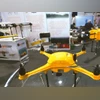
Falcon, a surveillance drone on display at Bharat Drone Shakti 2023 organised by the Indian Air Force and Drone Federation of India at the Hindon Airbase in September 2023. Photo: Reuters
KEY RECOMMENDATIONS TO ACCELERATE INDIA'S DRONE WARFARE CAPABILITIES
To truly realise the potential of drones in national defence, India must align its procurement frameworks and innovation ecosystems with the demands of modern warfare. Here are some strategic imperatives that can enable this transformation:
- Move from parity to superiority in drone deployment
Rather than matching adversaries, India should aim to outpace them by inducting higher-capability drones at every echelon of the armed forces. This shift in mindset — from seeking parity to striving for superiority —must reflect in deployment planning, budgeting, and operational doctrine.
- Deepen equipment penetration across forces
High-tech UAVs must not be limited to elite units. A deeper deployment of UAVs across battalions and commands will offer a numbers advantage, improve real-time situational awareness, and provide multi-mission flexibility at the tactical edge of combat.
- Leverage qualified systems for fast adoption
A list of certified UAV platforms that have cleared the most stringent and elaborate user trials and exploitation on ground should be published and updated regularly. These platforms should be made available for direct procurement, training, and maintenance.
- Build resilience against electronic warfare
As we have witnessed in global conflicts and during Operation Sindoor, electronic warfare,
counter-drone & air-defence systems are the new reality of the
modern-day battlefield. It is imperative that Indian drone systems are designed to be resilient in such contested environments. Enhancing the ability of drones to operate in GPS-denied environments and resist jamming or signal disruption will be a key differentiator in future conflicts.
- Promote modular, multi-role UAVs with full mission autonomy & field upgradability
To reduce back-end logistics and training burdens and increase operational flexibility, UAVs should support modular payloads and perform a variety of missions with minimal pilot intervention.
AI-enabled autonomy and swarming capabilities should become part of the baseline technology stack. Also, there must be an ability to upgrade the fleet with rapidly evolving technologies to gain and maintain an edge over adversaries.
- Publish and prioritise a list of critical defence technologies
The armed forces should annually publish a list of subsystems and technologies that are critical to future operations. This will give the industry clarity on investment focus areas and allow the government to align financial incentives like design-linked incentives and research and development (R&D) grants.
- Drive adoption and sustained demand
Sustained demand is crucial for any budding industry to mature and develop. Currently, drones are suffering from a lower than required rate of adoption for them to become agents of change. The government must assume the role of the demand generator for drones by mandating their use in baseline security, governance, and infrastructure monitoring.
 Premium ContentPremium ContentSubscription ExpiredSubscription Expired
Introducing Blueprint - A magazine on defence & geopolitics
From military strategy to global diplomacy, Blueprint offers sharp, in-depth reportage on the world’s most consequential issues.
annual (digital-only)
₹208/Month
annual (digital & print)
₹291/Month
annual (digital-only)
₹291/Month
annual (digital & print)
₹375/Month

Access to the latest issue of the Blueprint digital magazine
Online access to all the upcoming digital magazines along with past digital archives

Delivery of all the upcoming print magazines at your home or office
Full access to Blueprint articles online
Business Standard digital subscription
1-year unlimited complimentary digital access to The New York Times (News, Games, Cooking, Audio, Wirecutter, The Athletic)
Access to the latest issue of the Blueprint digital magazine
Online access to all the upcoming digital magazines along with past digital archives
* Delivery of all the upcoming print magazines at your home or office
Full access to Blueprint articles online
Business Standard digital subscription
1-year unlimited complimentary digital access to The New York Times (News, Games, Cooking, Audio, Wirecutter, The Athletic)
In this article : Top NewsDrones UAVDrones in IndiaIndian militaryDrones
Next Story


