Beyond May

India successfully tested some of its advanced weapons and systems in the four-day conflict with Pakistan. Now, India should bolster its arsenal to raise its military profile, experts say
20 min read
Updated On: Jun 25 2025 | 9:51 PM IST
indian military, indian army, defence, army

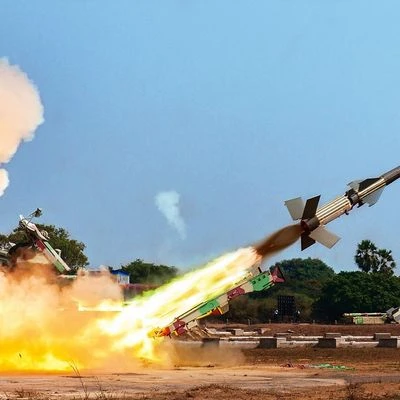
The short-to-medium range surface-to-air missile Pechora being fired at an undisclosed test-firing range in India. Photo: IAF

India and Pakistan engaged in conventional gunfight and cyberwar in the buildup to the latest military clash. Then, the night of May 8-9 became treacherous for India when villages, towns and cities along its entire northwestern border came under attack. Of the hundreds of drones that Pakistan sent towards India over the four-day conflict, the vast majority were sighted then. The drones, many carrying explosives, aimed to inflict damage across 36 locations in India, Indian military officials have said. India’s automated air defence systems intercepted the drones, as well as the missiles fired from fighter jets by Pakistan. India used drones and standoff weapons in its counterattacks.  
The conflict, a first between India and Pakistan since 1999, witnessed the debut of advanced weapons in the region. 
India demonstrated its combat capability effectively during this multidomain noncontact clash. Now the country needs to fill some critical gaps in its arsenal, not just to fight a larger adversary or a two-front war but to raise its military profile, according to defence analysts.India applied a mix of battle tactics and integrated technology to this conflict, the outcome of which also underscored the quality of weapons over quantity.  
The Indian Air Force and the Indian Army struck Pakistan wide and deep, including 100 kilometres from the international border, visual evidence of which was presented to the media by senior Indian military officers. The ceasefire, announced on May 10, was in force at the time of writing, when the Indian Navy remained forward deployed in the Arabian Sea.  
Prime Minister Narendra Modi told recent public rallies that India had paused Operation Sindoor, not ended it. India expanded its May 7 operation, initially intended as a reprisal against Pakistan for the April 22 terrorist attack in the Indian town of Pahalgam, into a military campaign after being hit back. An intense battle in the skies over the Line of Control, the de facto border, was an episode in the clash. The aircraft damage or losses, on both sides, are unclear. 
While no details of any fighting were shared, Air Marshal AK Bharti, as part of India’s Directorate General of Military Operations (DGMO), told a news conference in New Delhi on May 11, “Suffice to say, this was a different warfare”. 
The world’s military spending was $2.718 trillion in 2024. India ranked fifth on the list of top spenders after the United States, China, Russia and Germany, data from the Stockholm International Peace Research Institute (Sipri) shows.  India is behind China in military power at this time, but the US is significantly ahead of China in both capability and spending, according to analysts. Last year, the US spent $997 billion and China $314 billion (publicly known figure). India, which spent $86.1 billion in 2024, will likely increase its defence budget amid growing strategic challenges in its neighbourhood.  
“Pakistan is a thorn in India’s side. China is our greatest threat. That is common thinking, but we need to look ahead, irrespective of events and perceptions, to build on our national strength,” retired Air Marshal G S Bedi said. 
India should have complete ownership of technology in defence, so as to be truly self-reliant, and while such an ecosystem might take time to develop, he urged policy flexibility.  “We need to maintain a balance between retaining our military capability and working on self-reliance,” Bedi said.


THE TOP FIVE MILITARY SPENDERS (2024)


The world’s total military spending: $2,718 billion. The 9.4 per cent rise was the steepest year-on-year increase since 1988. The share of the world’s gross domestic product (GDP) spent on the military was up 2.5 per cent . Average military expenditure, as a share of government expenditure rose to 7.1 per cent. The world military spending per person was the highest since 1990, at $334 . The United States and China accounted for almost half of world military expenditure and 15 countries together accounted for 80 per cent of global military spending.   

   United States

  • $997 billion (total spending), 5.7 per cent higher than in 2023 and 19 per cent higher than in 2015
  • $246 billion on combat-credible conventional forces and nuclear weapons. This sum, $37.7 billion was spent on modernising nuclear weapons and $29.8 billion on missile defence   
  • $61.1 billion on weapon systems for its F-35 stealth fighter aircraft and $48.1 billion on new naval vessels
  • $72.8 billion includes $48.4 billion for Ukraine (financial aid, equipment and training) and $10.6 billion to support Israel  
  • $2.6 billion to bolster US and allied capabilities in the Indo-Pacific region, including $1.9 billion in military aid to Taiwan 


China


  • $314 billion (total spending estimate), up 7 per cent from 2023, the largest year-on-year percentage increase in China’s military spending since 2015 
  • Chinese defence spending up by 59 per cent over 2015–24
  • China is modernising its military until 2035


Russia


  • $149 billion (total spending estimate), 38 per cent more than in 2023 and double the level in 2015 
  • Russian military spending was equivalent to 7.1 per cent of its GDP. A significant portion was spent on buying weapon systems used in the Ukraine invasion and the continued war 


Germany 


  • $88.5 billion (total spending), or 1.9 per cent of the GDP, making it the largest defence spender in Central and Western Europe for the first time since the reunification
  • Military spending is up by 28 per cent as compared to 2023, and by 89 per cent as compared to 2015 
  • $7.7 billion in financial military aid to Ukraine 


India


  • $86.1 billion (total spending), up by 1.6 per cent from 2023, and by 42 per cent from 2015 
  • The current government policy earmarks 75 per cent of Indian capital outlays, which are equivalent to 22 per cent of total military spending, to fund domestic military procurement 
  • India makes armoured vehicles, helicopters and submarines, among others 
  • India is still reliant on imports for some advanced systems, such as combat aircraft

Data from the Stockholm International Peace Research Institute

 
Nuclear threshold
 
Pakistan used Turkish-made Yiha-III drones, Chinese-made PL-15 air-to-air missiles and Chinese-made JF-17 fighter jets in its attacks on India. Pakistan imports 80 percent of its weapons from China, according to Sipri. 
Over the years, the People’s Liberation Army Air Force has grown in size, with newer systems at its disposal, which should nudge India to fill both numerical and technological gaps in its arsenal. The numerical gap with China has worsened from what it was 15 years ago and is likely to grow. With advanced fighters, the ratio is three to one in China’s favour, according to data collated by Chris Clary and the International Institute for Strategic Studies, a London-based think tank.  
“But we also know, regardless of whether and how India suffered air losses (in the May conflict), that the quality of Chinese weaponry is improving, in some cases, such as air-to-air missiles, quite dramatically,” Shashank Joshi, defence editor, The Economist, said. 
India needs to diversify its weapon systems. There is a great deal of focus on individual platforms such as fighter jets to enhance squadron strength, but air-combat systems — airborne early-warning aircraft, the digital networks that allow them to send data to aircraft and to ground stations, and modern software that can keep track of aerial threats — are all equally important. 
Joshi said that India and the US seemed to be facing a similar problem: An eroding military balance with China, a rapid improvement in the quality of Chinese weaponry, and new technologies where China might be gaining an advantage, such as hypersonic (five times the speed of sound, Mach 5).   
“And much of that Chinese weaponry will keep proliferating to Pakistan in the years ahead, compounding the problem.”
The Indian government said in a media statement on May 14 that Operation Sindoor marked “a milestone” in the country’s journey towards technological self-reliance, from air defence to drones, and counter-unmanned aircraft systems to internet-centred warfare platforms.  
The S-400, a Russian-made air defence system that is integrated with India’s indigenously built platforms, and Israeli-made Harop drones were used in the counterattacks. The S-400 is an advanced long-range, surface-to-air missile system, among the world’s most advanced.  
An Indian Air Force Rafale fighter jet taking off during an exercise in an undisclosed location in India. Photo: IAF
 
India has ordered five such systems from Russia, and has received three so far. The remaining are delayed, owing to Russia’s ongoing war with Ukraine.Even so, it is impossible to have an air defence umbrella or dome that can cover the length and breadth of a large country with varying terrains, according to analysts.  
During the conflict, laser-guided bombs were used in the first attack across nine sites in Pakistan that India said were linked to two terrorist groups. India deployed advanced remotely piloted aircraft that mimic signatures of fighter jets to prompt radars in Pakistan to open, creating a corridor for missile strikes, Indian officials said.  
The Akash, an indigenous surface-to-air missile system, was among the weapons used, along with Rafale jets that launched Scalp cruise missiles and Hammer “smart weapons”, as well as sensor-equipped loitering munitions (or, the suicide drone that hovers long and detonates on impact). Long-range supersonic BrahMos missiles were used, but given the relatively short distance and weapon expense, not in abundance. India targeted eight military sites in Pakistan – airbases, radars and ammunition depots. 
“The role of the IAF was crucial, because air power is used extensively in modern wars like those going on in two other parts of the world,” retired Air Marshal Anil Chopra said. The Indian Army hit many targets from land while using its air defence systems to shield against attacks.Lieutenant General Rajiv Ghai said at a DGMO news conference in New Delhi on May 11 that a mix of legacy and modern systems were used by India, preventing Pakistan Air Force attacks on airfields and logistic installations during the night of May 9-10. 
Pakistan attempted to engage a number of military targets in northern and western India with drones and missiles, which were tackled by an unmanned aerial grid and air defence systems, on the night of May 7-8, the Indian government statement said.
Subsequently, India targeted air defence radars in Pakistan, including in Lahore, with the Pechora, a Russian-made missile system, and air defence guns, among other weapons. The most significant Indian strike was at the Nur Khan air base in Rawalpindi, which is not too far from Pakistan’s command authority that looks after its nuclear arsenal.  
In the past, it was assumed that large-scale air strikes against major military facilities would turn highly escalatory, something the fighting sides would avoid. “The post-Pahalgam exchange has changed that assumption. It expands the space under the nuclear threshold and shows what we already saw from Ukrainian missile strikes on Russia and Iranian ones against Israel — that it is possible to engage in major strikes against nuclear-armed states without causing uncontrolled escalation,” Joshi said. 
 
  China challenge 
Airborne early warnings were extensively used during the conflict, but analysts say more such systems are needed, along with surveillance satellites, which is an increasing requirement of the Indian military, because of China’s progress in this domain and its potential to militarise outer space. China has an equivalent of the global positioning system. 
The Indian Space Research Organisation (Isro) has developed an independent satellite system called Navigation with Indian Constellation, which offers standard positioning service to general users, as well as the armed forces. Taiwanese companies are providing chips to integrate the system with devices for a greater coverage.    
Isro Chairman V Narayanan said at a public event on May 11 that at least 10 satellites were working nonstop to ensure the safety and security of the country’s citizens, including monitoring India’s 7,000-kilometre coastline. Without satellite and drone technology, that wouldn’t have been possible, he added.  
The Galwan River valley clash between India and China in 2020, when at least 24 soldiers from both sides were killed, is often cited in India’s security circles as an example of why India needs to build a spy-satellite network. Some analysts have previously said that Indian casualties might have been avoided with better surveillance above the Line of Actual Control (LAC).  
Chief of Defence Staff General Anil Chauhan announced at a symposium in New Delhi on April 8 that India would launch 52 new spy satellites over the next five years to enhance real-time space-based surveillance by the armed forces. 
Isro will work with private companies to develop and launch the satellites. The project, which seeks to elevate India’s space-based intelligence, surveillance and reconnaissance (ISR) capabilities, has been placed on fast track since the Pakistan conflict, according to Indian media reports. 
India needs to upscale ISR, so that the military can give the political leadership the information in its width and depth to make quick decisions, said Bedi, the IAF veteran.  
The Netra, an airborne early warning and control system has been developed by India’s Defence Research and Development Organisation for surveillance, tracking, identification and classification of aerial and sea-surface targets. Photo: DRDO
 
Speaking at Kamal and Kavach, a defence seminar organised by Pentagon Press, an Indian publisher, in New Delhi on April 15, Lieutenant General Rakesh Kapoor, deputy chief of the army staff, said that autonomous weapons and secure networks were a given in new warfare that is noncontact and non-kinetic in nature. The requirement is of increased lethality, agility and survivability in such environments, he added.   
Retired Lieutenant General Raj Shukla said at the same event that the majority of Russian casualty – personnel and equipment — in its ongoing war with Ukraine was caused by drones, pulverising the battlefield. Ukarine is a country without a conventional navy or air force but is using drones as strategic air power.
 
China has sophisticated long-range weapons and large swarms of drones. He said India ought to build a“drone-missile force”.  
“While we have done a lot, the China challenge has grown so enormously and the changes in the character of war have been so profound that unless we broaden, deepen and accelerate our reforms, we will be hit grievously,” Shukla said, adding that incremental reform or simply pouring more money into projects won’t do.“We need to decide how to create this modern, calibrated, technologically enabled agile, fleet-footed instrument of deterrence and warfighting.”   
Shukla, who was an Indian Army commander during the Galwan clash, said, “persistence surveillance” is necessary at the LAC for a “fail-proof deterrence”. He also said that stealth-enabled offensive air power was becoming an “existential” requirement for India.The country is increasingly making weapons and systems. The idea is to have small-scale requirements met with imports for immediate capability alongside boosting force levels for the long term, two Indian officials said. With India playing an important role in the Indian Ocean region as China’s reach expands, and with the rapid growth in the strength and capability of the PLA Navy, the Indian Navy needs to modernise quicker. 
 
India sent its warships to the Arabian Sea just days before Operation Sindoor was launched. The Indian Navy was able to mobilise its ships at sea between 48 and 98 hours, according to a government source. Just before the operation was launched, it held two major live-fire drills, with Indian ships positioned “not too far from Karachi harbour”.The Indian Navy was forward-deployed in 1999, too.    
“Our ships were placed in such a manner that an operation could be undertaken shortly if needed,” the source said, of the days in May when tensions between India and Pakistan were high, adding that “a new normal” could be regular mission-deployed platforms, (when the Navy maintains a consistent presence for maritime security or operations) or re-routing assets at short notice from anti-piracy patrol, reconnaissance and humanitarian work.  
But China has numerical edge over India in warships alone: 370 versus 135 (public data). That is also because China has the world’s largest shipbuilding industry.  Just in terms of weapons (not the full range), the Indian Navy has indigenous surface-to-surface and surface-to-air missiles, long- and close-range guns, anti-submarine torpedoes and rockets. But air-launch missiles and anti-ship torpedoes are mostly still imported. The Indian Navy needs more anti-ship missiles and fighter jets.  
India has signed a deal with France to buy 26 Rafale marine aircraft for the Indian Navy, which the Indian government has said includes the transfer of technology for integration with indigenous weapons in India.  
The IAF needs more fighters and landing grounds. Its legacy fleet is low on numbers, with old aircraft being phased out, which is a well-known worry. Against a sanctioned strength of 42 squadrons, it is now operating at 31. Although India’s indigenous fighter aircraft programmes are ongoing, the delivery timelines are long. For instance, India has begun a project to make stealth, fifth-generation fighters, with mass production planned for 2035-36. 
Bedi said the Indian military should have more electronic warfare tools such as jammers, sensors and post-quantum cryptography, as well as hypersonic weapons, which India is developing.
 
China is closer to Pakistan than it was during the Kargil war, but China might not want to get directly involved in an India-Pakistan clash, owing to a number of reasons.“That means a two-front war scenario remains an extreme circumstance,” Joshi said.
 
Critical gap 
India has yet to make its own aeroengine for fighter jets. For a country that is among the world’s top five military powers in terms of spending, this critical gap in its arsenal is glaring. But more shocking is the lack of high-altitude testing facility for such engines in the country.  
Making a fighter engine is complex engineering. The US, Russia, France and the United Kingdom are the only countries with expertise to independently make it. China has started manufacturing but less is known about its programme.    
The Defence Research and Development Organisation (DRDO), which was established in 1958 to provide the Indian military with cutting-edge technologies in order to reduce the country’s dependency on defence imports, has worked on making jet engines since the 1980s.  
CV Ramanamurthy, director, Gas Turbine Research Establishment, DRDO, told a defence seminar in New Delhi on April 17 that even by global standards, it takes 20 years and billions of dollars to make fighter jet engines, from technology readiness and component development to the final product. 
The DRDO’s afterburner turbofan project Kaveri was originally intended to make engines for India’s light-combat aircraft Tejas. But it failed to meet the technical requirements earlier and India relied on foreign engines such as from the US company General Electric. Now, a variant of the Kaveri engine is being developed for an unmanned combat aerial vehicle that the DRDO is also developing for use by the IAF.    
The main reasons for the past struggles of the DRDO with the aeroengine were the lack of material, manufacturing and testing infrastructure, Ramanamurthy said.“We didn’t have the validated design proofs, tested material data and the legacy-tested information which are very much required for tooling the components.” 
The DRDO has had to depend on foreign facilities to test. “We could not give the certified engines to the LCA with the timelines, but we wanted to have a pragmatic, long-term policy to continue,” he said, adding that since then many scientific and technical cycles have been completed to move ahead with the engine variant.
 2985584 
“High-altitude testing is very expensive — the process to create a facility in India is underway,” an Indian official said on the condition of anonymity. DRDO Chairman V Kamat had earlier said a new thrust-to-weight class engine for advanced fighter jets would be developed in India with a foreign partner over the next 10 to 15 years. Engines with a high thrust-to-weight ratio perform well in combat. At this time, fighters, especially stealth, use turbofan engines that reduce infrared signature while maintaining high thrust and low radar cross-section.  
Retired Group Captain R K Narang, a former IAF helicopter pilot, who works at the Manohar Parrikar-Institute of Defence Studies and Analysis, a government think tank in New Delhi, said India should have ownership of technology rather than rely on foreign access. “India should develop its own aeroengine for the future, with a long shelf life, 10-15 years, based on 
­data-design efficiency.”  
BMP-2, a mechanised amphibious infantry combat vehicle of the Indian Army during a training exercise in the Thar desert in 2024. Photo: Indian Army
      The inability to indigenously develop aeroengines, multimode radars, multifunctional display systems and flight-control systems indicate the challenges faced by research agencies in developing complex technology in India, Narang said, adding that the import of fighter aircraft such as the MiG-21, MiG-23/27 and MiG-29 from Russia, the Jaguar and Mirage 2000 from the UK and France, respectively, and discontinuing indigenous programmes during the 1960s and ’80s had adversely impacted India’s fighter aircraft research.  
India’s overall investment in research and development has been less than 1 per cent of its GDP, which is below the 2.5 to 3 percent of GDP spent by the leading industrial powers.  
“A higher level of sending on defence research would be essential if we want to achieve self-reliance,” Narang said.  
He has argued in a book that unmanned aerial vehicles (UAVs) produced in India but assembled mostly from imported components might have inherent vulnerabilities. This aspect came to light when the Indian Army cancelled an order of 
200 medium-altitude logistical drones last August. 
India’s goals of becoming a drone hub by 2030 (the industry projection is a $11 billion market by then) and self-reliance in critical technologies, including unmanned aircraft systems, in the true sense are going to be challenging without necessary structural reforms.  
Narang is among experts urging civil-military technological fusion, without which a comprehensive defence-industrial complex cannot be created. During the May conflict with Pakistan, among the drones used by India, some were jointly made by Indian and Israeli companies.  
A surface-to-surface missile being fired from an Indian Navy ship in the Arabian Sea during a live-fire drill before Operation Sindoor was launched on May 7. Photo: Indian Navy
Defence Minister Rajnath Singh said in a media house seminar in New Delhi on April 17 that India would create a defence-industrial complex that will fulfil the needs of the country and support import requirements of others.
The government has said the aim is to achieve ~50,000 crore in defence exports by 2029 and make India a developed country by 2047, coinciding with the centenary of India’s independence from British rule.“While aeroengine development is still a big challenge, we are putting in effort to make it in India, by Indians, and I can assure you that even if it’s a bit late, we will achieve this goal,” Singh said.
     
Premium ContentPremium ContentSubscription ExpiredSubscription Expired

Your access to Blueprint has ended. But the story is still unfolding.

No longer a subscriber? There’s a new reason to return.

Introducing Blueprint - A magazine on defence & geopolitics

Introducing Blueprint - A magazine on defence & geopolitics

Like what you read? There’s more in every issue of Blueprint

From military strategy to global diplomacy, Blueprint offers sharp, in-depth reportage on the world’s most consequential issues.

Exclusive pricing for Business Standard digital subscribers

Choose your plan

Exclusive Pricing

Choose your plan

58% off
₹12,000

Blueprint Digital

₹5,000

annual (digital-only)

₹416/Month

72% off
₹24,000

Blueprint Complete

₹6,500

annual (digital & print)

₹541/Month

37% off
₹12,000

Blueprint Digital

₹7,500

annual (digital-only)

₹625/Month

62% off
₹24,000

Blueprint Complete

₹9,000

annual (digital & print)

₹750/Month

Here's what's included:

  • Access to the latest issue of the Blueprint digital magazine

  • Online access to all the upcoming digital magazines along with past digital archives

  • * Delivery of all the upcoming print magazines at your home or office

  • Full access to Blueprint articles online

  • Business Standard digital subscription

  • 1-year unlimited complimentary digital access to The New York Times (News, Games, Cooking, Audio, Wirecutter, The Athletic)

Written By :

Satarupa Bhattacharjya

Satarupa Bhattacharjya is a journalist with 25 years of work experience in India, China and Sri Lanka. She covered politics, government and policy in the past. Now, she writes on defence and geopolitics.
First Published: Jun 24 2025 | 5:01 PM IST

Next Story