US defence policy places India as a security partner in Asia

From the detachment of the Cold War era to a realignment, long-term interests are driving deeper security ties between the two countries
10 min read
Updated On: Jun 25 2025 | 9:25 PM IST
indian military, indian army, defence, army

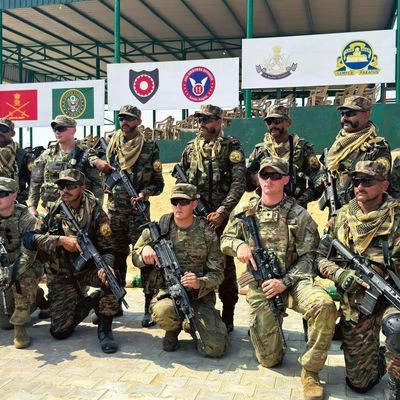
The India-US joint military exercise Yudh Abhyas conducted in Rajasthan in September 2024. Photo: PIB

During the Cold War, depending on the administration in office, India was either seen at worst as a mildly antagonistic state or, at best, a country that was mostly irrelevant to US security concerns. Some administrations, especially in the early Cold War, viewed India’s commitment to non-alignment as downright unhelpful. In fact, President Eisenhower’s staunchly anti-Communist Secretary of State, John Foster Dulles, referred to the doctrine as “immoral”. Others thought of it as quaint and pointless. President Richard Nixon and his opportunistic National Security Adviser (and subsequently Secretary of State), Henry Kissinger, were openly hostile towards India, especially after New Delhi had signed the Treaty of Peace, Friendship and Cooperation with the Soviet Union in 1971. 
Even after the Cold War, the two parties, while extolling their shared democratic values and institutions, could find little common ground when it came to matters of international and regional security. Successive administrations, both Democratic and Republican, admonished India for its flawed human rights record when it was trying to suppress the insurgency in Kashmir in the late 1980s and early 1990s. Also, they were at odds with India for its pursuit of a nuclear weapons programme outside the ambit of the Nuclear Nonproliferation Treaty (NPT) of 1968.   
Ironically, it was India’s nuclear tests of May 1998 that contributed to a meaningful security dialogue between New Delhi and Washington, DC. However, these discussions ended with New Delhi conceding little or no ground to Washington, DC. Indeed, it was not until the second George W Bush administration that Washington, DC, decided to initiate a conversation with India about its nuclear weapons programme. As is well-known, this culminated in the landmark 2008 US-India nuclear accord. This agreement enabled India to keep its nuclear weapons infrastructure while placing its civilian reactors under International Atomic Energy Agency (IAEA) safeguards.  
Ostensibly, this deal was designed to enable India to meet its growing energy needs. Left unstated, however, was the administration’s interest in bringing India on board to serve as a strategic bulwark against an increasingly assertive People’s Republic of China (PRC) in Asia. During its first term, the Obama administration, Bush’s successor, evinced little interest in India. The only meaningful form of cooperation that had emerged during his first term was the incipient steps towards the formation of the Quadrilateral Security Initiative, popularly referred to as the Quad, in the wake of the devastating December tsunami of 2004. In its wake, Australia, India, Japan, and the United States coordinated a significant humanitarian response to aid the victims across South and Southeast Asia. 
However, during his second term, after his many overtures towards Beijing did not prove fruitful on several fronts, Barack Obama embarked on the “pivot to Asia”, which involved shifting significant military resources from the Middle East and deploying them in Asia. In this context, India once again came to be seen as a possible counterweight to the PRC. Furthermore, Obama’s secretary of defense, Ashton Carter, also became convinced that India, under the right circumstances, may prove willing to work with the United States to forge a countervailing coalition against the PRC even as it maintained its prickly independence and steadfastly refused to enter an alliance with the US. To that end, before the administration ended, he designated India as a “major defence partner”, thereby facilitating Indian weapons acquisitions from the US. 
The first Trump administration, while it started its initial complaints about India’s tariff regime, squarely placed New Delhi in its defence strategy toward Asia. This, in large measure, stemmed from two key factors. First, Trump was inherently distrustful of the PRC and its global ambitions. Second, he had several key, senior defence personnel who shared his misgivings about the PRC. Consequently, his National Security Strategy, which was unveiled in December 2017, made it abundantly clear that while the US was prepared to cooperate with the PRC in Asia, it viewed many of the latter’s actions on the continent with considerable alarm and concern. In this context, the strategy reaffirmed the desire of the US to deepen its cooperation with India in the context of the Quad. 
In 2018, the then secretary of defense, James Mattis, changed the name of the United States Pacific Command to the Indo-Pacific Command. The change in the nomenclature was not cosmetic. Instead, it reflected two important factors. First, that the ties between the Indian and the Pacific oceans were seamless. Second, it also reflected the growing strategic significance the US had come to attach ­­to India.  
Another development that also underscored the importance of India was the initiative secretary Mattis undertook the same year. This was the creation of the 2-plus-2 dialogue. This involved an annual meeting of the US secretary of state along with the US secretary of defence with their Indian counterparts, the minister for external affairs and the minister of defence. Since its creation, it has met every year and focused on shared foreign and security policy concerns.  Apart from an understandable emphasis on the Indo-Pacific, the dialogue has encompassed a range of international security issues.  
All these developments of the past decade or so suggest two important shifts. First, the US now sees India at least as an incipient security partner in Asia. Second, India appears to have overcome, at least at a governmental level, its long-held aversion to discussing bilateral and international security matters with the US. Both developments, it needs to be recognised, constitute a significant departure from the past when any such discussions, especially from the Indian side, were almost anathema.  
Obviously, these developments portend well for New Delhi as they demonstrate that the US, regardless of the administration in office, increasingly sees it as a viable security dialogue partner. That said, three nagging questions persist. The first has squarely remained in New Delhi’s court. Can it overcome the lingering shadows of the Cold War,  and a consequent distrust of the United States, and think of forging a long-term security partnership with the US, all the while maintaining its much-vaunted “strategic autonomy”? Second, and related to the first question, can it cope with Donald Trump’s mercurial temperament and his transactional approach to most policy issues, whether domestic or foreign? For the most part, India need not concern itself with Trump’s domestic policy shifts apart from the possible issue of immigration. It is his fickleness in matters of foreign and security policy that should be of interest to New Delhi.   
This brings us to the third matter that could have a positive or an adverse effect on the future of the emerging 
US-India strategic partnership. These are early days for the Trump presidency, and consequently, it is premature to expect a full-blown statement of its policy goals in the Indo-Pacific. Nevertheless, Trump’s careless statements in the immediate aftermath of the Pahalgam crisis have, no doubt, caused some anxiety in New Delhi. Among other matters, he has claimed that he exerted pressure on both India and Pakistan to help terminate the conflict. However, there is no independent corroboration of his claim, and New Delhi has categorically denied that he played any role in defusing the crisis and bringing about a ceasefire. 

First, the US now sees India at least as an incipient security partner in Asia. Second, India appears to have overcome, at least at a governmental level, its long-held aversion to discussing bilateral and international security matters with the US.

Even more disturbing, however, was Secretary of State Marco Rubio’s assertion that India and Pakistan had agreed to discuss “a broad set of issues at a neutral site”. This statement highlighted two compelling issues. First, it is hard to imagine that New Delhi would have agreed to any such proposal, given India’s long standing aversion to allowing any third party, let alone the US, to mediate an end to the Kashmir dispute with Pakistan. Second, and in a related vein, it reflected Rubio’s complete ignorance of and insensitivity to India’s stated and oft-repeated position on this fraught subject.  
It is, of course, possible that Rubio may have gone out on a limb to remain in Trump’s good graces. However, a more disturbing explanation is equally plausible. He is, at least in principle, currently in charge of three other governmental entities while serving as the Secretary of State. Specifically, he is the interim National Security Advisor, the interim National Archivist, and the interim head of the United States Agency for International Development. Juggling all these responsibilities is more demanding than a Herculean task.  Consequently, he may not have had the time or the opportunity to consult any individual who is knowledgeable about the tortured history of the Indo-Pakistani conflict.  This explanation is entirely plausible because his department still lacks an Assistant Secretary of State for South and Central Asian Affairs, and the US has yet to nominate an ambassador to New Delhi. Consequently, it is reasonable to infer that there is a policy advisory void when it comes to key issues dealing with South Asian affairs. The absence of informed policy advice could very easily have led Rubio to make this blatant diplomatic gaffe.  
These indiscreet remarks have caused understandable distress in New Delhi and have been the subject of much commentary in the press. However, they may not necessarily reflect any dramatic policy shift towards India when it comes to the role that the US had previously accorded New Delhi as part of its Indo-Pacific strategy. Instead, as argued here, it may simply be a function of the dysfunctional policy-making mechanisms that have come to characterise the initial days of the second Trump administration.  
Trump’s personal proclivities and Rubio’s diplomatic lapses aside, the US simply cannot afford to dramatically alter the direction of American security policy towards the Indo-Pacific and thereby towards India. Apart from India’s ongoing rivalry with China, a matter that contributes to a strategic convergence with the US, the progress that has been made in US-India security cooperation over nearly two decades and now India’s emergence as the world’s fourth-largest economy, all militate against such a dramatic change of course. Consequently, the recent idiosyncrasies that have characterised US policy statements towards the latest India-Pakistan crisis should not be overblown. Instead, structural factors, most importantly the assertiveness of the PRC in the Indo-Pacific, are likely to ensure that India remains a key feature in American security policy towards the region. To that end, India’s policymakers should look past these seemingly feckless remarks and choose to dwell on the underlying drivers of American defence policy, which are likely to remain constant and transcend the current vagaries of the Trump administration. 
 
  Sumit Ganguly is a senior fellow and director of the Huntington Program on Strengthening US-India Relations at the Hoover Institution, Stanford University. Views are personal
    
Premium ContentPremium ContentSubscription ExpiredSubscription Expired

Your access to Blueprint has ended. But the story is still unfolding.

No longer a subscriber? There’s a new reason to return.

Introducing Blueprint - A magazine on defence & geopolitics

Introducing Blueprint - A magazine on defence & geopolitics

Like what you read? There’s more in every issue of Blueprint

From military strategy to global diplomacy, Blueprint offers sharp, in-depth reportage on the world’s most consequential issues.

Exclusive pricing for Business Standard digital subscribers

Choose your plan

Exclusive Pricing

Choose your plan

58% off
₹6,000

Blueprint Digital

₹2,500

annual (digital-only)

₹208/Month

70% off
₹12,000

Blueprint Complete

₹3,500

annual (digital & print)

₹291/Month

41% off
₹6,000

Blueprint Digital

₹3,500

annual (digital-only)

₹291/Month

62% off
₹12,000

Blueprint Complete

₹4,500

annual (digital & print)

₹375/Month

Here's what's included:

  • Access to the latest issue of the Blueprint digital magazine

  • Online access to all the upcoming digital magazines along with past digital archives

  • * Delivery of all the upcoming print magazines at your home or office

  • Full access to Blueprint articles online

  • Business Standard digital subscription

  • 1-year unlimited complimentary digital access to The New York Times (News, Games, Cooking, Audio, Wirecutter, The Athletic)

Written By :

Sumit Ganguly

Šumit Ganguly is a senior fellow and director of the Huntington Program on Strengthening US-India Relations at the Hoover Institution, Stanford University, US.
First Published: Jun 24 2025 | 8:17 PM IST

Next Story