Associate Sponsors

Co-sponsor

A precarious peace with the rise of a drone-missile arms race in South Asia

Post-Operation Sindoor, India and Pakistan are locked in a technology-driven arms race
11 min read
Updated On: Feb 10 2026 | 2:00 AM IST
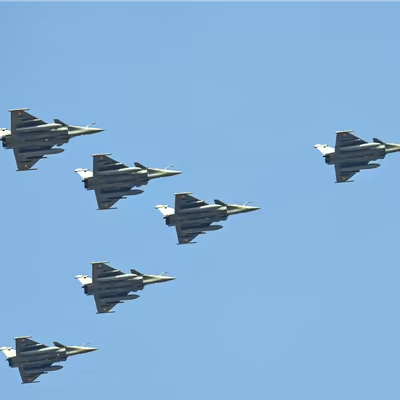
India seeks additional Rafale fighter jets from France (Photo: PTI)

India seeks additional Rafale fighter jets from France (Photo: PTI)

“Operation Sindoor remains ongoing.” In his annual press conference on January 13, Chief of the Army Staff General Upendra Dwivedi reaffirmed that hostilities with Pakistan will continue for the foreseeable future. 
  This has been a message that has been continuously reiterated by India’s top leadership ever since the two sides clashed in May last year following a terrorist attack that killed 26 civilians in Jammu and Kashmir’s Pahalgam.  
  The clash featured a mix of Indian BrahMos and SCALP missiles, as well as Pakistani Fatah-1 and 2 missiles. India also relied extensively on the use of drones and high-range precision strikes deep in Pakistan. 
  This brief but intense confrontation marked a shift in the way India and Pakistan employ conventional military force against each other. It was the first instance of a “no contact clash” and a direct drone-versus-drone battle between two nuclear-armed nations. Since then, both sides have increased their arms production, modernisation, and acquisitions.
  This is reflected in the growing investments being made in multilayered air defence systems, electronic warfare, and counter-unmanned aerial vehicle (C-UAV) capabilities, which suggests that future wars will be contactless.
  “It’s only been a few months since the May conflict, but early indications are that it has clearly shaped India’s military modernisation priorities,” Arzan Tarapore, senior fellow at Stanford University, said.
  As a part of a broader defence acquisition push in 2025, India’s Defence Acquisition Council (DAC) cleared procurement proposals worth around ₹79,000 crore in a single tranche, covering air defence missiles and combat and loitering drones. 
Special emphasis has been placed on air defences like S-400 that proved crucial during Operation  Sindoor. India seeks to acquire 280 additional S-400 missiles from Russia with an emphasis on local assembly for faster deployment.
  Air defences received symbolic impetus from the Prime Minister’s imprimatur too when he announced the Sudarshan Chakra air defence initiative on Independence Day last year.  
  Sudarshan Chakra is poised to be India’s ambitious multilayered, integrated air and missile defence system similar to Israel’s Iron Dome or the US’ proposed Golden Dome.
  “Certainly, air defences to cater for incoming drones and missiles will have to be the focus,” Manpreet Sethi, distinguished fellow, Centre for Air Power and Strategic Studies, said.
  “India's willingness to employ conventional force has been enabled by the acquisition of such capabilities, and this has made Pakistan realise that it will have to pay a cost for acts of cross-border terrorism,” she added. 
  Missile defence has regained significant impetus post Operation Sindoor. India tested the Agni Prime missile from a rail-based launcher in September last year.
  While ballistic missiles such as the Pralay have been tested in a salvo launch from a single mobile launcher at Chandipur, Odisha, in December 2025.
  BrahMos missile, which was a big success during Operation Sindoor, has regained interest from foreign buyers like Vietnam and Indonesia and could be part of a deal worth around ₹4,000 crore. Israeli drones were also widely used by India during the operation and have received renewed attention. 
  India has also signed up for additional purchases of satellite-connected Heron MK II UAVs under emergency provisions in late 2025, involving all services for the first time.
  Discussions are underway with Israel Aerospace Industries (IAI) to manufacture these systems in India in partnership with Hindustan Aeronautics Limited and private firms such as Elcom, with an indigenisation target of at least 60 per cent.
  The Indian Air Force (IAF) is now pitching for speedy development and induction of indigenous solutions such as the Nagastra and Sky Striker, which are being codeveloped with Israel’s Elbit Systems.
  Another collaboration between IAI and India’s Ministry of Defence is the“Project Cheetah”, which involves equipping old Heron drones with Spike non-line-of-sight (NLOS) missiles by leveraging the technical expertise of IAI.
  Air power continues to receive renewed attention in 2026, with the Defence Procurement Board clearing the acquisition of 114 additional Rafale fighter jets last month, in one of the largest single combat-aircraft approvals in the IAF’s history.
  In parallel with procurement decisions, India is moving to ease foreign direct investment (FDI) rules in its defence sector to attract global capital and technology. 
  Plans to increase FDI caps and relax ownership requirements are aimed at partnerships with major aerospace and defence firms like Airbus, Lockheed Martin, and Dassault Aviation.
  In the maritime domain, India moved to institutionalise the forward deterrent posture it adopted during Operation Sindoor by accelerating investments in anti-submarine warfare, long-range maritime strike and persistent surveillance across the northern 
Arabian Sea.
  In August last year, the DAC approved procurements worth about ₹67,000 crore, which included upgrades for naval modernisation.
  One of the key initiatives in this has been the induction of twin BrahMos supersonic cruise missile launchers on destroyers such as INS Veer. India has also signed deals for the acquisition of P-8I Poseidon maritime patrol aircraft and MH-60R helicopters.
  India’s defence exports have risen sharply, helped by the fact that several systems were seen as combat-proven during the confrontation.
  Apart from BrahMos, India has exported Pinaka multi-barrel rocket launchers to Armenia. Pinaka’s performance during Sindoor gave it credibility, and Armenia became one of the first buyers after the conflict.The Akash surface-to-air missile system has also attracted interest. 
  The Philippines is said to be in an advanced stage of negotiation with Indian suppliers.
  The total defence exports from India stood at the highest ever figure of ₹21,000 crore in the financial year 2025.
  In 2026, it is expected that defence exports will touch between ₹25,000 crore and ₹30,000 crore, with key markets placed in  Southeast Asia, Africa, and West Asia.  A selective race
  While it is usual for two sides to replenish supplies after a clash, the May conflict has triggered a selective, technology-driven arms competition. 
  In strategic terms, this fits a “technology- and domain-specific arms race”, not a Cold War-style buildup.However, experts warn that India risks over-learning the lessons of Sindoor, rushing to refight the last war, and not preparing adequately for an adaptive adversary in Pakistan, or a completely different challenge in China.  
“Once again, we are seeing India undertake modernisation and force-structure planning reactively, based on the latest clashes (Sindoor) just as it did following the Ladakh crisis,” said Tarapore.  
“This means deliberate long-term capability development gets deferred again,” he added. 
  For instance, the launch of 10 Indian warships in 2025 was seen as an indicator of naval progress, yet six of those ships were the result of decisions made decades earlier.
  Ever since the Ladakh stand-off in 2020, it has been observed that the focus of the Indian defence spending has shifted from naval push to ground forces and infrastructure development on the border.
  Trouble next door 
  Across the border, Pakistan drew its own lessons from the four-day confrontation and has meanwhile prioritised naval modernisation by inducting eight Hangor-class submarines from China. 
  These submarines are diesel powered and derived from China’s Type-039A/Yuan design and equipped with air-independent propulsion. 
Pakistan has also acquired MILGEM-class corvettes from Turkiye, which can be paired with submarine-launched cruise missiles such as the Babur-3. In the air domain, Pakistan is considering the acquisition of additional Chinese jets, possibly including  J-10CE fighters, and exploring longer-term options such as J-35 stealth aircraft. 
The Sindoor confrontation appears to have deepened Pakistan’s dependence on China as its principal defence supplier, as it served as a testing ground for Chinese aircraft like the J-10C and JF-17 Thunder.  
  “China is the primary external actor in Islamabad’s defence modernisation, providing submarines, fighters, missiles, and air defence systems with minimal political conditions,” a security analyst familiar with Pakistan’s force planning said. 
  “Beijing’s support also corresponds with its wider Indo-Pacific naval strategic interests, especially through infrastructure development and defence collaborations associated with the China-Pakistan Economic Corridor,” he added. 
Post May 2025, Pakistan has received orders for JF17 from the Libyan National Army, in the country’s biggest ever arms deal. It is also in talks with Bangladesh for the possible sale of JF-17s. It has also signed memorandums of undertaking for the supply of JF-17 Thunder to Azerbaijan during the Dubai Airshow in November 2025. Moreover, 52 MFI-395 Super Mushshak trainer aircraft have also been delivered to Turkiye.
  The Pakistani defence exports were at their highest ever level in 2025, amounting to nearly $10 billion, by marketing its  weapons as “combat-tested”. 
One of the most consequential lessons of Operation Sindoor for Pakistan was the vulnerability of its air defence architecture. The inability to confidently protect critical military infrastructure and airspace, hampered Pakistan’s escalation, and reinforced Indian confidence in employing conventional force below the nuclear threshold. 
  For Pakistan, this episode changed its strategic calculus; rather than relying on its traditional nuclear deterrence, it appears to be pursuing a selective modernisation strategy. 
  To boost its missile defence, Pakistan has conducted an indigenously developed “Taimoor” air-launched cruise missile, and it has also tested a Chinese surface-to-air missile LY-80(N) during a naval exercise in the north Arabian Sea. 
  Barely two months after the conflict, Pakistan created its own missile command structure, known as the Army Rocket Force Command, which aimed at integrating all of Pakistan’s missile assets into one system.
  India is also looking to raise its own Integrated Rocket Force, which will be a “rocket-cum-missile” force as explained by Army chief General Upendra Dwivedi in his annual presser. 
  Pakistan has also made structural changes in its military by abolishing the office of Chairman Joint Chiefs of Staff Committee and creating the post of Commander of the National Strategic Command, which will control country’s nuclear command. 
  Post the conflict, Pakistan has also boosted its defence spending substantially by 20 per cent, which is its biggest spike in decades.
  What emerges from both sides’ post-Sindoor modernisation is not only the speed and lethality on the battlefield, but the entire escalation environment, which has become more compressed and unclear to the adversary.
  Elusive stability
  Despite the absence of direct troop contact during the May confrontation, the crisis underscored how quickly future clashes could intensify. 
  “Any conflict in the presence of nuclear weapons carries risks, especially of inadvertent or accidental escalation. It is for this reason that the Indian kinetic operations put so much emphasis on precision attacks to minimise chances of collateral damage,” Sethi said.
  “As Pakistan builds its own conventional capability, it could be emboldened once again. Till Pakistan continues with its strategy of bleeding India through a thousand cuts, stability will remain elusive,” she added.
  Both sides are rushing to build deterrence post-conflict and maintain technological prowess, but this has not been matched by a commensurate investment in escalation-control mechanisms.  
The danger in this landscape is not an immediate return of dispute but the gradual erosion of escalation control mechanisms.  
When both sides can employ conventional force without going to the nuclear threshold, that belief can carry its own risks; it means they can keep climbing the escalation ladder until there is a third-party mediation.  
Military hotlines remain largely at the director-general of military operations (DGMO) level, with the uncertainity increasing due to the absence of robust communication channels. 
  “It is necessary to invest in credible mechanisms for escalation control (hotlines at more than DGMO levels, trusted back channels, etc), especially since the availability and reliability of third parties cannot be guaranteed in the current geopolitical environment,” Sethi added.  
Faith in third-party mediation is fading, particularly when the President of the United States, Donald Trump, on multiple occasions tried to claim credit for brokering the ceasefire, much to India’s ire. This can further disillusion India from seeking external mediation in the future.
  In an environment defined by compressed timelines and contested diplomacy, the situation is precarious, and the peace holds for now. 
Premium ContentPremium ContentSubscription ExpiredSubscription Expired

Your access to Blueprint has ended. But the story is still unfolding.

No longer a subscriber? There’s a new reason to return.

Introducing Blueprint - A magazine on defence & geopolitics

Introducing Blueprint - A magazine on defence & geopolitics

Like what you read? There’s more in every issue of Blueprint

From military strategy to global diplomacy, Blueprint offers sharp, in-depth reportage on the world’s most consequential issues.

Exclusive pricing for Business Standard digital subscribers

Choose your plan

Exclusive Pricing

Choose your plan

58% off
₹6,000

Blueprint Digital

₹2,500

annual (digital-only)

₹208/Month

70% off
₹12,000

Blueprint Complete

₹3,500

annual (digital & print)

₹291/Month

41% off
₹6,000

Blueprint Digital

₹3,500

annual (digital-only)

₹291/Month

62% off
₹12,000

Blueprint Complete

₹4,500

annual (digital & print)

₹375/Month

Here's what's included:

  • Access to the latest issue of the Blueprint digital magazine

  • Online access to all the upcoming digital magazines along with past digital archives

  • * Delivery of all the upcoming print magazines at your home or office

  • Full access to Blueprint articles online

  • Business Standard digital subscription

  • 1-year unlimited complimentary digital access to The New York Times (News, Games, Cooking, Audio, Wirecutter, The Athletic)

Written By :

Mohammad Asif Khan

Mohammad Asif Khan is a Senior Correspondent at Business Standard, where he covers defence, security, and strategic affairs.
First Published: Feb 10 2026 | 2:00 AM IST

Next Story